
In my three decades as a sensory evaluator, I have witnessed a curious phenomenon in almost every cupping lab from Seattle to Addis Ababa. A novice taster will take a sip of a piping hot brew, nod politely, and move on. But a veteran? A veteran will wait. We wait ten, fifteen, even twenty minutes, circling back to the same cup as if it were a different beverage entirely.
The truth that every professional knows is this: the hot cup is a mask. The cold cup is the truth. If you want to Develop a Professional Palate: A 30-Year Guide, you must learn to embrace the cooling process. It isn’t just your imagination playing tricks on you; it is a complex intersection of thermodynamics, organic chemistry, and the biological limitations of your own taste buds. Understanding why your coffee “transforms” is the key to mastering the Geometry of Flavor: Why I Still Prefer the V60 After 30 Years.
The Biological Threshold: Your Tongue’s Sensitivity
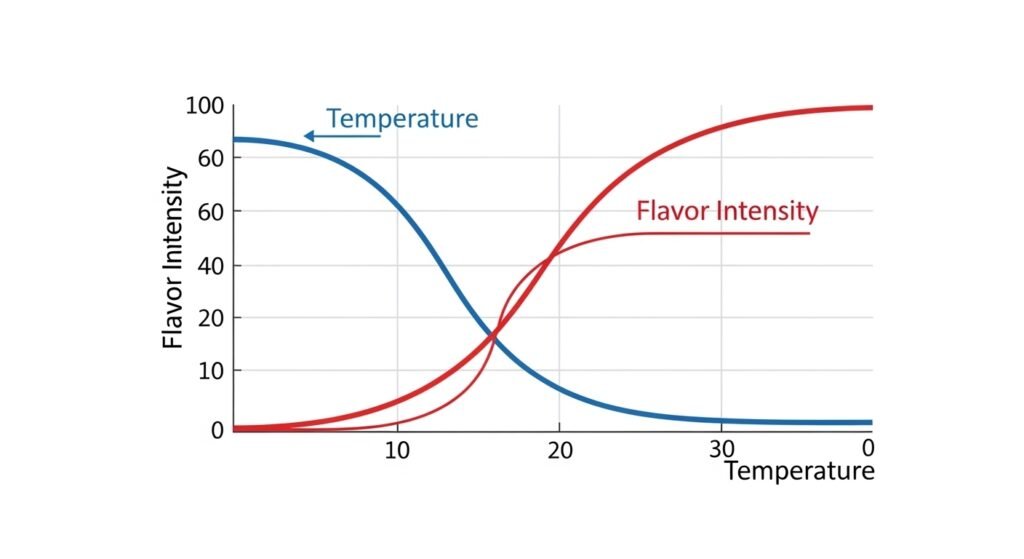
The first reason coffee tastes different as it cools has nothing to do with the beans and everything to do with your anatomy. Human taste receptors are highly sensitive to temperature. When a liquid is above $70^{\circ}C$ ($160^{\circ}F$), the heat essentially “stuns” your taste buds. This is a survival mechanism to prevent you from scalding your digestive tract.
At these high temperatures, your brain focuses on the sensation of heat rather than the nuance of flavor. You might perceive “bitterness” or “body,” but the delicate volatile compounds are overshadowed by the thermal energy. As the coffee drops to $50^{\circ}C$ ($122^{\circ}F$) and below, your receptors “wake up.”
Specifically, the TRPM5 protein in our taste cells, which is responsible for detecting sweetness and bitterness, becomes more active as the temperature approaches body temperature. This is why a coffee that felt balanced when hot can suddenly taste syrupy sweet or aggressively bitter as it cools. If you’ve ever wondered why Kenyan Slingshots: That Unforgettable Tomato Acidity Explained feel so much more intense after five minutes, this biological shift is the primary reason.
Volatile Aromas vs. Stable Flavors
Coffee contains over 800 aromatic compounds, but many of them are extremely “volatile,” meaning they evaporate quickly. When your coffee is steaming, those aromas are being projected directly into your nose (orthonasal olfaction). This creates that wonderful “fresh coffee smell” that fills a room.
However, as the coffee cools, the rate of evaporation slows down. The aromas that were once in the air are now trapped in the liquid, waiting to be released via retronasal olfaction (aromas traveling from the back of the mouth to the nose while swallowing).
-
The Hot Stage: Dominated by nutty, chocolatey, and roasty notes.
-
The Warm Stage: This is where the acids shine. The citric, malic, and phosphoric acids become identifiable.
-
The Cool Stage: The sugars and the complex defects emerge.
In my 30 years of training baristas, I always tell them that a “clean” coffee is one that doesn’t fall apart as it reaches room temperature. If a coffee becomes “vinegary” or “metallic” when cold, it is a sign of poor harvesting or roasting. A world-class Volcanic Soils and High Altitudes: Why Central America Rules the World bean should taste like a delicious fruit juice even when it’s cool.
Oxidation and Chemical Degradation
While biology explains our perception, chemistry explains the actual changes in the liquid. From the moment the water hits the grounds, a process of oxidation begins. Coffee is an organic product, and like a sliced apple, it begins to degrade when exposed to oxygen.
One of the most significant changes is the breakdown of Chlorogenic Acids into Quinic and Caffeine acids. This chemical reaction is accelerated by heat but continues as the cup sits. This is why coffee that has been sitting on a “warming plate” in a diner tastes so incredibly bitter and acrid; the constant heat is forcing a rapid chemical breakdown.
In a standard manual brew, like a Siphon or a V60, the cooling is natural. However, the pH level of the coffee actually drops as it cools, making it more acidic. For a veteran like me, this is the ultimate test of a roast. If the roaster didn’t develop the sugars properly, this rising acidity will feel “sour” and “thin.” But if the roast is perfect, the acidity will feel “bright” and “effervescent.”
The “Sweet Spot” for Tasting
If you want to experience the full spectrum of your coffee, you need to find the “Sweet Spot.” In professional cupping, we usually wait until the coffee is between $45^{\circ}C$ and $55^{\circ}C$. This is the window where the human palate is most objective.
I remember a specific competition in the early 2000s where a judge waited nearly 25 minutes to score a cup. At the time, I thought he was being dramatic. Now, I realize he was looking for the Aftertaste (Finish). As coffee cools, the finish becomes more persistent. You can feel the “mouthfeel”—the silkiness or the astringency—much more clearly. This is a vital part of The Third Wave Defined: My Witness Account of the Specialty Shift, where we moved away from the “hot and fast” consumption of the First Wave toward a slow, appreciative experience.
Practical Tips for the Home Brewer
How can you use this knowledge to improve your daily ritual?
-
Don’t Rush: If you drink your coffee the second it’s brewed, you are missing 70% of the flavor profile. Pour it, wait three minutes, then start sipping slowly.
-
Use Quality Vessels: Ceramic and glass allow for a natural cooling curve. Avoid plastic-lined travel mugs if you want to taste the nuance, as they can trap heat too efficiently and impart “off” flavors during the oxidation process.
-
The “Spoon Test”: If you aren’t sure if a coffee is good, take a tablespoon of it and let it sit for five minutes until it’s room temperature. Slurp it. If it’s still sweet and pleasant, you have found a great roaster.
Conclusion: The Beauty of the Fade
After three decades, I’ve learned that the most beautiful part of a great cup of coffee is its “fade.” It’s like a song that ends with a long, harmonic reverb. A coffee that tastes better as it cools is a testament to the farmer’s labor, the roaster’s precision, and the brewer’s skill.
The next time you’re enjoying a high-altitude Central American lot or a wild Kenyan brew, pay attention to the transition. Notice how the chocolate turns into cherry, or how the bitterness softens into a honeyed sweetness.
Coffee is a living beverage. It changes, it evolves, and it eventually dies. Learning to appreciate it at every stage of its life cycle is the hallmark of a true connoisseur. So, let your coffee cool. The truth is waiting for you at the bottom of the cup.

Brown Christopher is 47 years old and has been passionate about coffee since he was 15. For more than three decades, he has explored coffee culture, brewing methods, and the flavors behind every cup. Through this blog, he shares simple tips and knowledge to help beginners better understand and enjoy coffee in their daily lives. ☕