
If you have spent any amount of time in the specialty coffee world, you have likely obsessed over your grind size, your water temperature, and the specific Volcanic Soils and High Altitudes: Why Central America Rules the World where your beans were grown. But I want to let you in on a secret I learned the hard way over 30 years: your coffee is 98.5% water. If you are brewing with tap water, you aren’t tasting your coffee; you are tasting your local municipality’s plumbing.
In my early years in the 90s, we didn’t think much about water. We assumed that as long as it was filtered for chlorine, it was “clean.” But as I transitioned into The Third Wave Defined: My Witness Account of the Specialty Shift, the industry began to realize that water is not just a solvent—it is a chemical participant. My journey from using simple tap water to building custom mineral-perfect profiles has been the single biggest “upgrade” in my career.

The Chemistry of Extraction: Magnesium vs. Calcium
Water is like a bus that picks up flavor compounds from the coffee grounds. If the bus is already full of minerals (hard water), it can’t pick up any more flavor, resulting in a flat, dull cup. If the bus is completely empty (distilled or RO water), it is too aggressive, picking up everything—including the bitter, woody tannins that you don’t want.
Through my decades of testing, I’ve learned that two specific minerals do the heavy lifting:
-
Magnesium ($Mg^{2+}$): Think of magnesium as the “flavor magnet.” It is highly reactive and great at pulling out the sharp, fruity acids, like those found in Kenyan Slingshots: That Unforgettable Tomato Acidity Explained.
-
Calcium ($Ca^{2+}$): Calcium is more selective. It tends to highlight the creamy, chocolatey, and heavy-bodied notes.
The balance between these two, along with bicarbonates (buffer), determines whether your coffee tastes like a vibrant fruit juice or a muddy mess. If your water has too much bicarbonate, it will neutralize the acids entirely. This is why How to Develop a Professional Palate: A 30-Year Guide often involves tasting the same coffee brewed with three different water profiles.
My First Filter: The Charcoal Era
When I started, the “Gold Standard” for a home enthusiast was a simple carbon-block pitcher. These are excellent for removing chlorine and “off” smells, but they do absolutely nothing for the mineral content.
If you live in a city with “hard” water (high mineral content), a charcoal filter will still leave you with coffee that tastes chalky and lacks “sparkle.” In my 30 years, I have seen hundreds of espresso machines destroyed by scale buildup because the owners thought a basic pitcher was enough protection. It wasn’t. For a serious brewer, charcoal is only the first step of a multi-stage process.
The Reverse Osmosis Revolution
By the early 2010s, the “Total Dissolved Solids” (TDS) meter became a common tool in high-end cafes. We started installing Reverse Osmosis (RO) systems. An RO system strips the water of almost everything—minerals, fluoride, heavy metals—leaving you with a “blank canvas.“
However, brewing coffee with pure RO water is a disaster. Without minerals to act as “hooks,” the coffee tastes salty and sour. The real breakthrough came with re-mineralization. We began using “re-min” cartridges that add back a controlled amount of magnesium and calcium. This was the moment I realized I could make coffee in London taste exactly like coffee in Melbourne. We had finally achieved consistency through chemistry.

The “Coffee Water” Packets: Precision for the Masses
The biggest change in the last five years has been the accessibility of mineral packets. For a veteran like me, who used to mix Epsom salts and baking soda in a basement lab, these pre-measured packets are a godsend.
You simply take a gallon of distilled water, drop in a packet, and you have the exact mineral balance recommended by the Specialty Coffee Association (SCA). This has democratized high-end coffee. Now, even if you are using the Geometry of Flavor: Why I Still Prefer the V60 After 30 Years in a remote cabin, you can have competition-level water. It removes the one variable that most people ignore, and it instantly makes every bean you buy taste twice as expensive.
Testing Your Own Water: A Practical Guide
I often tell my students that you cannot manage what you do not measure. If you are serious about your Equipment and Accessories: Invest in the Grinder, Not the Machine, you need to know your starting point.
-
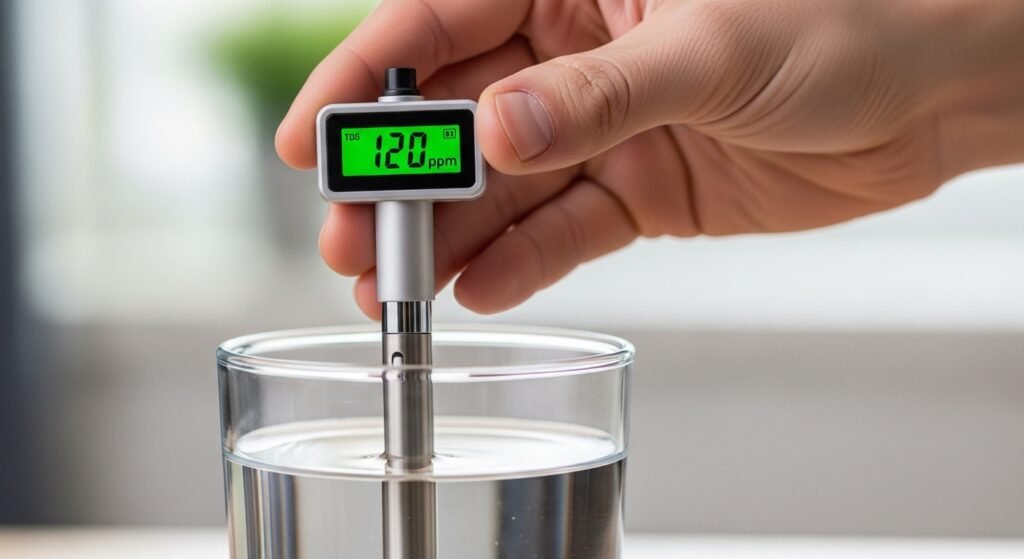
Buy a TDS Meter: They are inexpensive and give you a snapshot of your water’s mineral density. Ideally, for coffee, you want a TDS between 75ppm and 150ppm.
-
Check for Alkalinity: This is the “buffer.” If your alkalinity is too high (above 40-50 ppm), your coffee will never be bright or acidic, no matter how many Kenyan beans you use.
-
The Bottled Water Alternative: If you don’t want to install a filtration system, look for bottled spring water with a low mineral content. Avoid “Mineral Water” like Perrier or San Pellegrino, as they are far too “heavy” for brewing.
Why Water is the Ultimate Maintenance Tool
Beyond the flavor, water quality is about the longevity of your gear. In 30 years, I’ve seen $10,000 espresso machines turned into paperweights by “limescale”—the white, stony deposits that form when calcium-heavy water is heated.
A proper filtration system isn’t just a flavor upgrade; it’s an insurance policy. By controlling the hardness of your water, you prevent the internal boilers and copper pipes from clogging. This is why I always suggest that Investing in the Grinder should be followed immediately by investing in your water. One provides the flavor; the other protects the machine that delivers it.
Conclusion: The Final Piece of the Puzzle
Water is the silent partner in your morning cup. It doesn’t get the glory that a new shiny grinder or a rare micro-lot bean does, but it works harder than any other ingredient. After 30 years of chasing the “perfect” extraction, I can tell you that my best cups weren’t the result of a secret technique; they were the result of perfect water meeting perfect beans.
Don’t let your local tap water dictate the limits of your coffee. Take control of your minerals, understand your chemistry, and you will unlock a level of sweetness and clarity that you never thought possible. Once you taste coffee made with “proper” water, there is no going back. You have been warned.

Brown Christopher is 47 years old and has been passionate about coffee since he was 15. For more than three decades, he has explored coffee culture, brewing methods, and the flavors behind every cup. Through this blog, he shares simple tips and knowledge to help beginners better understand and enjoy coffee in their daily lives. ☕