
In my thirty years of working with coffee, I have stood at hundreds of cupping tables across the globe. I’ve cupped in the sterile, air-conditioned labs of exporters in Geneva and on rough wooden planks in the highlands of Ethiopia, where the aroma of the coffee competed with the scent of woodsmoke and rain. To a professional, cupping is a clinical, objective process used to assign a numerical score to a lot of beans. But to the enthusiast, cupping is something far more profound: it is the moment the blindfold is removed.
Most people drink coffee as a background activity. But when you cup, you are finally paying attention. You are comparing, contrasting, and deconstructing. Hosting a cupping at home is the fastest way to Develop a Professional Palate and help your friends understand why you spend so much time obsessing over the Precision of the Gooseneck Kettle. It is an invitation to explore the world through a silver spoon.
The Philosophy of the Table: Why We Cup
Before we get into the equipment, we must understand the “why.” We don’t “brew” coffee during a cupping in the traditional sense. We use a standardized immersion method. This eliminates the variables of the brewer. Whether you prefer the Geometry of Flavor from a V60 or the pressure of an AeroPress, cupping levels the playing field.
By using the exact same water-to-coffee ratio, the same grind size, and the same temperature for every cup, you ensure that the only difference you are tasting is the bean itself. This allows you to truly see how Volcanic Soils and High Altitudes change the molecular structure of the flavor compared to a low-altitude estate.
Essential Equipment for the Home Cupper
You don’t need a professional lab to host a successful session, but you do need consistency. Here is what I recommend for a group of four:
-
The Bowls: You need identical glass or ceramic bowls. Ideally, they should hold between 200ml and 260ml. If the bowls are different shapes, the heat will dissipate at different rates, affecting your Sensory Perception.
-
The Spoons: Traditional cupping spoons are deep and round, designed to hold a specific volume of liquid and allow for a powerful “slurp.” If you don’t have them, large soup spoons will work in a pinch.
-
The Grinder: This is the most critical tool. As I’ve said for decades, Invest in the Grinder because you need a very specific medium-coarse grind—think of sea salt.
-
The Water: Use filtered water or a custom mineral profile. If your water is bad, your cupping will be a waste of time.
-
The Coffee: Choose 3 to 5 different coffees. I like to have a “wildcard,” like a Kenyan Slingshot, alongside a classic Colombian and perhaps a natural-process Brazilian.
The Protocol: A 30-Year Ritual
Follow this timeline to ensure your home cupping stays within the professional “SCA” (Specialty Coffee Association) guidelines:
1. The Dry Aroma (0:00)
Grind the coffee fresh into the bowls. Have your guests walk around and smell the dry grounds. This is when the “volatile” aromatics are most intense. Ask them: Does it smell like nuts? Berries? Or maybe just “brown sugar”?
2. The Pour (0:02)
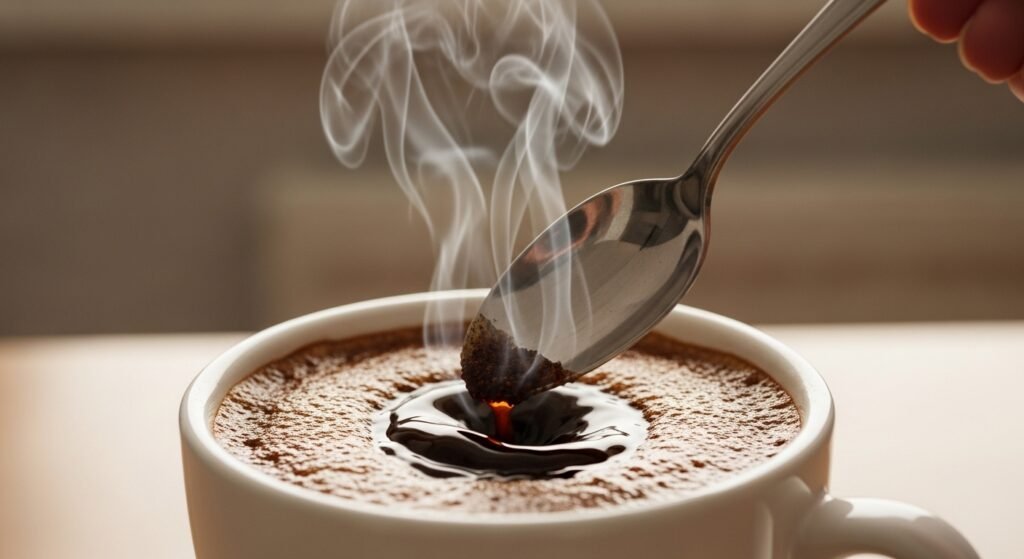
Gently pour the hot water ($93^{\circ}C$) into the bowls, ensuring all grounds are saturated. Let it sit undisturbed for exactly 4 minutes. A “crust” of grounds will form at the top.
3. Breaking the Crust (0:06)
This is the most theatrical part. Use your spoon to gently push the grounds away from the surface while putting your nose directly over the bowl. This releases a burst of aroma that was trapped under the crust. This is often the moment when a Professional Palate detects the most delicate floral notes.
4. Cleaning the Surface
Use two spoons to skim off the remaining foam and floating grounds. You want a clear, clean surface for tasting.
5. The Tasting (0:10 – 0:20)
Wait for the coffee to cool. As we know, Coffee Tastes Better When it Cools Down. Take a spoonful and slurp it loudly. You want to aerate the coffee so it hits all your taste buds and travels to the back of your nose.

How to Lead the Discussion
The goal of a home cupping isn’t to be “right”; it’s to be descriptive. In my 30 years, I’ve found that the best way to get people talking is to use the Flavor Wheel.
Instead of asking “What do you taste?”, ask:
-
“Is the acidity bright like a lemon or soft like a peach?”
-
“Does the mouthfeel feel thin like tea or heavy like cream?”
-
“Is the Aftertaste sweet or does it leave your tongue feeling dry?”
Remind your guests that coffee from different regions has a “biological blueprint.” A coffee from the Volcanic Soils of Guatemala will almost always have more chocolate and spice than an African bean. Helping them make these connections is the “Aha!” moment of the evening.
The “Ethics” of the Table: Double Dipping and Silence
In a professional lab, we have strict rules. At home, you can be more relaxed, but two rules should remain:
-
No Double Dipping: Always rinse your spoon in a cup of hot water between every sip. This keeps the flavors pure and the environment hygienic.
-
Silence During Tasting: Don’t let your guests talk until everyone has tasted every bowl. If I say “I taste blueberry,” your brain will immediately start looking for blueberry, even if it’s not there. Let everyone find their own truth first.

The Impact of Temperature Evolution
As the session goes on (20 to 30 minutes), the coffee will reach room temperature. This is the “Truth Phase.” A coffee that was exciting when hot might become bitter as it sits. A coffee that was boring might suddenly reveal a hidden sweetness.
Encourage your guests to circle back to the first bowl after 15 minutes. This teaches them about the Science of Cooling and why we don’t judge a coffee by its first, scalding-hot sip.
Conclusion: Turning a Drink into a Language
Hosting a cupping at home transforms coffee from a commodity into a language. It is a social bridge that connects the hard work of a farmer in the mountains to the sensory experience in your living room.
After 30 years in this trade, I still find cupping to be the most humbling part of my job. Every table is a new lesson. Every bean has a story that it only tells if you are willing to listen with your spoon and your nose. By sharing this ritual with your friends, you aren’t just serving coffee; you are teaching them how to see the world in a cup.
The next time you bring home a bag of Kenyan AA or a rare Panamanian Geisha, don’t just brew it in your AeroPress. Set the table, call your friends, and break the crust together. You’ll find that the best flavor notes are the ones you discover together.

Brown Christopher is 47 years old and has been passionate about coffee since he was 15. For more than three decades, he has explored coffee culture, brewing methods, and the flavors behind every cup. Through this blog, he shares simple tips and knowledge to help beginners better understand and enjoy coffee in their daily lives. ☕