
In my 30 years in this industry, I have seen more expensive equipment ruined by neglect than by actual mechanical failure. I’ve seen $5,000 espresso machines choked to death by limescale and $1,000 grinders with burrs so caked in rancid oils that every coffee they touched tasted like old fish. We often obsess over Calibrating Your Espresso or sourcing the perfect Kenyan Slingshot, but if your equipment isn’t clean, you are building your house on sand.
Cleaning is the “unsexy” side of coffee, but it is the most vital. Coffee is an organic product. It contains fats, proteins, and oils that oxidize and turn rancid the moment they are exposed to air and heat. Furthermore, Water Quality acts as a silent architect, slowly depositing minerals inside your boilers and pipes. In my three decades of experience, I’ve learned that a clean, mid-range machine will always outperform a dirty, high-end one.

The Enemy Within: Coffee Oils and Oxidation
Every coffee bean contains about 10% to 15% lipids (oils). When you grind coffee, these oils are released and coat every surface they touch—the hopper, the burrs, the chute, and the brewing chamber.
If you don’t clean your Grinder regularly, these oils stick to the metal. Over a few weeks, they undergo oxidation, turning from sweet and aromatic to bitter and sour. This is why many people think they don’t like certain African Coffees; they aren’t tasting the “berry” notes, they are tasting the rancid residue of last month’s dark roast.
As someone who has Developed a Professional Palate, I can tell you that “dirty equipment flavor” is a distinct sensory defect. It presents as a metallic, ashy aftertaste that coats the back of the throat. To avoid this, you must treat your coffee gear like your kitchen pans: if you wouldn’t cook a steak in a pan with old grease, don’t brew coffee in a machine with old oils.
The Grinder: Your First Line of Defense
After 30 years, I still see people who have never cleaned their grinder burrs. They assume that because it’s “dry,” it doesn’t need washing. This is a mistake.
1. The Weekly Brush-Down
Once a week, you should empty the hopper and use a stiff nylon brush to sweep out the chute. Use a vacuum to remove any “fines” (micro-particles) that have settled in the crevices. These fines are the primary cause of Inconsistent Extractions.
2. The Monthly Deep Clean
Every month, use specialized cleaning tablets (usually made from biodegradable cereals). As they pass through the burrs, they absorb the oils and “scrub” the metal. This is much safer than disassembling the grinder if you aren’t mechanically inclined. However, if you are comfortable, taking the burrs out once a year to soak them in a specialized solvent will extend their life by years.
Espresso Machines: The Backflush Ritual
If you own an espresso machine, “Backflushing” is your most important daily habit. When you finish your brewing for the day, coffee oils are trapped behind the “shower screen” and inside the 3-way solenoid valve.
-
Water Backflush (Daily): Simply use a blind filter (one with no holes) to force hot water back through the group head. This flushes out the loose grounds.
-
Chemical Backflush (Weekly): Use a specialized detergent powder. This dissolves the stubborn, baked-on oils.
I remember a client in the early 2000s who complained that his machine was “losing pressure.” When we opened it up, the group head was almost entirely blocked by a solid “puck” of old, carbonized coffee. A $2 cleaning powder could have saved him a $400 repair bill. Maintenance isn’t a cost; it’s a saving.
Descaling: The Battle Against Limescale
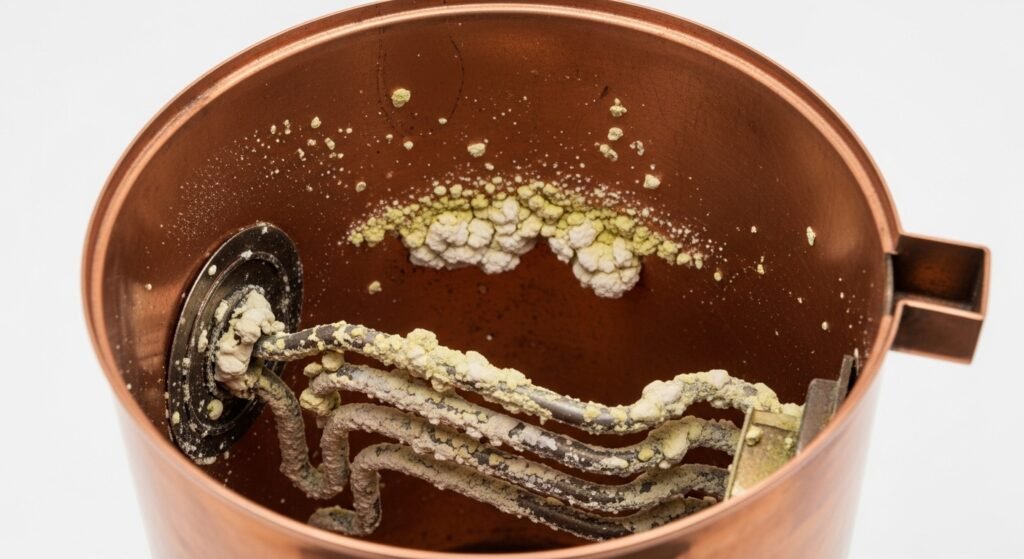
As we explored in Water Quality: The Invisible Ingredient, minerals like calcium and magnesium are essential for flavor, but they are deadly for machines. When water is heated, these minerals precipitate and form “scale”—a white, stony crust.
Scale acts as an insulator, meaning your boiler has to work twice as hard to reach the same temperature. Eventually, the scale will break off and clog the tiny “gicleur” orifices that control the flow of your espresso.
How to Descale Safely
Don’t use vinegar. In my 30 years, I’ve seen vinegar ruin more gaskets and seals than I can count. Vinegar is also incredibly hard to rinse out, leaving your coffee tasting like a salad for weeks. Use a citric-acid-based descaler. It is more effective and rinses clean. If you have “Hard Water,” you should be doing this every 3 to 6 months.
Manual Brewers: V60, Chemex, and AeroPress
Manual brewers are easier to clean, but they still have “blind spots.”
-
The Chemex: Because of its shape, it’s hard to reach the bottom. Use a bottle brush and a mixture of ice, salt, and a little lemon juice. Swirl it around; the ice and salt act as a gentle abrasive to remove coffee stains.
-
The AeroPress: The rubber seal on the plunger is the most sensitive part. Over time, oils will make it sticky and compromise the Pressure Phase. Wash it with mild soap after every use and store it plunged through to prevent the rubber from deforming.
-
The French Press: The mesh filter is a trap for old grounds. You must disassemble the filter assembly every time you wash it. If you don’t, the grounds trapped between the screens will rot, creating a “compost” flavor in your next cup.
The Steam Wand: A Biological Necessity
If you froth milk, your steam wand is a playground for bacteria. Milk is a protein-rich liquid that spoils rapidly.
-
The Purge: Always purge your steam wand before and after use to clear any milk that might have been “sucked back” into the wand as it cooled.
-
The Wipe: Use a damp, dedicated microfiber cloth to wipe the wand immediately. If the milk “bakes” onto the metal, it becomes a permanent home for bacteria.
-
The Soak: Once a week, soak the wand in a specialized milk-protein cleaner to ensure the internal holes are clear.

Conclusion: Respect the Craft, Respect the Gear
Maintenance is a form of respect. It is respect for the machine you bought, the money you spent, and the coffee you are about to drink. After 30 years, I can tell you that the “secret” to consistent, world-class coffee isn’t a secret recipe; it is the discipline of cleanliness.
When your gear is clean, the Science of Aftertaste is clear and sweet. The Geometry of Flavor is precise. And your mornings are free from the frustration of equipment failure.
Take ten minutes this weekend to deep-clean your setup. Your palate—and your wallet—will thank you. Coffee is a ritual of beauty, and beauty requires a clean canvas.

Brown Christopher is 47 years old and has been passionate about coffee since he was 15. For more than three decades, he has explored coffee culture, brewing methods, and the flavors behind every cup. Through this blog, he shares simple tips and knowledge to help beginners better understand and enjoy coffee in their daily lives. ☕