
In the vast landscape of coffee brewing, few devices command as much attention as the Siphon. Also known as a Vacuum Pot, it looks more like something you would find in a 19th-century chemistry laboratory than in a modern kitchen. It consists of two glass chambers, a rubber seal, a cloth filter, and a direct heat source. When it’s in operation—with water defying gravity by climbing upward and then rushing back down—it is pure theater.
But beyond the visual spectacle, the Siphon is revered by many professionals as one of the most precise and clean brewing methods ever invented. While we often discuss the Geometry of Flavor in a V60 or the portability of an AeroPress , the Siphon offers a unique combination of full immersion and high-clarity filtration. To understand why it produces such a distinctive cup, we have to look at the physics of vacuum pressure and thermal stability.
The Science of the Vacuum: How It Works
The Siphon operates on a simple yet elegant principle of physics: vapor pressure. The process is divided into four distinct phases, each contributing to the final Science of Aftertaste .
-
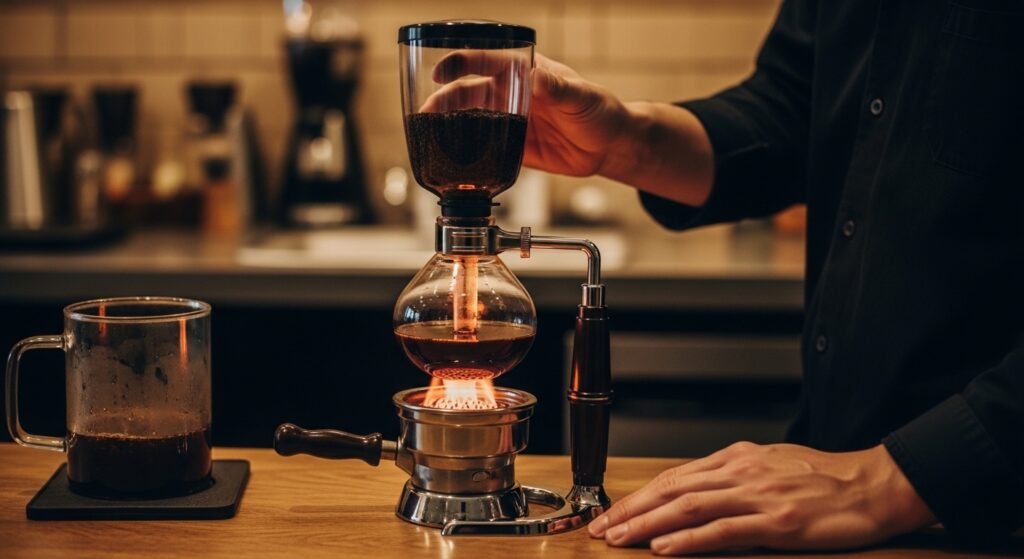
The Rise: As you heat the water in the lower globe, it begins to turn into water vapor. This gas creates pressure, forcing the remaining liquid water up through a glass tube and into the upper chamber.
-
The Immersion: Once the water is in the top chamber, you add your coffee grounds. Unlike a pour-over, where water passes through the coffee, the Siphon is a full-immersion method. Every grain of coffee is surrounded by water at a very stable, high temperature.
-
The Break: When the heat source is removed, the air in the lower globe begins to cool and contract. This creates a partial vacuum.
-
The Draw-Down: The vacuum “sucks” the brewed coffee back down through a filter (usually cloth or glass) into the lower globe.
This rapid draw-down is the Siphon’s secret weapon. The vacuum pressure pulls the liquid through the coffee bed with much more force than gravity alone, resulting in an incredibly efficient extraction.
Thermal Stability: The Siphon’s Edge
One of the biggest challenges in manual brewing is maintaining a consistent temperature. In a ceramic V60, the water begins to lose heat the moment it leaves the kettle. However, in a Siphon, the heat source remains under the lower globe during the entire immersion phase.
This allows the barista to maintain a constant temperature—usually around $91^{\circ}C$ to $94^{\circ}C$—throughout the entire brew. This level of stability is vital for extracting the complex sugars found in High-Altitude Beans . When the temperature stays high and steady, you avoid the “hollow” flavors that occur when the water cools too quickly during the extraction process.
The Cloth Filter: Clarity Meets Body
Most Siphons use a circular cloth filter. This is a crucial distinction. Paper filters, like those used in a Chemex, are very effective at removing oils, leading to a thin, tea-like body. Metal filters, like in a French Press, let almost everything through, leading to a heavy, silty cup.
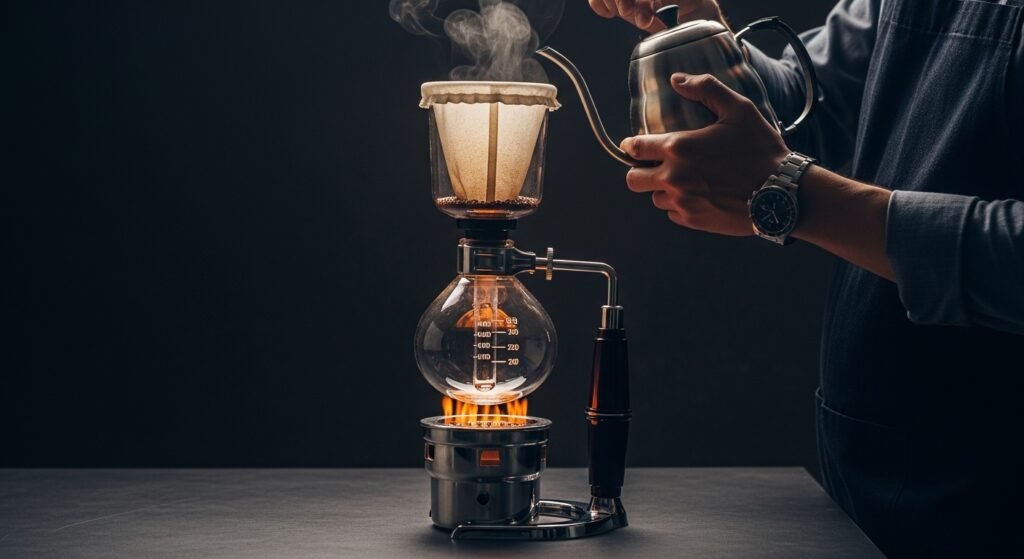
The cloth filter sits perfectly in the middle. It is fine enough to catch the “fines” (micro-particles), ensuring a cup with extreme clarity, but it allows the natural oils to pass through. The result is a cup of coffee that looks as transparent as a V60 brew but feels as silky and heavy as a full-immersion brew. It highlights the floral notes of an Ethiopian Yirgacheffe without sacrificing the mouthfeel.
The Ritual of Preparation
Using a Siphon requires patience and a high degree of Maintenance. It is not a method for a hurried Monday morning.
-
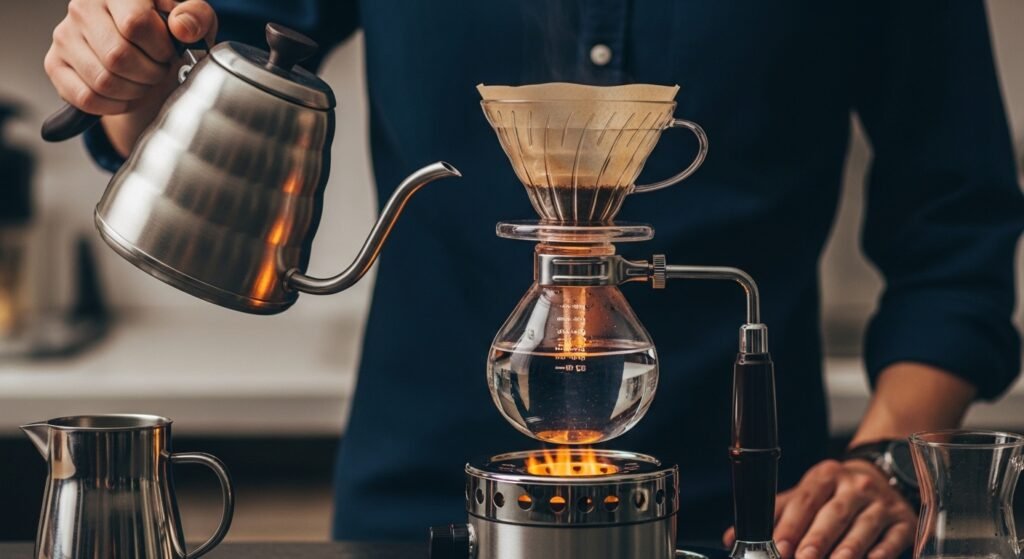
The Grind: You need a medium grind, slightly finer than a French Press but coarser than an espresso. If the grind is too fine, the vacuum won’t be strong enough to pull the liquid back down, leading to a “stuck” brew.
-
The Filter Care: Cloth filters must be kept meticulously clean. If they are allowed to dry out, the oils trapped in the fabric will turn rancid. After use, they should be boiled in water and stored in a jar of clean water in the refrigerator.
-
The Heat Source: While many entry-level Siphons come with a small alcohol burner, professionals prefer butane burners or halogen “beam heaters.” These allow for much more precise control over the “Rise” and “Draw-Down” phases.
Why the Siphon Fell Out of Favor (And Why It’s Back)
During the mid-20th century, the Siphon was a common household appliance. However, as convenience became the priority, it was replaced by automatic drip machines. It was seen as too fragile, too dangerous (due to the open flame), and too difficult to clean.
However, the rise of the Specialty Coffee movement has brought the Siphon back into the spotlight. In the best cafes in Tokyo and Seoul, the Siphon is treated with religious reverence. It is seen as the ultimate expression of the barista’s craft—a method that requires a deep understanding of Water Quality and timing. It is a slow-coffee movement icon, reminding us that the best things in life take time and a bit of scientific rigor.
Tasting the Results: What to Expect
When you drink Siphon coffee, the first thing you notice is the aroma. Because the system is partially closed during the brew, fewer aromatics escape into the room; they are instead trapped within the liquid.
The palate experience is often described as “vibrant.” The acidity is crisp, the sweetness is well-developed, and the Aftertaste is remarkably clean. It is the perfect method for exploring the “sparkling” acidity of a Kenyan AA or the complex, wine-like qualities of a natural-process bean.
Conclusion: Science in Service of Art
The Siphon is a paradox. It is one of the oldest brewing methods still in use, yet it feels futuristic. It is a high-maintenance tool that rewards you with an effortless-tasting cup. It reminds us that coffee brewing is essentially a series of controlled chemical reactions.
While it may never replace the V60 as the go-to for daily brewing, the Siphon remains the “gold standard” for those who want to experience the maximum clarity and body of a high-quality bean. It is a method that demands respect for the physics of the vacuum and the fragility of the glass.
The next time you want to truly celebrate a special bag of coffee, skip the automation. Light the burner, watch the water defy gravity, and enjoy the clean, complex result that only a vacuum can provide. It is a reminder that sometimes, the most sophisticated way to move forward is to look back at the elegant physics of the past.

Brown Christopher is 47 years old and has been passionate about coffee since he was 15. For more than three decades, he has explored coffee culture, brewing methods, and the flavors behind every cup. Through this blog, he shares simple tips and knowledge to help beginners better understand and enjoy coffee in their daily lives. ☕