
In the world of specialty coffee, high-end equipment usually involves delicate glass, hand-hammered copper, or computerized espresso machines costing as much as a small car. Then there is the AeroPress. Made of BPA-free plastic and looking more like a science project or a large syringe than a refined brewer, it was invented in 2005 by Alan Adler—the same man who created the Aerobie flying disc. On paper, a toy inventor making a coffee brewer should have been a footnote in history. Instead, the AeroPress sparked a global movement, complete with its own world championship.
The genius of the AeroPress lies in its versatility. It is neither a pure immersion brewer nor a pure pressure brewer; it is a hybrid that allows the user to manipulate almost every variable of extraction. When you are Understanding Why Some Cheap Coffees Surprise You and Some Expensive Ones Disappoint , you often find that the AeroPress is the “great equalizer.” It can make a mediocre coffee taste decent and a great coffee taste extraordinary, provided you understand the physics of the plunger.
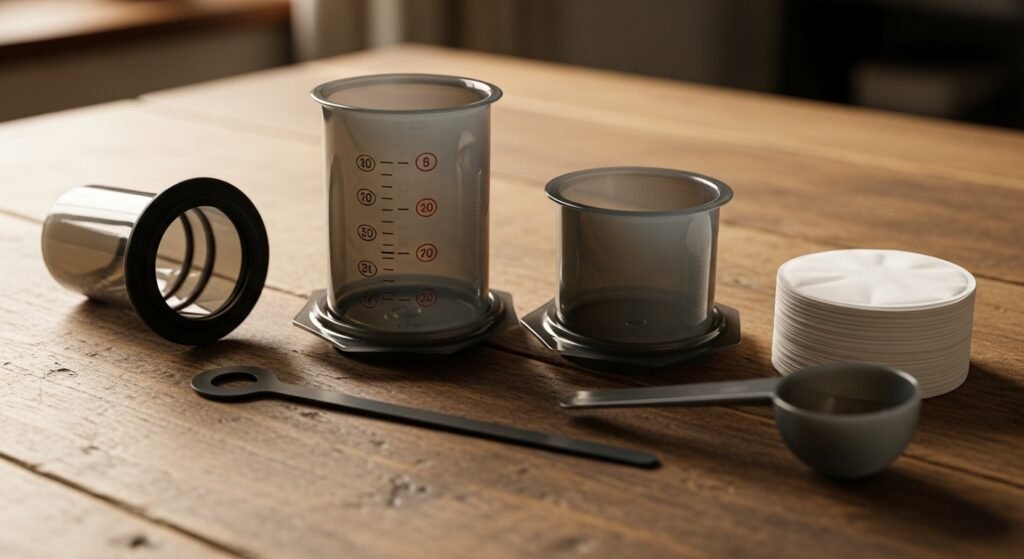
The Hybrid Physics: Immersion Meets Pressure
Most brewing methods fall into one of two camps. The French Press is immersion (coffee sits in water), while the V60 is percolation (water passes through coffee). The AeroPress does both.
First, the coffee and water steep together, allowing for the gentle and even extraction characteristic of immersion. Then, when you press the plunger, you create air pressure that forces the liquid through a paper filter. This added pressure speeds up the final stage of extraction and filters out the “fines” and oils, resulting in a cup with a clarity that rivals the Geometry of Flavor Found in Conical Paper Filters.
This hybrid nature means you can achieve a very high extraction yield in a very short amount of time. While a High-Altitude Kenyan Coffee might take four minutes in a V60, you can achieve a similar flavor profile in just 90 seconds with an AeroPress.
The Two Schools of Thought: Standard vs. Inverted
Because the AeroPress is basically a plastic tube, users quickly realized they could flip it upside down. This led to the two primary brewing methods that dominate the community:
-
The Standard Method: You place the AeroPress on top of your mug, add coffee and water, and press. The downside is that some water begins to drip through the filter before you are ready to steep.
-
The Inverted Method: You flip the device so the plunger is at the bottom. This allows for a 100% full-immersion steep without any “leakage.” You only flip it back over when you are ready to plunge.
After years of testing, many professionals prefer the inverted method for its consistency. It allows you to control the exact contact time down to the second, which is vital when you are Dialing-In a Complex Espresso Shot or a Strong Coffee Concentrate .
Grind Size and the “Espresso-Style” Myth
One of the most common marketing claims is that the AeroPress can make “espresso.” Physically, this is impossible. Real espresso requires 9 bars of pressure; a human being pushing an AeroPress plunger generates about 0.5 to 0.75 bars.
However, the AeroPress can make a very concentrated coffee “shot.” By using a fine grind and a small amount of water, you create a liquid with high TDS (Total Dissolved Solids) that works beautifully as a base for lattes or a Modern Coffee Cocktail Like the Carajillo .
The flexibility of the grind size is the AeroPress’s greatest strength. You can use a fine grind for a 1-minute brew or a coarse grind for a 4-minute steep. The device doesn’t care; as long as you have the strength to push the plunger, it will extract.
The Importance of the Seal and Maintenance
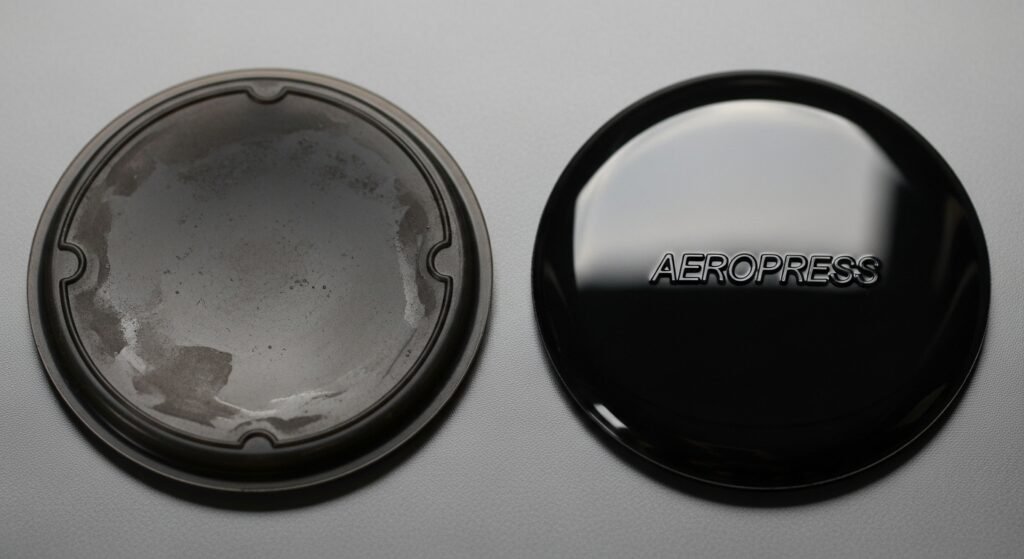
Because the AeroPress relies on air pressure, the rubber seal at the end of the plunger is the most critical component. Over time, coffee oils and heat can cause the rubber to lose its elasticity or become sticky.
To keep your device in top shape, you must Invest in Proper Cleaning and Maintenance of Your Accessories . A simple rinse is usually enough for the plastic, but the rubber seal should be cleaned with mild soap occasionally. More importantly, always store the AeroPress with the plunger pushed all the way through or completely detached. If you store it halfway in, the constant pressure will eventually compress the seal, causing it to leak air during your next brew.
Temperature Control: Breaking the $100^{\circ}C$ Habit
Alan Adler, the inventor, famously recommended brewing at $80^{\circ}C$ ($175^{\circ}F$). In the early days of specialty coffee, this was considered heresy. We were taught that $93^{\circ}C$ was the golden rule.
However, because the AeroPress is so efficient at extracting, lower temperatures often result in a much sweeter cup with less bitterness. This is particularly true for darker roasts or for people using Water with High Mineral Content . By dropping the temperature, you slow down the extraction of the harsher, woody compounds, allowing the natural sweetness of the bean to take center stage.
Travel and Durability: The Nomad’s Choice
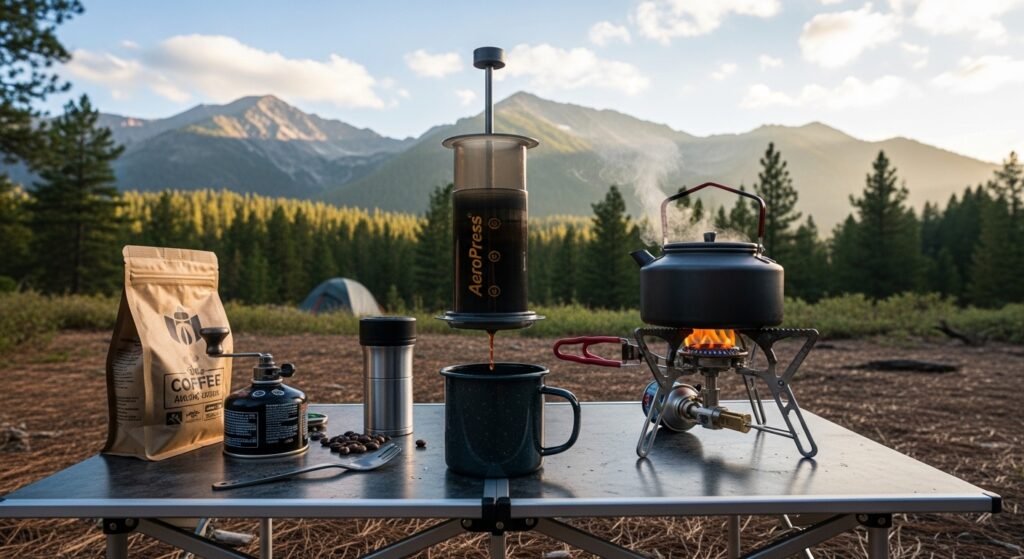
The AeroPress is virtually indestructible. I have seen them dropped on concrete, stuffed into overpacked hiking bags, and used in hotel rooms across the globe. For the traveling coffee lover, it is the undisputed champion. It doesn’t require a goose-neck kettle, a scale (if you use the provided scoop), or a stable surface.
When you are far from home and want to Develop Your Palate by Testing Local African or South American Beans , the AeroPress provides a consistent “control” environment. You know exactly how it behaves, making it easier to judge the quality of the coffee rather than the limitations of your temporary setup.
Conclusion: Simplicity as a Virtue
The AeroPress teaches us that sophistication doesn’t always require complexity. It stripped away the snobbery of manual brewing and replaced it with a spirit of playfulness and experimentation. It is a tool that invites you to break the rules.
Whether you are a world-class barista or someone just starting to Learn About the Nuances of High-Altitude Terroir , the AeroPress has a place in your kitchen. It is a reminder that great coffee is about the relationship between water, pressure, and time—and sometimes, a simple plastic tube is the best way to manage that relationship.
So, the next time you feel overwhelmed by the technicality of coffee, go back to the basics. Grab your AeroPress, try the inverted method, and remember that at the end of the day, the best brewing method is the one that makes you smile when you take that first sip.

Brown Christopher is 47 years old and has been passionate about coffee since he was 15. For more than three decades, he has explored coffee culture, brewing methods, and the flavors behind every cup. Through this blog, he shares simple tips and knowledge to help beginners better understand and enjoy coffee in their daily lives. ☕