
In the specialty coffee industry, “Cupping” is the universal language of quality control. It is a standardized method of tasting coffee that levels the playing field, removing the variables of different brewing methods like the V60 or the AeroPress to focus solely on the raw potential of the bean. For decades, this was a ritual reserved for green coffee buyers in the mountains of Ethiopia or roasters in high-end laboratories. However, bringing this practice into your own kitchen is the single fastest way to Develop a Professional Palate and Learn to Identify the Hidden Nuances of Regional Terroirs .
Hosting a cupping at home isn’t about being a critic; it’s about discovery. It allows you to compare different origins side-by-side, revealing how The Unique Chemistry of High-Altitude Volcanic Soils Impacts the Final Flavor in Your Cup . By following a few simple rules of physics and sensory science, you can transform a casual morning into a deep educational experience.
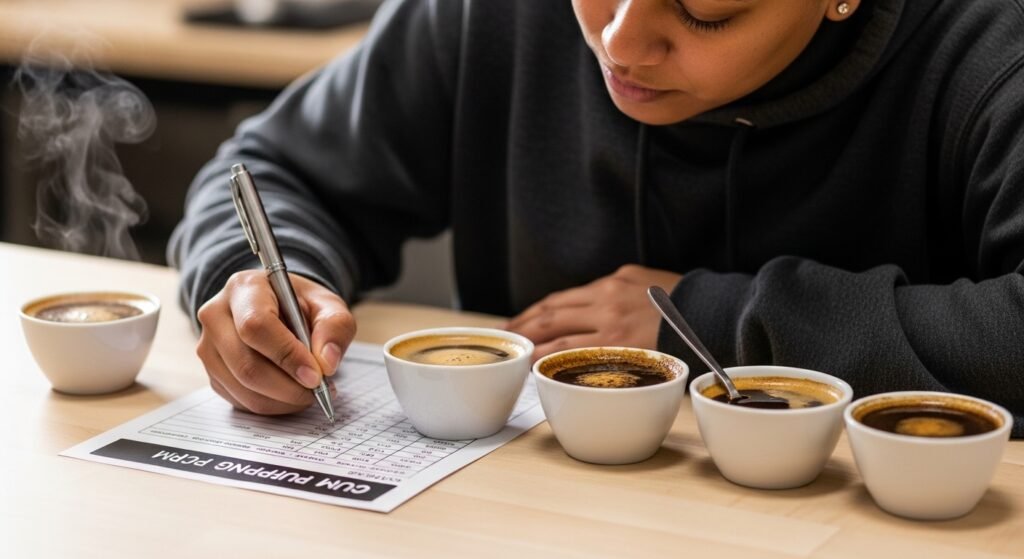
The Philosophy of the Spoon: Why We Cup
The goal of cupping is consistency. If you brew one coffee in a French Press and another in a Chemex, you are tasting the equipment as much as the coffee. Cupping uses a basic “immersion” technique—similar to how you might steep tea—to ensure that every coffee is treated exactly the same way.
When you remove the paper filter and the pressure of a machine, you are left with the “naked” truth of the bean. This is where you can truly Analyze the Long-Lasting Science of Aftertaste and Determine Which Beans Offer the Best Sweetness . It is a meditative process that requires silence, focus, and a clean palate.
Setting Up Your Tasting Station
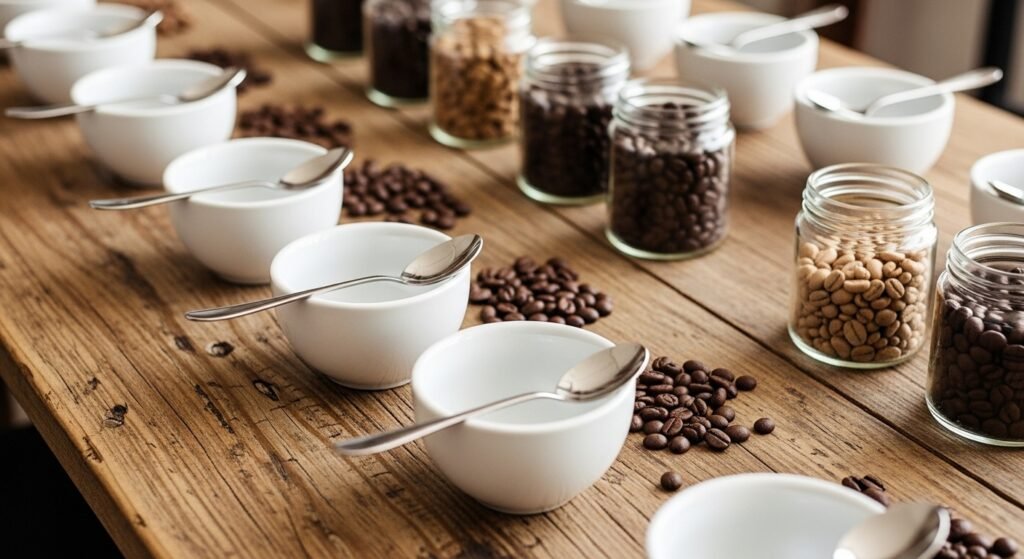
To perform a professional-grade cupping at home, you need a few essential tools. Precision is your best friend here.
-
The Glassware: Use identical cups or bowls, ideally between 160ml and 200ml. Transparency isn’t necessary, but ceramic or glass is preferred to avoid any metallic interference.
-
The Spoons: A traditional cupping spoon is deep and round, designed to hold enough liquid for a forceful “slurp.” If you don’t have one, a large soup spoon will suffice.
-
The Scale and Grinder: Consistency is key. You must Ensure Your Burr Grinder is Clean and Calibrated to a Coarse Sea-Salt Consistency for every sample.
-
Rinse Water: Have a separate cup of hot water for each person to rinse their spoon between samples. This prevents “cross-contamination” of flavors.
The Magic Ratio
The industry standard is $8.25$g of coffee for every $150$ml of water. This ratio is designed to provide enough concentration to reveal defects but enough clarity to highlight delicate florals.
The Step-by-Step Ritual
Phase 1: The Dry Aroma (Fragrance)
Grind each coffee sample immediately before starting. Lean over the dry grounds and take a deep breath. This is the “Fragrance.” Is it nutty? Floral? Smoky? This is often where you will find the most volatile aromatics that disappear once water is added.
Phase 2: The Infusion
Pour your hot water ($93^{\circ}C$ is ideal) directly onto the grounds, making sure to saturate them completely. Fill the cup to the brim and start a timer. Let the coffee steep undisturbed for 4 minutes. During this time, a “crust” of grounds will form on the surface.
Phase 3: Breaking the Crust
At the 4-minute mark, take your spoon and gently push the floating grounds back three times. As you “break the crust,” lean in close and inhale. This is the “Aroma.” It will be different from the dry fragrance—often sweeter and more complex. Once the crust is broken, use two spoons to skim off any remaining foam or floating particles.
Phase 4: The Slurp (The Tasting)
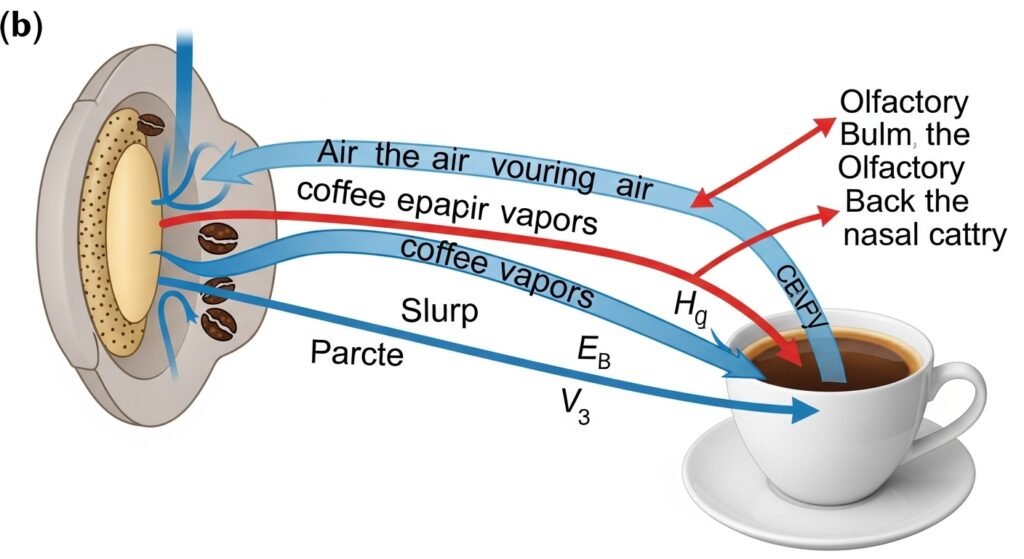
Wait until the timer reaches 9 or 10 minutes. The coffee must cool down to around $55^{\circ}C$ to $60^{\circ}C$ to avoid burning your tongue and to allow the sugars to shine. Dip your spoon, take a small amount of liquid, and slurp it forcefully into your mouth. The goal is to aerate the coffee, spraying it across your entire palate and up into your nasal cavity (retronasal olfaction).
What to Look For: Developing Your Sensory Map
As you move between the cups, don’t just ask “Do I like this?” Instead, try to categorize the experience:
-
Acidity: Is it sharp like a lemon (Kenya) or soft like a grape (Colombia)?
-
Body: Does it feel heavy like cream or thin like water?
-
Cleanliness: Is the flavor pure, or do you notice “muddy” or fermented notes?
-
Sweetness: Does it remind you of brown sugar, honey, or caramel?
This is where Understanding the Technical Difference Between a Properly Calibrated Espresso and a Cupping Sample becomes useful. Espresso is about intensity and balance in a few seconds, while cupping is about the evolution of flavor over twenty minutes.
The “Cooling” Revelation
The most fascinating part of cupping happens as the coffee reaches room temperature. Many coffees that taste “fine” when hot will reveal their flaws—or their hidden beauty—as they cool. A high-quality bean will actually become sweeter as it nears $30^{\circ}C$. If the coffee becomes bitter or unpleasantly sour as it sits, it’s a sign that the beans were either poorly roasted or of lower quality. This is the ultimate test of the Invisible Ingredient: Your Local Water Quality and Mineral Content .
Conclusion: Becoming Your Own Expert
Hosting a coffee cupping is a humbling and enlightening experience. It strips away the marketing and the fancy packaging, leaving you alone with the liquid and your senses. It teaches you to trust your own palate rather than the notes written on the bag.
By practicing this ritual regularly, you will find that your daily morning cup becomes more intentional. You will start to notice why you prefer certain regions over others and how Maintaining Your Grinder and Cleaning Your Equipment Directly Influences Your Tasting Success .
The world of specialty coffee is vast, and cupping is your map. So, invite a few friends over, grind some beans, and start slurping. You aren’t just drinking coffee; you are exploring a world of chemistry, geography, and art, one spoonful at a time.

Brown Christopher is 47 years old and has been passionate about coffee since he was 15. For more than three decades, he has explored coffee culture, brewing methods, and the flavors behind every cup. Through this blog, he shares simple tips and knowledge to help beginners better understand and enjoy coffee in their daily lives. ☕