
In the pursuit of the perfect cup, we often obsess over the most visible variables. We spend hours Developing a Professional Palate and Learning to Identify Hidden Nuances , we buy expensive high-altitude beans, and we invest in precision kettles. However, there is a silent enemy lurking in almost every home kitchen: coffee oil residue and mineral scale. Even the most sophisticated brewing setup is only as good as its cleanliness. If your equipment is dirty, you aren’t tasting the “terroir” of the bean; you are tasting the oxidized ghost of every cup you’ve made in the last month.
Maintaining your gear is not just about hygiene; it’s about preserving the chemical integrity of your brew. Coffee contains organic fats and oils that, when exposed to air and heat, turn rancid. When you are Evaluating the Science of Aftertaste and How It Lingers on Your Palate , any bitterness or metallic “twang” you perceive is often the result of old oils trapped in your filter or group head. To keep your coffee tasting “high-definition,” you must treat your equipment with the same respect a chef treats a professional knife.
The Grinder: The Heart of the Operation
The grinder is arguably the most important piece of equipment you own, yet it is often the most neglected. Every time you grind a bean, a microscopic layer of oil is deposited on the burrs. Over time, these oils attract dust and coffee “fines,” creating a sticky paste that slows down the motor and taints the flavor of fresh coffee.
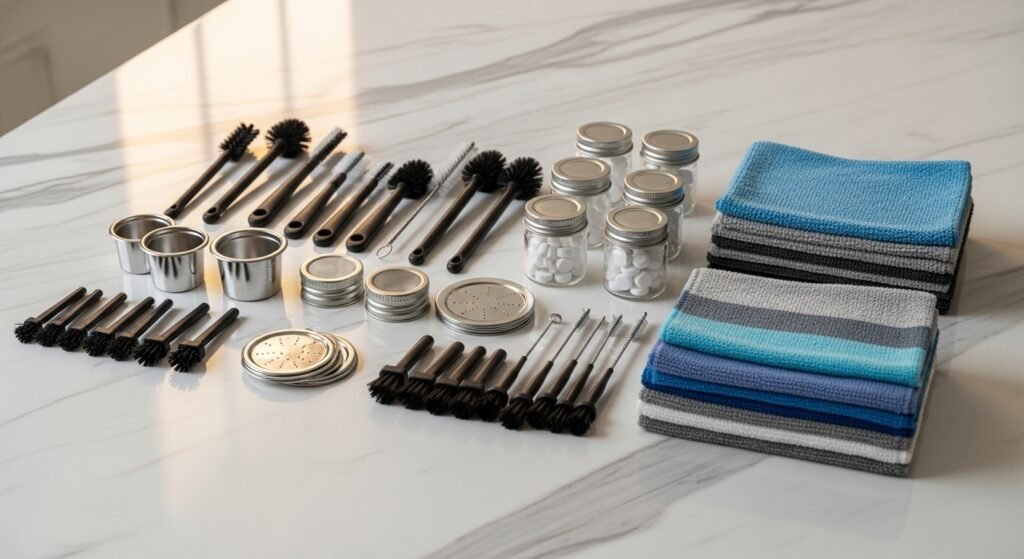
To prevent this, you should perform a “dry clean” every week using a stiff brush to remove loose particles. Once a month, use specialized grinder cleaning tablets (which look like coffee beans but are made of food-safe binders) to absorb the deep-seated oils. If you are Calibrating Your Espresso and Noticing Inconsistent Flow Rates , the culprit is often a “clogged” burr set that is heating up and causing the coffee to clump. A clean grinder ensures that the particle distribution remains uniform, allowing for an even extraction.
The Espresso Machine: Battling the Scale
If you own an espresso machine, you are fighting a two-front war: one against coffee oils and another against mineral deposits (scale).
-
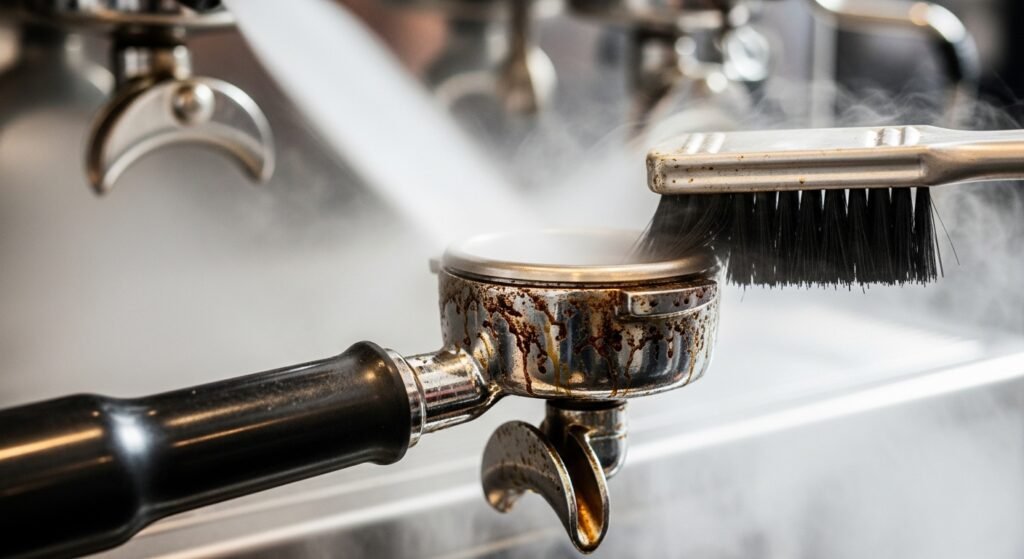
Backflushing: Every day, you should perform a plain water backflush to clear the shower screen. Once a week, use a specialized detergent to “deep clean” the internal three-way solenoid valve. If you skip this, old coffee solids will build up inside the machine, leading to a permanent “burnt” taste that no amount of Water Quality and Mineral Balancing can fix.
-
Descaling: Depending on your local water hardness, minerals like calcium and magnesium will eventually coat your heating elements. This acts as insulation, making your machine work harder to heat the water and eventually causing total failure. Descaling should be a regular part of your routine to ensure your machine lasts for decades rather than years.
Manual Brewers: The Invisible Film
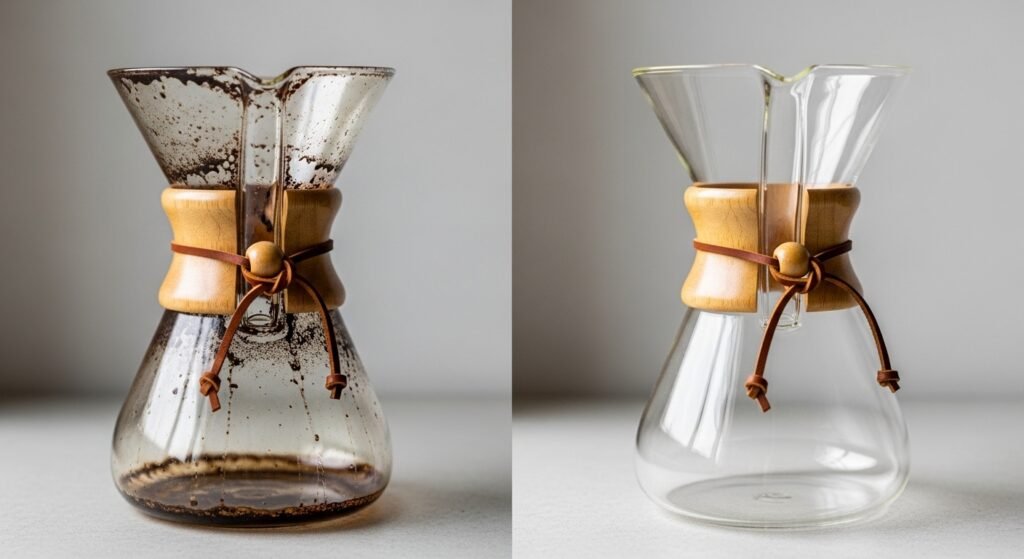
Devices like the V60, Chemex, or AeroPress might seem easy to clean, but they are not immune to build-up. Glass brewers, in particular, can develop a “haze” over time. This haze is actually a thin film of polymerized coffee oils.
For these, a simple rinse with water is never enough. You should use a mild, fragrance-free detergent or a specialized coffee equipment cleaner. If you use a Siphon or Vacuum Pot with a Cloth Filter , maintenance becomes even more critical. Cloth filters must be kept submerged in clean water and stored in the refrigerator, or they will turn rancid and ruin every subsequent brew. The goal is to ensure that the only flavor in your cup is the one intended by the Farmer at a High-Altitude Ethiopian Estate .
The Steam Wand: A Biological Necessity
If you froth milk, the steam wand is a potential breeding ground for bacteria. Milk proteins “bake” onto the hot metal instantly. You should purge the wand before and after every use and wipe it down with a damp cloth immediately. If the holes in the tip become blocked, your steam pressure will drop, making it impossible to create the “micro-foam” needed for a Modern Coffee Cocktail or a Professional Latte .
Why Clean Equipment Improves Your Palate
The most surprising benefit of a strict maintenance routine is that it actually makes you a better taster. When your equipment is pristine, you are removing the “static” from the signal. You can finally distinguish between the “bright” acidity of a Kenyan bean and the “sourness” of an under-extracted shot.
When your gear is dirty, every coffee tastes vaguely the same—bitter and muddled. By Applying This Level of Technical Care to Your Daily Ritual , you allow the true science of the bean to take center stage. You’ll find that you need less sugar and milk because the coffee itself is no longer fighting against the flavor of its own decay.
Conclusion: Respect the Machine
Maintenance is the unglamorous side of specialty coffee, but it is the foundation upon which everything else is built. You can have the Best Water Quality in the World and the Most Expensive High-Altitude Beans , but if your group head is caked in last month’s espresso, you are wasting your money.
Treat your coffee gear like the precision instruments they are. Develop a daily, weekly, and monthly rhythm for cleaning. Your reward will be a machine that lasts a lifetime and, more importantly, a cup of coffee that is consistently vibrant, sweet, and clean. In the world of specialty coffee, cleanliness is not just next to godliness—it is the secret to the perfect brew.

Brown Christopher is 47 years old and has been passionate about coffee since he was 15. For more than three decades, he has explored coffee culture, brewing methods, and the flavors behind every cup. Through this blog, he shares simple tips and knowledge to help beginners better understand and enjoy coffee in their daily lives. ☕