
If you examine the packaging of any premium bag of specialty coffee, you will almost always find a number followed by the letters “MASL” (Meters Above Sea Level). To the uninitiated, this might seem like a trivial geographical detail, similar to knowing the name of the farm or the province. However, in the world of botanical science and sensory analysis, altitude is perhaps the single most important predictor of a coffee’s potential. It is the silent architect of flavor, dictating the density of the bean, the complexity of its acids, and the depth of its sweetness.
The relationship between elevation and quality is not a coincidence of scenery; it is a matter of biological survival. Coffee plants grown at high altitudes—typically between 1,500 and 2,200 meters—face a much harsher environment than those grown in the lowlands. By Understanding How the Unique Chemistry of Volcanic Soils and Rare Altitudes Impacts the Final Flavor , we can begin to appreciate why a bean from the peaks of Ethiopia tastes so fundamentally different from a mass-produced bean from a low-lying plantation.
The “Slow-Growth” Paradox: Density as a Virtue
The primary reason altitude matters is temperature. For every 100 meters you climb, the temperature drops significantly. At high elevations, the coffee cherry (the fruit) grows much more slowly than it does in a warm, tropical valley. This extended maturation period is the secret to coffee greatness.
Because the fruit takes longer to ripen, the plant has more time to pump complex sugars and organic acids into the seed (the bean). This results in what is known as a “Strictly Hard Bean” (SHB). High-altitude beans are physically denser and smaller than their low-altitude counterparts. This density is a direct indicator of flavor concentration. When you are Calibrating Your Extraction Process for a Dense Espresso Shot , you will notice that these hard beans require more energy—often higher temperatures—to release their internal treasures.
Acidity: The Sparkling Peak
In the world of professional tasting, “acidity” is a positive attribute. It refers to the brightness and liveliness of the cup. Low-altitude coffees often lack this, resulting in a flavor that is “flat” or “earthy.” In contrast, high-altitude coffees are famous for their vibrant, sparkling acidity.
This happens because the cool mountain nights allow the plant to rest, preventing it from consuming its own sugar reserves through respiration. The result is a bean packed with phosphoric, citric, and malic acids. This is why Evaluating the Lingering Science of Aftertaste in High-Altitude Beans is so rewarding; the acidity provides a structure that carries the flavor across your palate like a fine wine, rather than disappearing instantly.
The Struggle Against Pests: A Natural Purity
Altitude also acts as a natural filter for pests and diseases. The Coffee Berry Borer and Coffee Leaf Rust (Roya) thrive in warm, humid conditions. As you move higher into the mountains, the environment becomes too cold and oxygen-thin for these threats to survive.
Because the plants are less stressed by pests, they can focus all their metabolic energy on fruit production. This is particularly evident when you Develop Your Professional Palate by Comparing Clean African Heirlooms to Common Commercial Grades . High-altitude coffees are naturally “cleaner” because they have fewer chemical defects caused by insect damage or fungal infections.
Terroir and the Mineral Connection
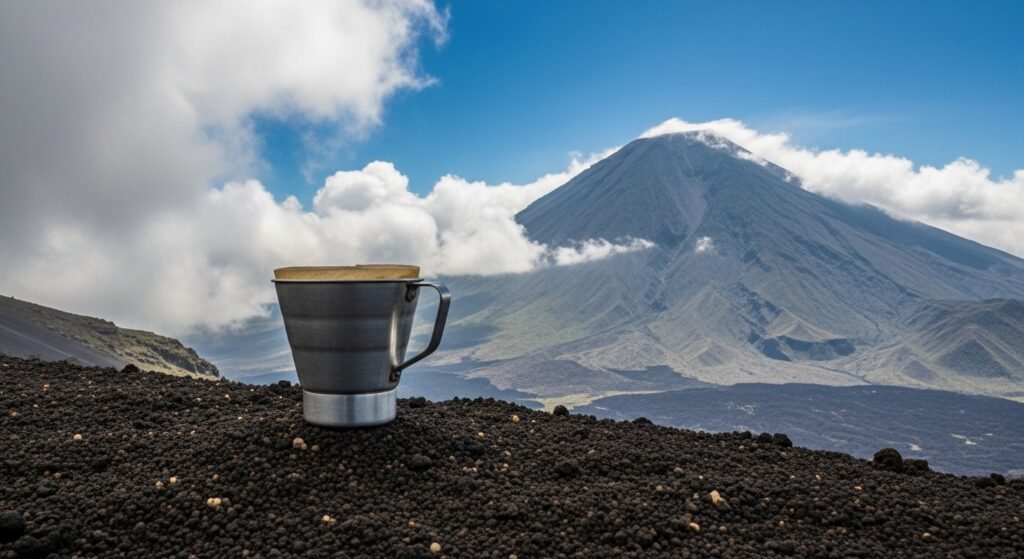
It isn’t just about the height; it’s about what the mountain is made of. Many of the world’s highest coffee regions, such as the Great Rift Valley in Africa or the Andean peaks in South America, are volcanic. Volcanic soil is incredibly rich in minerals like potassium, magnesium, and phosphorus.
When these minerals combine with the slow-growth cycle of high altitude, the bean becomes a concentrated mineral capsule. This chemical makeup is extremely sensitive to the Invisible Ingredient: Your Local Water Quality and Its Ability to Extract Mountain Minerals . If your water is too filtered or lacks its own mineral balance, you won’t be able to “unlock” the complex profile that the mountain worked so hard to create.
The Altitude Hierarchy: Grading the Quality
Different countries use different terms to describe altitude, but they all point to the same biological truth.
-
SHB (Strictly Hard Bean): Usually grown above 1,350 meters. These are the crown jewels of specialty coffee.
-
HG (High Grown): Typically 1,000 to 1,350 meters. These offer good balance but may lack the intense “sparkle” of SHB.
-
Standard/Lowland: Grown below 1,000 meters. These are often used for instant coffee or mass-market blends because they lack complexity.
This grading is so reliable that it dictates the price on the global market. When you Maintain and Clean Your Equipment to Professional Standards , you are essentially protecting an investment in the thousands of hours of slow mountain growth that produced that specific bean.
Brewing Challenges of Mountain Coffee
Because high-altitude beans are so dense, they can be difficult to brew correctly. They are “stubborn.”
-
Heat is Necessary: You often need water closer to boiling ($95^{\circ}C$ to $97^{\circ}C$) to penetrate the dense cellular walls of a mountain-grown bean.
-
Precision Grinding: These beans shatter differently. Using a Calibrated Burr Grinder to Ensure a Uniform Particle Size is essential. If your grind is inconsistent, the dense core of the mountain bean will remain under-extracted while the outside becomes bitter.
-
Resting Time: High-altitude beans often need more time to “degas” after roasting. Their tight structure traps carbon dioxide more effectively than softer beans.
Conclusion: The Elevation of the Experience
Altitude is a reminder that in coffee, as in life, struggle produces character. The thin air, the cold nights, and the steep slopes of the world’s mountains force the coffee plant to produce its very best work. When you take a sip of a high-altitude coffee, you are tasting a biological response to a challenging environment.
By Applying This Technical Knowledge to Your Daily Brewing Ritual , you move beyond being a consumer and become a guardian of quality. You begin to see the “MASL” on the bag not as a number, but as a promise of complexity, acidity, and sweetness. The next time you find a bean grown at 2,000 meters, treat it with the respect it deserves. It has spent a long time in the cold mountain air just to bring that specific, sparkling note to your cup.
Respect the mountain, and the mountain will reward your palate.

Brown Christopher is 47 years old and has been passionate about coffee since he was 15. For more than three decades, he has explored coffee culture, brewing methods, and the flavors behind every cup. Through this blog, he shares simple tips and knowledge to help beginners better understand and enjoy coffee in their daily lives. ☕