
When we discuss the art of brewing, we spend a vast amount of time analyzing the bean. We debate the merits of High-Altitude Terroir and Its Impact on Bean Density and we meticulously Calibrate Our Grinders to Ensure Absolute Precision in Every Extraction . But there is a silent partner in this process that often goes ignored: the water. If you are brewing a standard pour-over, approximately 98.5% of what is in your cup is water. If that water is poor, your coffee will be poor.
Water is not just a neutral base; it is a powerful solvent. Its chemical makeup—specifically its mineral content and pH level—dictates which flavors are extracted from the ground coffee and which are left behind. If you have ever wondered why your expensive Ethiopian beans taste vibrant at a cafe but flat and ashy at home, the answer is likely flowing from your kitchen tap. To truly master coffee, you must Understand the Invisible Chemistry of Water and How It Unlocks Floral and Fruity Notes .
The Chemistry of Extraction: Magnesium and Calcium
Water “pulls” flavor out of coffee through a process of molecular attraction. Two minerals, in particular, do most of the heavy lifting: Magnesium ($Mg^{2+}$) and Calcium ($Ca^{2+}$).
-
Magnesium: This is the “flavor vacuum.” Magnesium ions are highly reactive and are particularly good at pulling out complex, fruity, and acidic compounds. High-magnesium water often results in a cup that feels bright and vibrant.
-
Calcium: While also helpful for extraction, calcium is more selective. It tends to enhance the heavier, creamier notes of a coffee. However, too much calcium leads to “lime scale” buildup, which is why Maintaining and Descaling Your Equipment is Critical for Machine Longevity .
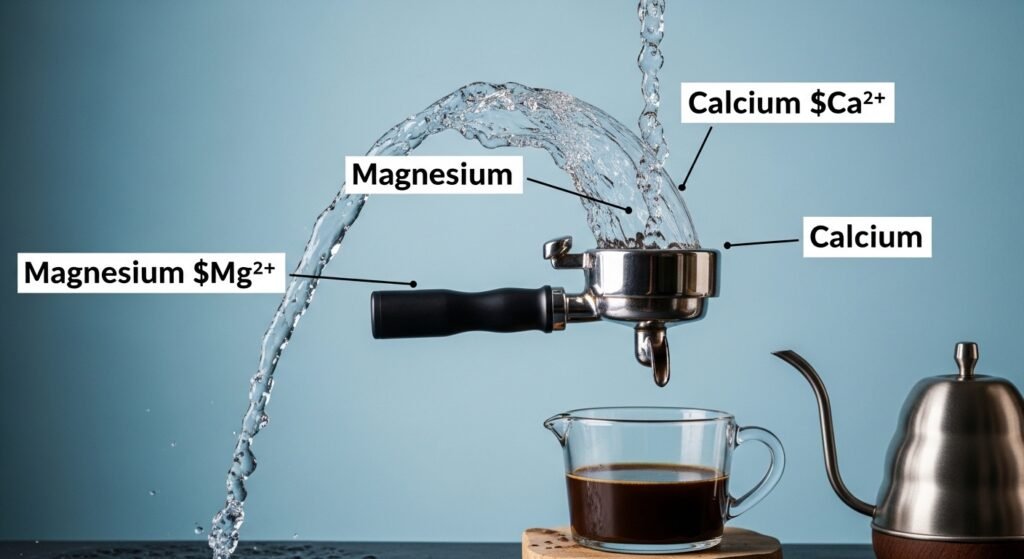
If your water is “soft” (lacking these minerals), it will be a weak solvent. The coffee will taste sour and thin because the water simply didn’t have the chemical “hooks” to grab the flavor molecules. Conversely, if your water is too “hard,” it will be over-saturated with minerals, leaving no room for the coffee solids to dissolve, resulting in a muddled, chalky taste.
Buffer and Alkalinity: The Acid Balancer
Beyond the minerals that extract flavor, there is the issue of Bicarbonate ($HCO_{3}^{-}$). Bicarbonate acts as a “buffer,” meaning it neutralizes acid. In small amounts, this is essential; it prevents the coffee from tasting unpleasantly sharp or vinegary.
However, many municipal water supplies have very high alkalinity. If your water has too much bicarbonate, it will neutralize all the beautiful, sparkling acids found in High-Altitude Kenyan or Ethiopian Beans . The result is a coffee that tastes “flat,” “dull,” or even “earthy,” regardless of how fresh the roast is. This is a common frustration for those trying to Evaluate the Science of Aftertaste and Finding Only Bitterness Instead of Sweetness .
The Problem with Pure Water: Why Distilled is Destructive
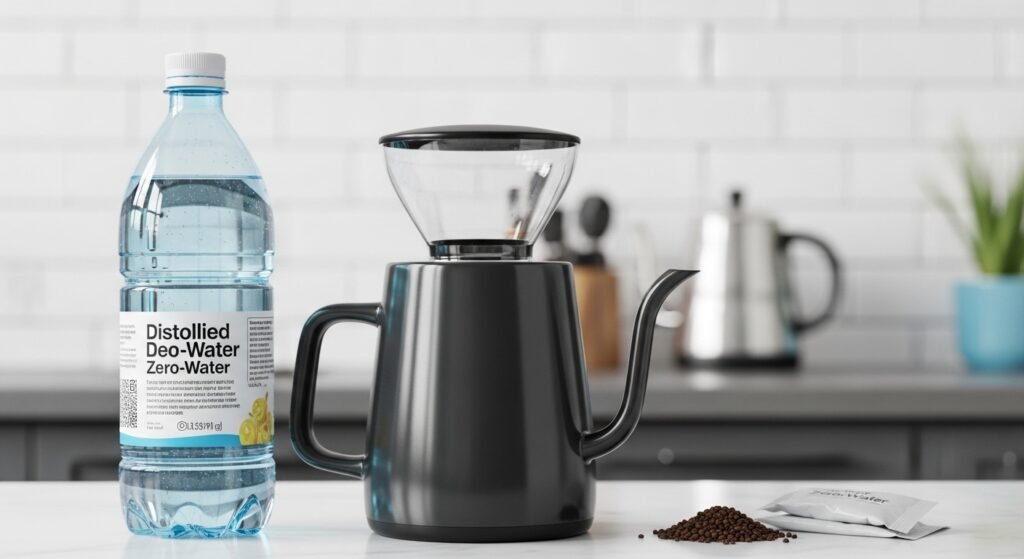
A common mistake made by home brewers is using distilled or Zero-Water. It sounds logical: if tap water is bad, “pure” water must be better. Unfortunately, distilled water is too pure. It has zero mineral content, which means it has no ability to extract the flavorful oils and sugars from the bean.
Brewing with distilled water produces a cup that is hollow, intensely sour, and lacks any body. To get the best results, you need a “controlled” amount of minerals. This is why many enthusiasts now use “remineralization” packets—small sachets of minerals that you add to distilled water to create the “perfect” brewing chemistry.
Filtration vs. Transformation
Most basic kitchen filters (like Brita pitchers) are designed to remove chlorine and organic contaminants. This is excellent for improving the smell and safety of your water, but it rarely changes the mineral composition.
If you live in an area with extremely hard water, a standard charcoal filter won’t help your coffee extraction. You may need a specialized “Reverse Osmosis” system with a remineralization stage or a dedicated coffee water solution. By Applying This Level of Technical Rigor to Your Water Supply , you ensure that every gram of expensive specialty coffee you buy is given the best possible chance to shine.
Temperature and Kinetic Energy
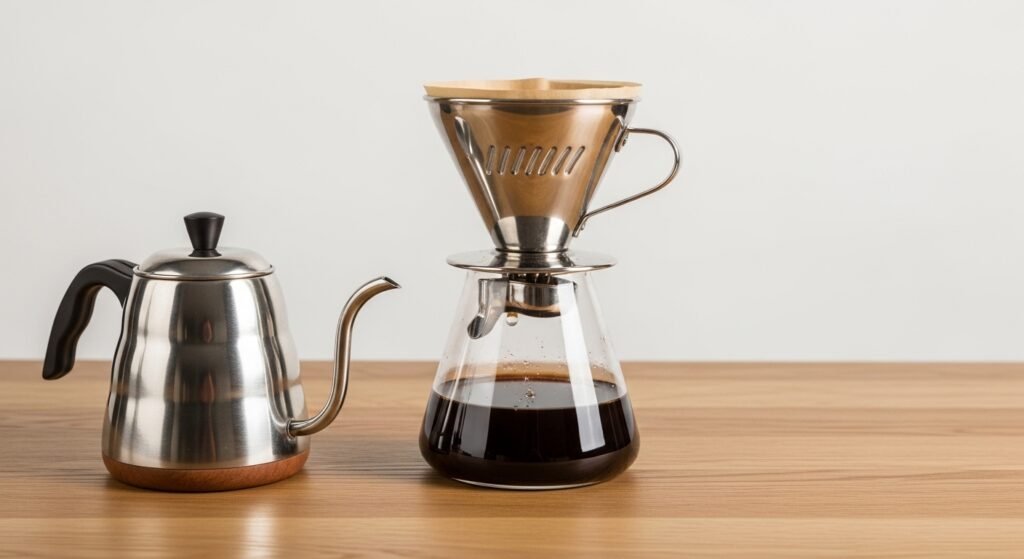
Water quality isn’t just about minerals; it’s about how those minerals behave under heat. As we know from the Physics of the Siphon and Manual Brewing Methods , higher temperatures increase the kinetic energy of water molecules, making the extraction more aggressive.
If your water is chemically “aggressive” (low buffer, high magnesium), using water straight off the boil will likely lead to over-extraction and bitterness. If your water is “lazy” (high buffer, low minerals), you might actually need that extra heat to force an extraction. This delicate dance is why Dialing-In a New Bag of Coffee is a Continuous Process of Trial and Error .
The Sensory Test: The “Water Cupping”
If you want to understand the impact of water on your coffee, try this experiment:
-
Buy a bottle of high-quality mineral water (like Volvic or Crystal Geyser).
-
Use your filtered tap water.
-
Host a Mini Coffee Cupping at Home Using the Same Beans for Both Waters .
The difference will shock you. One cup will likely be vibrant and sweet, while the other might be muddled or unpleasantly dry. This exercise is the fastest way to convince your palate that water is, indeed, a primary ingredient.
Conclusion: The Final 98%
We often treat water as a utility—something that is simply “there.” But in the world of specialty coffee, water is a tool. It is the vehicle that carries the soul of the bean from the grounds into your cup.
By paying attention to your water’s mineral balance and alkalinity, you are respecting the Incredible Effort That Farmers Put Into Growing High-Altitude Masterpieces . You are ensuring that the jasmine, the blueberry, and the chocolate notes aren’t lost to a chemical mismatch in your kettle.
Stop treating water as an afterthought. Invest in a good filtration system or explore mineral additives. When you fix the “invisible ingredient,” every other part of your brewing process—from the Precision of Your Grinder to the timing of your pour—will finally fall into place. Your coffee will taste clearer, brighter, and exactly the way it was meant to be.

Brown Christopher is 47 years old and has been passionate about coffee since he was 15. For more than three decades, he has explored coffee culture, brewing methods, and the flavors behind every cup. Through this blog, he shares simple tips and knowledge to help beginners better understand and enjoy coffee in their daily lives. ☕