
In the hierarchy of coffee equipment, the grinder is often the most undervalued tool by beginners and the most obsessed-over tool by professionals. You can have the Best Water Quality Managed by Mineral Precision and the rarest High-Altitude Beans from the Peaks of Ethiopia , but if your grind is inconsistent, your extraction is doomed. The goal of grinding is not just to break the bean into pieces, but to create a uniform surface area that allows water to flow through and extract flavors at an even rate.
When you look at coffee under a microscope, it is a cellular matrix. To get the flavor out, water must penetrate these cells. If your grinder produces a mix of massive chunks (boulders) and microscopic dust (fines), you are brewing two different coffees at the same time. This inconsistency is the primary reason why Evaluating the Science of Aftertaste Often Leads to Muddled Flavors rather than the clean, shimmering sweetness we strive for.
Blades vs. Burrs: The Physics of Crushing
The most common entry-level grinder is the blade grinder. These function like small blenders, with a metal blade spinning at high speeds, “chopping” the beans into random sizes. Because there is no way to control the distance between the blades and the beans, the result is a chaotic mixture.
Professional brewing requires a Burr Grinder. Instead of chopping, burr grinders use two abrasive surfaces—one stationary and one rotating—to “crush” and “shear” the beans. The distance between these two burrs dictates the grind size. As the bean enters the burrs, it is broken down progressively until the particles are small enough to pass through the gap. This mechanical precision is what allows for the Accurate Dialing-In of a Complex Espresso Shot .
Conical vs. Flat Burrs: The Flavor Profile Debate
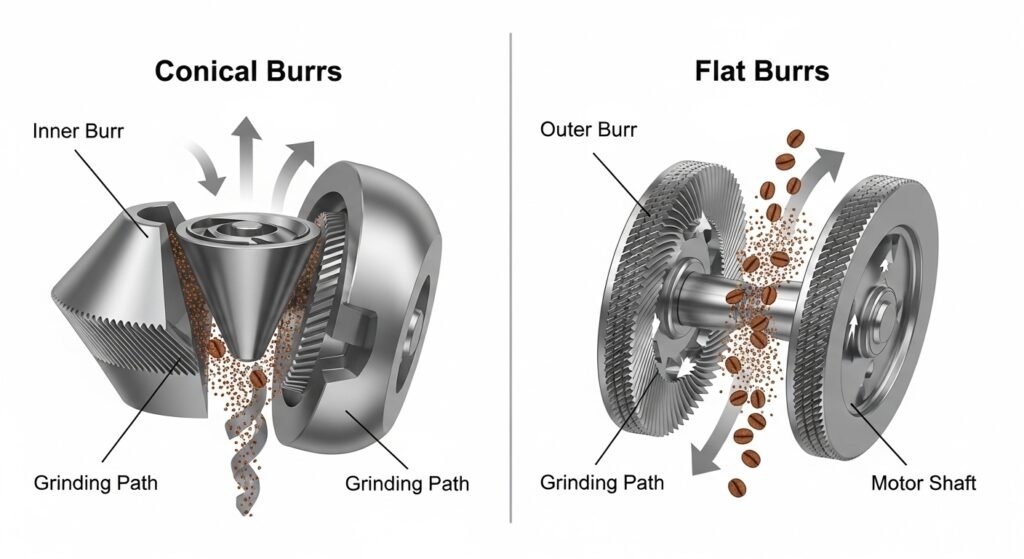
Among specialty enthusiasts, the debate between conical and flat burrs is legendary. While both are superior to blades, they interact with the bean’s geometry in different ways:
-
Conical Burrs: These use a cone-shaped center burr that fits into a ring-shaped outer burr. They typically spin at lower speeds and produce a “bimodal” distribution, meaning there is a slight mix of two particle sizes. This creates a “traditional” espresso profile with a heavy body and a rich texture.
-
Flat Burrs: These consist of two parallel rings with teeth. They produce a “unimodal” distribution, where almost every particle is the exact same size. This creates a “modern” profile with extreme clarity and vibrant acidity, perfect for Highlighting the Delicate Jasmine Notes of an African Heirloom .
The Problem of Fines and Boulders
In a perfect world, every coffee particle would be identical. In reality, every grinder produces some level of “fines” (extremely small particles) and “boulders” (large particles).
-
Fines have a massive surface area. They over-extract almost instantly, adding bitterness and a “dusty” mouthfeel to your cup.
-
Boulders have a small surface area relative to their mass. Water cannot reach their center in time, leading to under-extraction and a sour, salty taste.
When you have too much of both, your coffee is simultaneously bitter and sour—a phenomenon known as “muddled” flavor. By Investing in a High-Quality Burr Set and Maintaining Its Cleanliness , you minimize these outliers. A clean grinder ensures that the “teeth” of the burrs can shear the bean cleanly rather than smashing it into dust.
Heat and Friction: The Silent Flavor Killers
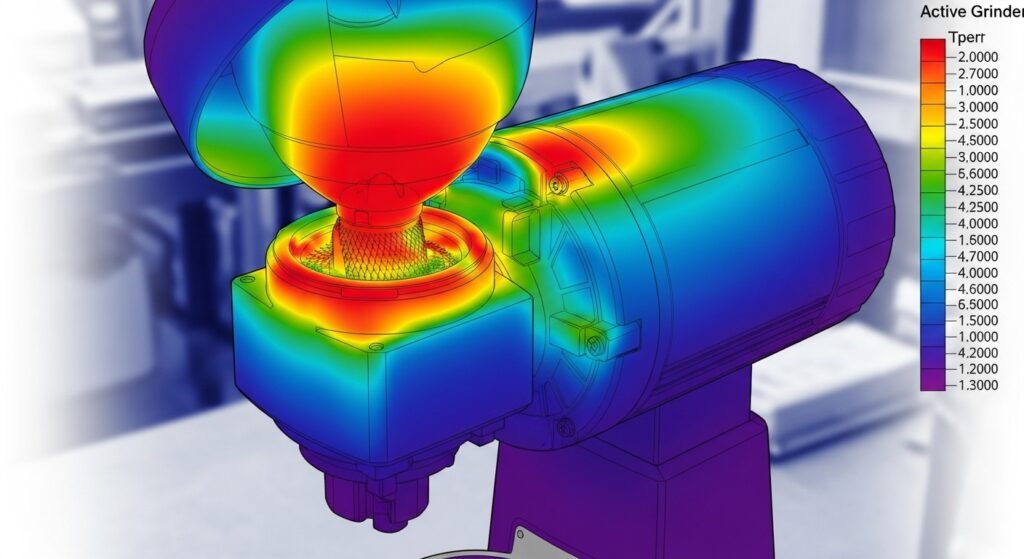
Grinding is a high-friction activity. As the burrs spin, they generate heat. If you are grinding for a Modern Coffee Cocktail Like a Carajillo and you grind a large amount of coffee at once, the burrs will heat up. This heat can actually begin to “cook” the coffee’s volatile oils before the water even touches it, resulting in a flat, “toasted” aroma.
This is why professional-grade grinders have massive burrs and powerful motors that spin at lower RPMs (Revolutions Per Minute). They are designed to move a lot of coffee quickly without raising the temperature. If you are a home brewer, you can mitigate this by Cleaning Your Grinder Regularly to Remove Rancid Oils which can act as a sticky thermal bridge between the burrs and the fresh beans.
Static and Retention: The Ghost in the Machine
Have you ever noticed your coffee grounds clinging to the side of the container or flying across the counter? This is static electricity, caused by the friction of the grinding process. Static is particularly aggressive when using Very Dry, High-Altitude Beans . A simple trick is “RDT” (Ross Droplet Technique)—adding a single drop of water to the beans before grinding to neutralize the charge.
Retention is another technical challenge. This is the amount of “old” coffee that stays inside the grinder after you finish. If your grinder has 2 grams of retention, your morning cup will contain 2 grams of stale coffee from yesterday. This is why “Zero Retention” grinders are so popular in the specialty world; they ensure that what you put in is exactly what you get out, preserving the Integrity of Your Carefully Chosen Water and Mineral Balance .
Conclusion: The First Step in the Chain
We often think of brewing as the most important step, but the grinder is the gatekeeper of quality. It is the bridge between the agricultural miracle of the bean and the chemical extraction of the liquid. If the bridge is broken, the flavor cannot cross.
By Applying This Technical Understanding of Grind Geometry to Your Routine , you gain control over the most chaotic variable in coffee. You stop guessing why your coffee tastes different every day and start understanding how particle size, heat, and uniformity dictate the experience.
Don’t settle for “chopped” coffee. Respect the geometry of the bean, invest in the precision of the burr, and watch as the hidden sweetness and clarity of your favorite origins finally come into focus.

Brown Christopher is 47 years old and has been passionate about coffee since he was 15. For more than three decades, he has explored coffee culture, brewing methods, and the flavors behind every cup. Through this blog, he shares simple tips and knowledge to help beginners better understand and enjoy coffee in their daily lives. ☕