
In the history of coffee invention, most iconic brewers were created by chemists, artists, or engineers with a background in aesthetics. The AeroPress, however, was born from the mind of Alan Adler, an inventor and Stanford lecturer who also created the Aerobie—a record-breaking flying disc. Released in 2005, the AeroPress was designed with a single goal: to make a single, high-quality cup of coffee that was fast and free of bitterness. What Adler didn’t realize at the time was that he had created the most versatile coffee tool in existence, a device so flexible that it now has its own world championship.
The AeroPress is often misunderstood as a “portable espresso maker” or a “glorified French Press,” but it is actually a category of its own. It combines immersion brewing, pressure-assisted filtration, and speed into one lightweight package. When you Understand How High-Altitude Bean Density Resists Extraction , you realize that the AeroPress is one of the few manual tools that gives you the physical force needed to “punch through” that density and extract the deep sweetness within.
The Physics of Air Pressure
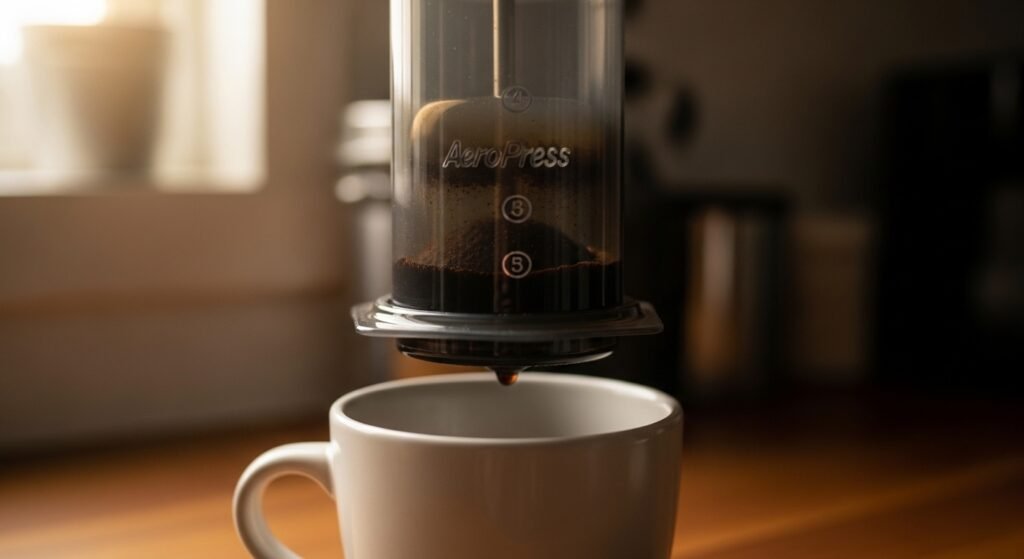
The core of the AeroPress is its “plunger” system. Unlike a French Press, which uses a metal mesh to push the grounds down through the liquid, the AeroPress uses a cushion of air to push the liquid through a fine paper filter. This creates several unique chemical advantages:
-
Low Acidity: Because the contact time is short (often less than two minutes), the water doesn’t have time to pull out the heavier, more acidic compounds that can cause stomach irritation.
-
Pressure Extraction: While not reaching the 9 bars of an espresso machine, the pressure of the AeroPress (about 0.3 to 0.5 bars) is enough to force the water through the coffee cells more efficiently than gravity alone.
-
Total Clarity: The paper filter traps the “fines” and oils that would normally make a full-immersion brew taste “muddy.” This clarity is essential when Identifying the Subtle Bergamot and Jasmine Notes in a Washed African Coffee .
The Two Methods: Standard vs. Inverted
The AeroPress community is famously divided into two camps: those who brew the “Standard” way and those who use the “Inverted” method.
-
The Standard Method: You place the AeroPress on top of the cup, add coffee and water, and insert the plunger. This allows some coffee to drip through prematurely. Adler intended this to create a cleaner, faster cup.
-
The Inverted Method: You turn the device upside down, so the plunger is at the bottom. This turns the AeroPress into a total immersion brewer, allowing you to control the steep time perfectly without any “leakage.” This method is favored by those who want to Analyze the Science of Aftertaste and How It Develops Over a Longer Steep .
Both methods require a Clean and Calibrated Burr Grinder to Ensure a Uniform Medium-Fine Grind . If your grind is too coarse, the pressure won’t build; if it’s too fine, you’ll find it impossible to push the plunger down.
Temperature and Agitation: Breaking the Rules
Alan Adler originally recommended using water at exactly $80^{\circ}C$ ($175^{\circ}F$), which is much lower than the industry standard of $93^{\circ}C$. His reasoning was that lower temperatures reduce the extraction of bitter tannins. While this works beautifully for dark roasts, many specialty enthusiasts prefer Using Higher Temperatures to Extract the Complex Minerals in Dense Mountain Beans .
Agitation (stirring) is another powerful variable. Because the AeroPress is a small-volume brewer, a quick stir can radically increase the extraction rate. This is why Dialing-In an AeroPress Recipe Requires Extreme Consistency in Your Stirring Technique . Even three extra stirs can change a sweet cup into an over-extracted one.
The AeroPress as an Espresso Concentrate
While it isn’t “true” espresso, the AeroPress can produce a highly concentrated coffee that mimics the intensity of a shot. By using a very small amount of water (e.g., 50g water to 18g coffee) and a fine grind, you create a base that is perfect for milk-based drinks or for making a Modern Coffee Cocktail Like a Carajillo When You Don’t Have an Espresso Machine .
This concentrate also highlights the Mineral Balance of Your Brewing Water . Because the water-to-coffee ratio is so tight, any imbalance in your magnesium or bicarbonate levels will be magnified in the final cup.
[Image showing a concentrated ‘Aero-Shot’ being poured into a glass of ice and liqueur]
Maintenance: The “Indestructible” Brewer
One of the greatest appeals of the AeroPress is its durability. Made of BPA-free polypropylene, it is virtually indestructible—making it the king of travel brewing. However, maintenance is still vital. The rubber seal (the plunger head) will eventually lose its flexibility if Not Cleaned Properly to Remove Polymerized Coffee Oils .
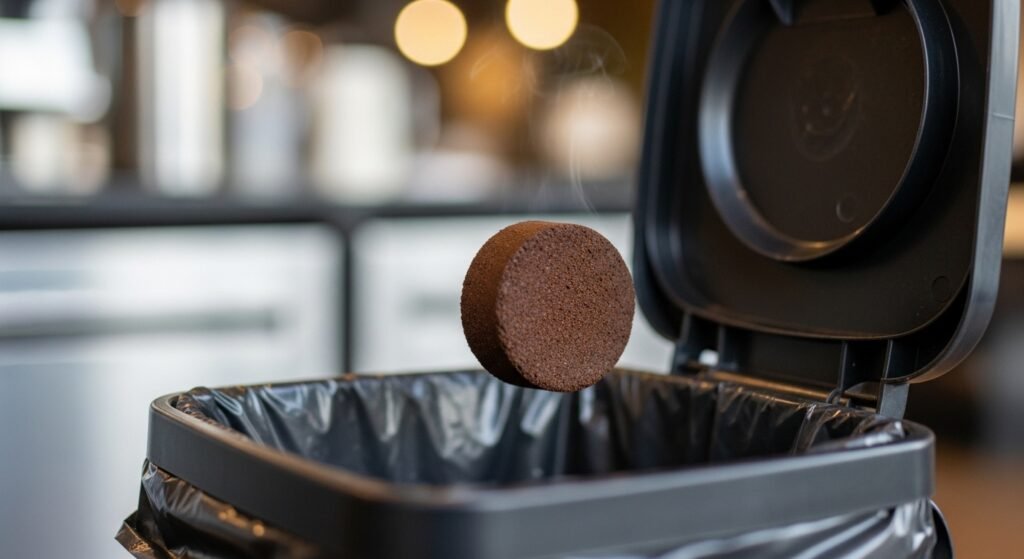
Always eject the “puck” of coffee immediately after brewing to release the tension on the seal. If you leave it compressed, the rubber will flatten over time, causing air leaks and a loss of pressure.
Why It Won the World’s Heart
The AeroPress became a global phenomenon because it removed the barrier to entry for great coffee. You don’t need a thousand-dollar machine or a delicate glass Chemex that might break in your suitcase. You only need the device, a Good Quality Water Source , and the willingness to experiment.
The “World AeroPress Championship” (WAC) is a testament to this versatility. Each year, the winning recipe is completely different—sometimes using huge amounts of coffee with low temperatures, sometimes using bypass water, and sometimes using multiple filters. It proves that there is no “correct” way to use an AeroPress; there is only the way that Highlights the Sweetest Possible Aftertaste for Your Specific Palate .
Conclusion: The Ultimate Tool for the Curious Palate
The AeroPress is more than just a coffee maker; it is a laboratory in your hand. It invites you to change one variable at a time—time, temperature, pressure, or grind—until you find the perfect expression of the bean. It is a tool that respects the Technical Complexity of High-Altitude Farming while remaining accessible to the average home brewer.
Whether you are camping in the mountains of Brazil or sitting in a high-rise in London, the AeroPress provides a bridge between convenience and specialty excellence. It is the paradox that works: a simple plastic tube that produces some of the most complex cups of coffee in the world.

Brown Christopher is 47 years old and has been passionate about coffee since he was 15. For more than three decades, he has explored coffee culture, brewing methods, and the flavors behind every cup. Through this blog, he shares simple tips and knowledge to help beginners better understand and enjoy coffee in their daily lives. ☕