
In the history of coffee equipment, few devices have sparked as much creativity as the AeroPress. Invented in 2005 by Alan Adler—a Stanford lecturer and engineer who also designed the Aerobie flying disc—the AeroPress was a radical departure from traditional brewers. It is a hybrid device that combines the full-immersion characteristics of a French Press with the pressure and paper filtration of an espresso machine.
Because the AeroPress is essentially a syringe for coffee, it allows the brewer to manipulate variables that are usually fixed. You can change the pressure, the orientation of the device, and even the filter material. To master it, you must apply the same Technical Rigor Used in Calibrating Professional Espresso Machines , while respecting the Biological Complexity of High-Altitude Beans .
Standard vs. Inverted: The Battle of Methods
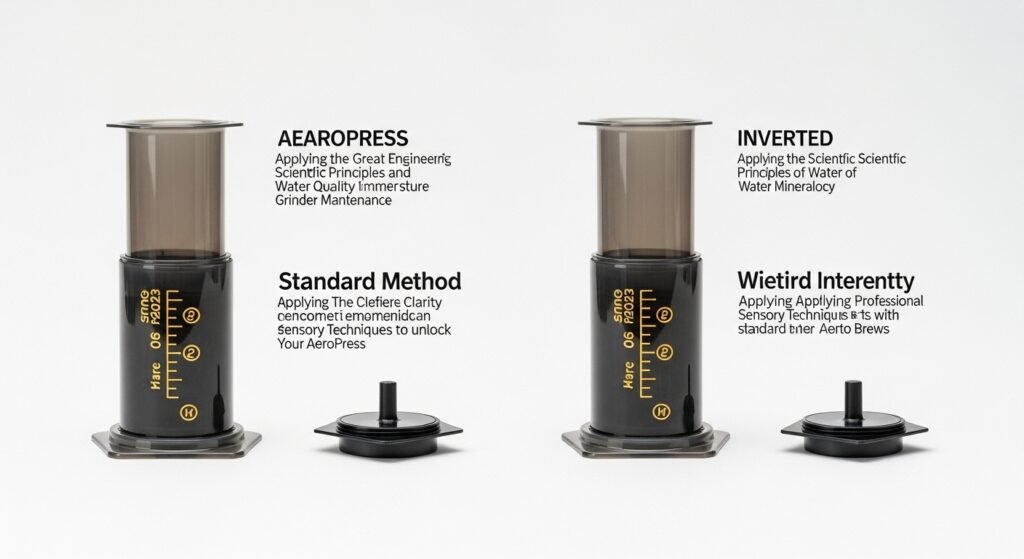
The AeroPress community is divided into two schools of thought: the Standard Method and the Inverted Method.
-
The Standard Method: The device sits on top of the cup, and water is poured over the grounds. Some water inevitably drips through before the plunger is inserted. This method favors clarity and is excellent for Highlighting the Delicate Floral Notes of Kenyan or Ethiopian Coffees .
-
The Inverted Method: The device is turned upside down, ensuring no water escapes until you are ready to plunge. This is a full-immersion technique that results in a heavier body and more intense sweetness. It is the preferred method for those who want to Analyze the Science of Aftertaste and Syrupy Mouthfeel .
Regardless of the method, the final “hiss” of air at the end of the plunge is a signal of completion. However, many professional competitors stop just before the hiss to avoid pushing out the final, more bitter oils that can settle at the bottom of the puck.
The Variable of Pressure: Manual Fluid Dynamics
Unlike a Moka Pot or an Espresso machine, the pressure in an AeroPress is generated by your own body weight. The amount of force you apply dictates the flow rate through the paper filter.
If you press too hard, you create “channeling,” where the water finds a weak spot in the coffee bed and bypasses the grounds. If you press too lightly, the water stays in contact with the coffee too long, leading to over-extraction. This balance is especially sensitive to Water Quality and Mineral Concentration ; if your water has a high mineral content, the extraction happens faster, and you must adjust your plunge speed accordingly.
Grind Size: The Versatility of the Syringe
One of the AeroPress’s greatest strengths is that it can work with almost any grind size.
-
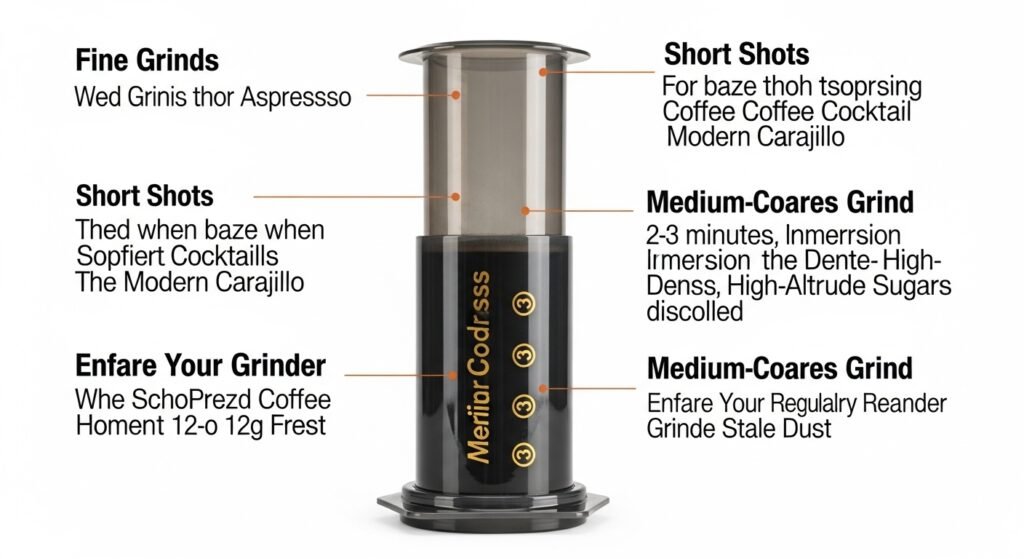
Fine Grind: Used for “short shots” that mimic espresso. This is ideal when creating the base for a Sophisticated Coffee Cocktail like the Modern Carajillo .
-
Medium-Coarse Grind: Used for longer, filter-style brews. This requires a longer immersion time (2 to 3 minutes) to ensure the Dense, High-Altitude Sugars are fully dissolved.
To maintain consistency, you must Ensure Your Grinder is Regularly Cleaned and Free of Stale Dust . Because the AeroPress uses such a small amount of coffee (usually 12g to 18g), even a single gram of “old” coffee from a previous day will noticeably taint the flavor profile.
Temperature Control: The 80°C Paradox
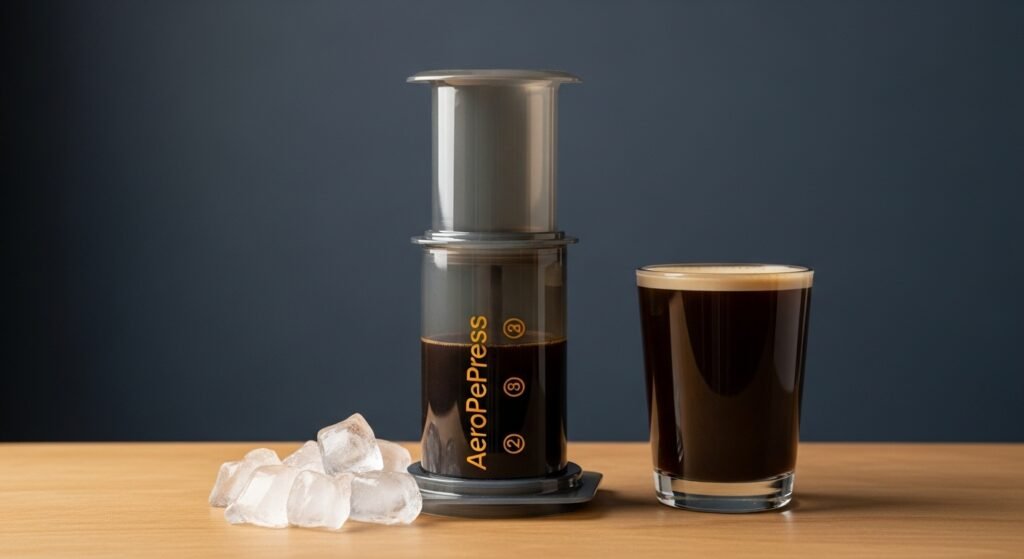
One of the most controversial aspects of Alan Adler’s original instructions was the recommendation to use water at $80^{\circ}C$. While specialty coffee is usually brewed at $92^{\circ}C$ to $96^{\circ}C$, the AeroPress’s unique pressure-agitation combination allows it to extract sweetness at lower temperatures.
Lower temperatures help to avoid the extraction of bitter polyphenols, which is why AeroPress brews are often described as exceptionally smooth. This makes it a perfect tool for Hosting a Home Cupping Session for beginners, as it removes the “harshness” that can sometimes distract an untrained palate from detecting subtle fruit notes.
Maintenance: Protecting the Seal
The AeroPress is virtually indestructible, but its performance depends entirely on the rubber seal (the plunger). Over time, coffee oils and heat can cause the rubber to lose its elasticity.
-
Storage Tip: Always store your AeroPress with the plunger pushed all the way through the chamber. This prevents the seal from being compressed and deformed over time.
-
Cleaning Tip: While the device is “self-cleaning” (the plunger wipes the chamber as you press), you should still Regularly Disassemble and Deep-Clean the Cap and Plunger to remove the buildup of microscopic oils that can eventually turn rancid.
Terroir and the AeroPress: What to Brew?
Because the AeroPress is a high-clarity immersion brewer, it is the ultimate tool for exploring “clean” terroirs.
-
Washed Central Americans: The AeroPress excels at highlighting the crisp, malic acidity of coffees from Guatemala or Honduras.
-
African Naturals: Using the Inverted Method, you can extract a “fruit bomb” quality from Ethiopian Natural Processed Beans that tastes like blueberry jam.
-
Experimental Lots: The rapid extraction of the AeroPress is perfect for Testing Anaerobic Fermentation Samples , as it allows you to taste the “funky” fermentation notes without them becoming overwhelming.
Conclusion: The Ultimate Coffee Swiss Army Knife
The AeroPress is a reminder that great engineering doesn’t have to be complicated. It empowers the user to become a scientist in their own kitchen, experimenting with Water Mineralogy , pressure, and time.
By Applying Professional Sensory Techniques to Your AeroPress Brews , you can unlock profiles that are impossible to achieve with a standard drip machine. It is the perfect travel companion, the perfect experiment station, and a testament to the fact that the most important part of any brewing system is the curiosity of the person pressing the plunger.
Ready to plunge into the laboratory? Experiment with your pressure, watch your temperature, and let the AeroPress reveal the hidden potential of your beans.

Brown Christopher is 47 years old and has been passionate about coffee since he was 15. For more than three decades, he has explored coffee culture, brewing methods, and the flavors behind every cup. Through this blog, he shares simple tips and knowledge to help beginners better understand and enjoy coffee in their daily lives. ☕