
In the world of specialty coffee, the “God Shot”—that elusive, perfectly balanced espresso—is not the result of luck. It is the result of a rigorous scientific method known as “dialing in.” Unlike filter coffee, where gravity does most of the work, espresso is an extreme extraction method. By forcing Precisely Mineralized Water through a compacted puck of coffee at 9 bars of pressure, we are accelerating chemical reactions that usually take minutes into just 25 to 30 seconds.
Because espresso is so concentrated, even the smallest error is magnified. A difference of 0.5 grams of coffee or a half-millimeter change in grind size can be the difference between a sour, undrinkable liquid and a syrupy masterpiece. To succeed, you must Understand How High-Altitude Bean Density Impacts Pressure Resistance and apply a systematic approach to variables.
The Holy Trinity of Variables: Dose, Yield, and Time
To calibrate espresso, you must control three primary variables. In the specialty industry, we use a “recipe” based on weight rather than volume, as the crema (foam) can be misleading.
-
The Dose (In): The amount of dry ground coffee you put into the portafilter basket. Typically, this is between 18g and 20g for a double shot.
-
The Yield (Out): The weight of the liquid espresso in the cup. A standard ratio is 1:2 (e.g., 18g of coffee producing 36g of espresso).
-
The Time: The duration of the extraction, from the moment you start the pump to the moment you reach your target yield. The target is usually 25 to 32 seconds.
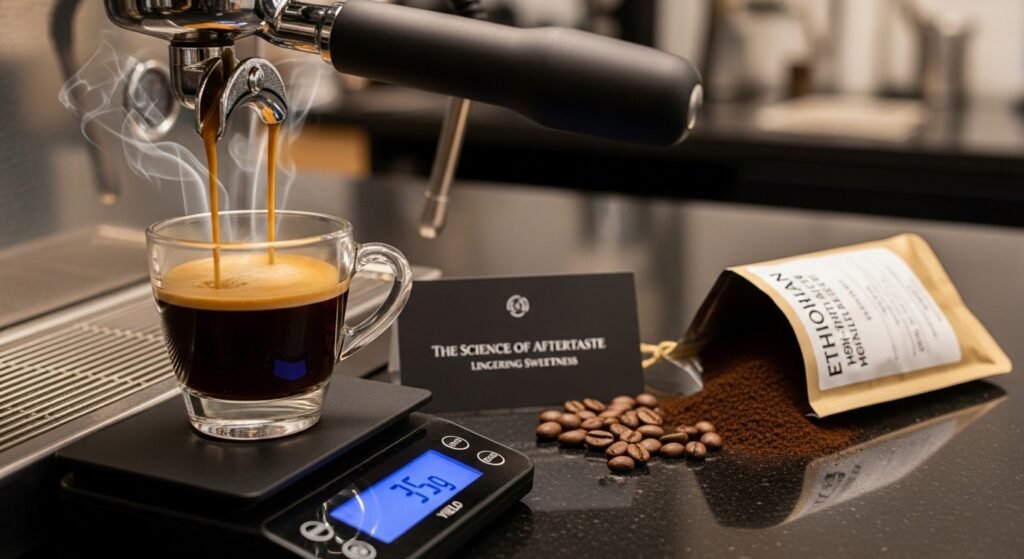
If you are Using a Dense, High-Altitude Coffee from Ethiopia , you may find that you need a longer time or a higher yield to fully extract the complex sugars. If you don’t calibrate correctly, you will lose the Science of Aftertaste and the Lingering Sweetness that defines high-end beans.
Step 1: Establishing the Baseline
Before you start, you must Ensure Your Grinder is Free of Residual Dust from Previous Roasts . Start with a “standard” grind setting.
-
The Test: Pull a shot using 18g in and aiming for 36g out.
-
The Result: If the 36g is reached in 15 seconds, the grind is too coarse. If it takes 45 seconds or only drips slowly, the grind is too fine.
Step 2: The Flavor Compass (Fixing the Shot)
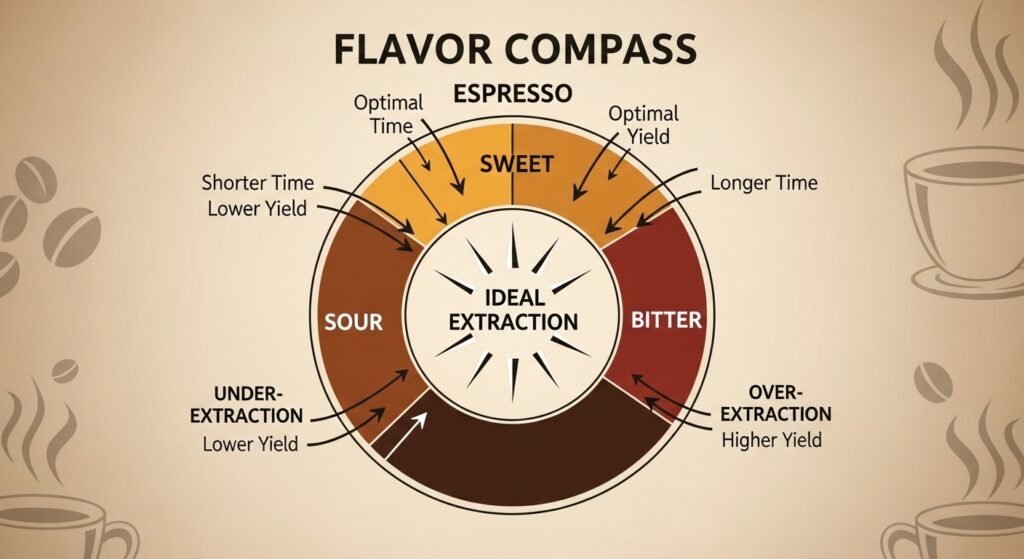
Once you have a shot that lands in the 25-30 second window, you must taste it. This is where Your Sensory Training and Palate Calibration become your most important tools.
-
If it tastes Sour and Salty: The coffee is under-extracted. The water passed through too quickly to pull out the sugars. Solution: Grind finer to increase resistance, or increase the water temperature.
-
If it tastes Bitter and Dry (Astringent): The coffee is over-extracted. The water sat in contact with the grounds for too long, pulling out tannins. Solution: Grind coarser or decrease the yield.
-
If it tastes Sweet and Balanced: You have found the “Sweet Spot.” This is where the acidity is bright like fruit, but balanced by a rich, caramel-like finish.
The Invisible Variable: Temperature and Water Chemistry
Even with the perfect grind, your espresso can fail if your water isn’t right. Espresso machines are susceptible to temperature “surfing.” If your machine isn’t thermally stable, the first shot might be $90^{\circ}C$ and the second $95^{\circ}C$, leading to inconsistent results.
Furthermore, because espresso is a high-concentration extraction, the Mineral Balance in Your Water (Magnesium and Calcium) acts as the chemical “hand” that reaches into the coffee cells. If your water is too soft, the espresso will lack body; if it is too hard, it will taste “muddy” and mask the Floral Aromatics of a High-Altitude Bean .
Troubleshooting Channeling and Distribution
If your shot looks “spattery” or flows unevenly from the bottomless portafilter, you are experiencing channeling. This happens when the water finds a crack or a weak spot in the coffee puck.
To prevent this, you must use a distribution tool or the “WDT” method (using needles to break up clumps). Clumps are often caused by static or by Poorly Maintained Grinder Burrs . If the puck isn’t perfectly uniform, the water will over-extract the channel and under-extract the rest of the puck, leaving you with a shot that is simultaneously sour and bitter—the worst of both worlds.
Calibrating for Milk and Cocktails
If you are using your espresso as a base for a Sophisticated Modern Carajillo , you may want to “calibrate” differently. For cocktails, a “Ristretto” (a shorter 1:1.5 ratio) often works better. The higher concentration of oils and solids ensures the coffee flavor isn’t “drowned out” by the liqueur’s sugars, preserving the Intense Science of Aftertaste.
The Daily Calibration: Dealing with Humidity
Coffee is hygroscopic, meaning it absorbs moisture from the air. On a rainy day, the beans will expand, requiring you to grind slightly coarser. On a very dry day, you may need to grind finer. This is why professional baristas “re-dial” their machines several times a day. If you Apply This Level of Attention to Your Home Ritual , you will ensure that every bag of coffee you buy is used to its full potential.
Conclusion: The Precision of Pleasure
Dialing in is the bridge between the science of the lab and the art of the cafe. It requires patience, a keen palate, and a deep understanding of Equipment Maintenance and Hygiene . While it may seem tedious at first, once you taste the difference that a 1-second adjustment can make, you will never look at espresso the same way again.
By Respecting the Technical Variables of the Espresso Puck , you are honoring the work of the farmers at High Altitudes who produced those complex chemical precursors. You are the final link in the chain, and calibration is how you ensure that chain remains unbroken.
Are you ready to pull your next shot? Weigh your dose, watch your timer, and trust your palate.

Brown Christopher is 47 years old and has been passionate about coffee since he was 15. For more than three decades, he has explored coffee culture, brewing methods, and the flavors behind every cup. Through this blog, he shares simple tips and knowledge to help beginners better understand and enjoy coffee in their daily lives. ☕