
When we discuss the recipe for a perfect cup of coffee, we often spend hours analyzing the Biological Density of High-Altitude Beans or the precise micron size of our grind. However, we frequently overlook the fact that a standard cup of specialty coffee is composed of approximately 98% to 99% water. In an espresso, that figure is still a staggering 90% to 92%.
Water is not just a base; it is the solvent. Its chemical composition determines which flavors are extracted from the bean and which are left behind. If your water is out of balance, even the most expensive Heirloom Beans from Ethiopia or Kenya will taste flat, metallic, or unpleasantly bitter. To master coffee, you must first master the chemistry of your water.
The Chemistry of Extraction: Magnesium, Calcium, and Sodium
Not all water is created equal. Distilled water, for example, is a terrible solvent for coffee. Because it lacks minerals, it is chemically “empty” and aggressive, often leading to a sharp, sour, and hollow extraction. On the other hand, water that is too “hard” (full of minerals) is already saturated and cannot “pick up” the flavors from the coffee grounds effectively.
The three key players in coffee extraction are:
-
Magnesium ($Mg^{2+}$): This is the “heavy lifter” of coffee chemistry. Magnesium ions are small and have a high charge density, making them excellent at pulling out complex, fruity, and high-energy flavor compounds.
-
Calcium ($Ca^{2+}$): While not as aggressive as magnesium, calcium helps extract creamy textures and heavier notes like chocolate and nuts. However, too much calcium leads to limescale buildup in your machines.
-
Sodium ($Na^{+}$): In small amounts, sodium can enhance sweetness and balance bitterness. In high amounts, it makes coffee taste salty and “dead.”
By Evaluating the Science of Aftertaste and Mineral Interaction , we realize that the “brightness” of a coffee is often a direct result of the magnesium-to-calcium ratio in the brewing water.

Buffer and Alkalinity: The Acid Balance
Beyond extraction, water acts as a buffer. Coffee is naturally acidic ($pH$ around 5). Water contains bicarbonates ($KH$), which act as an “antacid.”
-
Low Alkalinity: If your water has very few bicarbonates, the natural acids in the coffee will dominate. This leads to a cup that is “vinegary” or unpleasantly sharp.
-
High Alkalinity: If your water is high in bicarbonates, it will neutralize all the beautiful phosphoric and malic acids. This results in a “flat,” chalky, or “earthy” cup that lacks any vibrancy.
This is why water from the tap in many cities produces “boring” coffee; the high bicarbonate levels designed to protect city pipes are unfortunately destroying the delicate flavor profile of your beans.
The Impact on Equipment: Limescale and Corrosion
From a technical maintenance perspective, water quality is the difference between a machine that lasts 20 years and one that dies in 2.
When hard water is heated inside a boiler, the calcium and magnesium minerals precipitate out of the liquid and form limescale (calcium carbonate). This scale acts as an insulator, making your heating elements work harder and eventually clogging the narrow pipes of an espresso machine. To prevent this, Strict Maintenance and the Use of Scale-Inhibiting Filters are mandatory.
However, there is a danger in going too far. “Aggressive” water (water that is too soft or has a low $pH$) can actually corrode the copper and brass internal components of professional equipment. The goal is “balanced” water: mineralized enough for flavor and machine safety, but soft enough to prevent scale.
Filtration Systems: From Pitchers to Reverse Osmosis
How do you achieve this balance at home? There are four main levels of water treatment for coffee enthusiasts:
-
Carbon Filtration (Pitchers): These are great for removing chlorine and bad odors but do very little to change the mineral content (hardness).
-
Ion-Exchange Filters: These specifically target calcium and magnesium, replacing them with sodium or hydrogen. They are excellent for preventing limescale but can drastically shift the $pH$ of your water.
-
Remineralized Distilled Water: A favorite of the “Third Wave” movement. You start with pure distilled water and add specific packets of minerals (like Third Wave Water) to reach the exact SCA (Specialty Coffee Association) specifications.
-
Reverse Osmosis (RO) with Bypass: The gold standard for cafes. An RO system strips the water of everything, and then a “bypass” valve blends a small amount of filtered tap water back in to achieve the desired mineral count.

Tasting the Difference: The “Water Cupping”
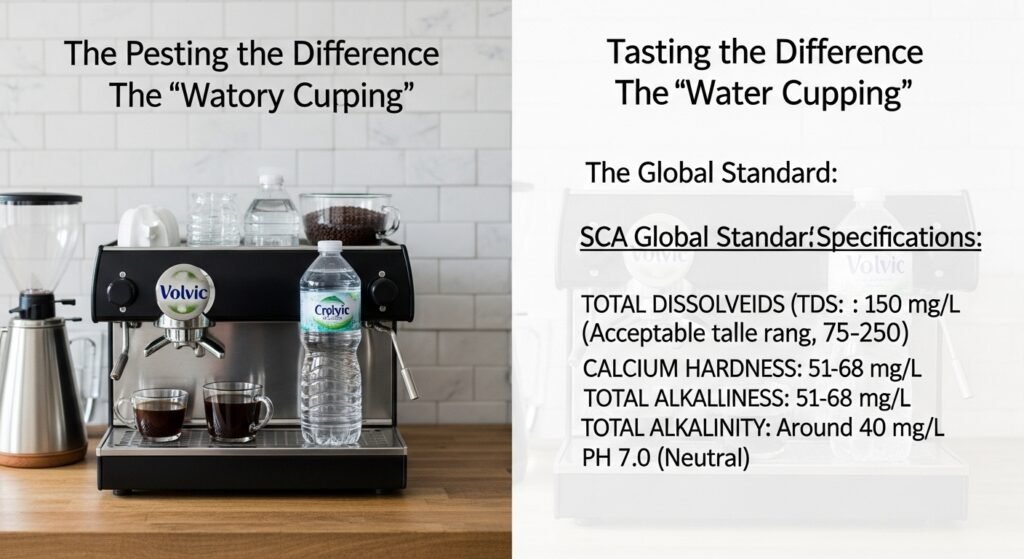
If you are skeptical about the impact of water, try a simple experiment. Brew the same coffee twice using the same grind and temperature, but use two different waters: one from the tap and one high-quality bottled water (like Volvic or Crystal Geyser).
When you Perform This Side-by-Side Sensory Analysis , pay attention to the “clarity.” Tap water often masks the individual notes, making the coffee taste like “just coffee.” The optimized water will allow the specific fruit or floral notes of the terroir to shine through with a clean, lingering finish.
The Global Standard: SCA Water Specifications
The Specialty Coffee Association has defined what “ideal” brewing water looks like. While difficult to achieve without a lab, these numbers provide a target:
-
Total Dissolved Solids (TDS): 150 mg/L (Acceptable range 75-250)
-
Calcium Hardness: 51-68 mg/L
-
Total Alkalinity: Around 40 mg/L
-
pH: 7.0 (Neutral)
Maintaining these standards ensures that whether you are in Tokyo, London, or Brazil, the Technical Calibration of Your Espresso remains consistent with the roaster’s intent.
Conclusion: Don’t Let Your Water Drown Your Coffee
We invest so much in high-end grinders, precision scales, and ethically sourced beans. It is a disservice to those efforts to use water that actively works against the extraction. By understanding the relationship between minerals, buffers, and $pH$, you transition from being a “maker of coffee” to an “architect of flavor.”
Treat your water with the same respect you treat your beans. Use a filter, test your local hardness, and experiment with mineral additions. Your palate—and your expensive equipment—will thank you. The next time you take a sip of a particularly vibrant, sweet cup, remember: you aren’t just tasting the coffee; you are tasting the chemistry of the water that brought it to life.

Brown Christopher is 47 years old and has been passionate about coffee since he was 15. For more than three decades, he has explored coffee culture, brewing methods, and the flavors behind every cup. Through this blog, he shares simple tips and knowledge to help beginners better understand and enjoy coffee in their daily lives. ☕