
In the world of specialty coffee, the word “recipe” is often a misnomer. Unlike baking, where 500g of flour always yields the same result, coffee is a biological product that changes daily. Factors such as humidity, the age of the beans, and even the mean that a recipe that worked yesterday may produce a sour or bitter cup today.
Dialing-in is the technical process of adjusting your variables—dose, yield, time, and temperature—to find the “sweet spot” of extraction for a specific bean. This is where the meets the physics of fluid dynamics. Without a proper calibration, even the most expensive African Heirloom Coffee will fail to reach its potential.
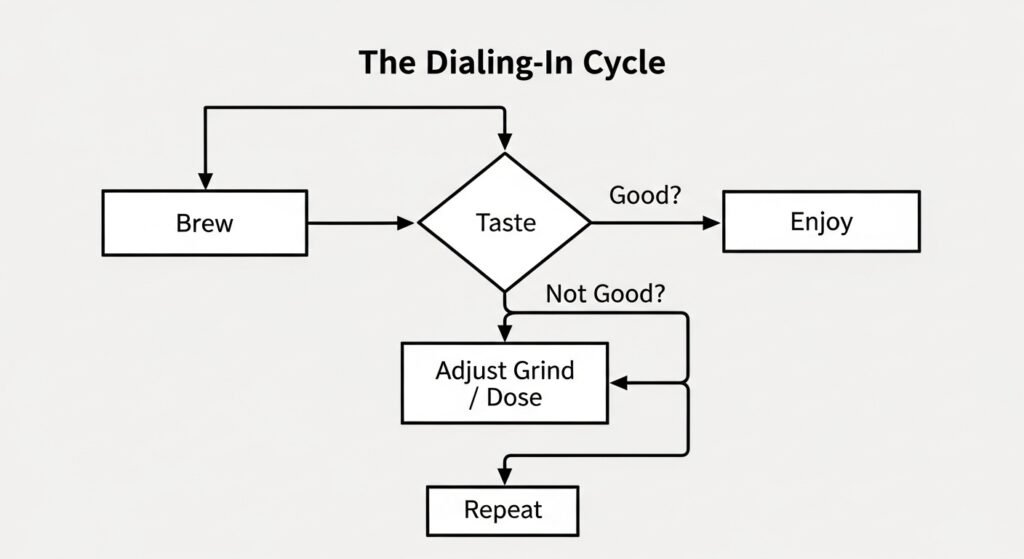
of Espresso Calibration
To calibrate effectively, you must understand the relationship between four key variables. Changing one will inevitably affect the others.
1. The Dose (Input)
This is the amount of dry coffee grounds in your portafilter. For modern specialty espresso, this usually ranges from 18g to 22g. A higher dose provides more body but requires a more to avoid under-extraction.
2. The Yield (Output)
This is the total weight of the liquid espresso in the cup. The standard specialty ratio is 1:2 (e.g., 18g in, 36g out). If you want to emphasize the , you might increase the yield to 1:2.5 to pull out more brightness.
3. Brew Time
Time is a result of the resistance created by the coffee puck. Most specialty recipes aim for a contact time of 25 to 32 seconds. If the water flows too fast, the coffee will be sour; if too slow, it will be bitter and dry.
4. Temperature
Temperature acts as a catalyst. Hotter water ($94^{\circ}C – 96^{\circ}C$) increases extraction speed, which is necessary for . Darker roasts usually require cooler water ($90^{\circ}C – 92^{\circ}C$) to prevent burning the delicate oils.
Step-by-Step Calibration: The Professional Workflow
Before you begin, ensure your . Stale coffee trapped in the burrs will provide false sensory data, leading you to make the wrong adjustments.
Phase 1: Setting the Baseline
Choose a starting point. Let’s use the 18g in, 36g out ratio. Set your grinder to what you perceive as a “medium-fine” setting and pull a shot.
Phase 2: Analyzing the Flow and Time
-
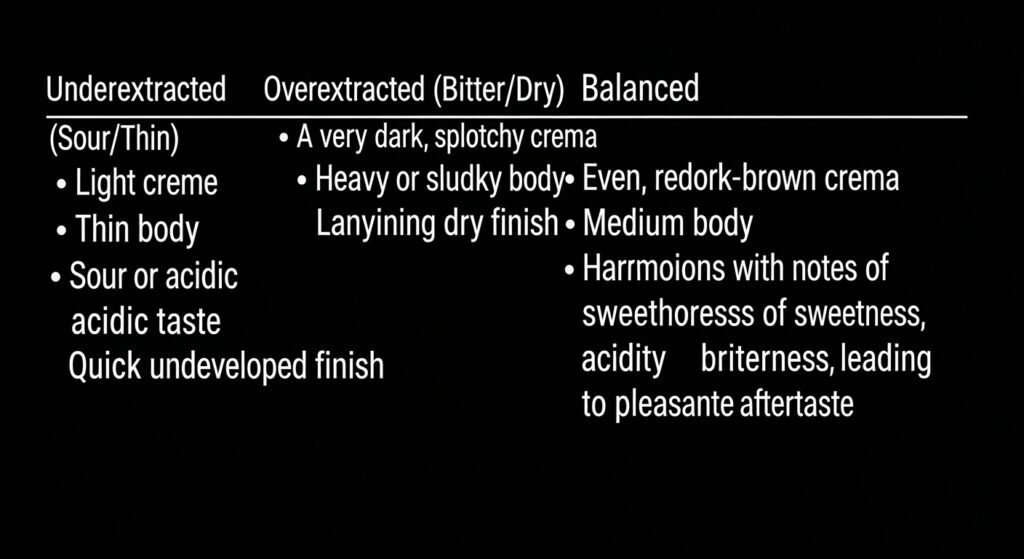
The Shot is too fast (Under 20 seconds): The water is finding too little resistance. This results in “Under-extraction.” The flavor will be sharp, salty, and sour. You need to grind finer.
-
The Shot is too slow (Over 40 seconds): The water is struggling to pass through. This results in “Over-extraction.” The flavor will be bitter, ashy, and astringent. You need to grind coarser.
Phase 3: The Sensory Adjustment
Once you hit the 25-30 second window, the real work begins. Use your palate to .
-
If the coffee is balanced but lacks body, try increasing the dose by 0.5g.
-
If it has a great body but is slightly too intense/bitter, try increasing the yield (more water) to “open up” the flavors.
The Impact of Freshness and Degassing
Espresso is sensitive to $CO_2$. Freshly roasted coffee contains a high amount of carbon dioxide, which creates a thick “crema” but can interfere with water contact, causing an uneven extraction.
As beans age, they lose $CO_2$, meaning they offer less resistance. Over a period of two weeks, you will notice that you have to grind finer almost every two days to maintain the same 30-second brew time. This is why is the only way to ensure consistency.
Water Chemistry and Extraction Energy
We cannot discuss calibration without discussing the solvent. If your water is , it will extract too much, too quickly, making the dialing-in process frustrated and inconsistent.
Professional baristas use “Soft” water with a specific magnesium-to-calcium ratio to ensure that the is highlighted rather than masked by metallic or chalky mineral notes.
Distribution and Tamping: The Mechanical Variables
Even if your grind is perfect, poor technique will ruin the shot. Channeling occurs when water finds a path of least resistance through the coffee puck, bypassing the flavor compounds.
-
Distribution: Use a WDT (Weiss Distribution Technique) tool to break up clumps.
-
Tamping: Pressure doesn’t need to be excessive (around 15kg is enough), but it must be level. A slanted tamp will cause one side of the puck to over-extract while the other under-extracts, destroying the .

Conclusion: Calibration as a Daily Ritual
Dialing-in is not a one-time setup; it is a conversation between the barista and the bean. It requires patience, a developed palate, and a commitment to .
By mastering the variables of dose, yield, and time, you move away from luck and toward engineering. You begin to understand why matter so much, as you can finally taste the difference that those factors make in a perfectly calibrated shot. Espresso is a pursuit of perfection that is never truly finished—and that is exactly what makes it so rewarding.

Brown Christopher is 47 years old and has been passionate about coffee since he was 15. For more than three decades, he has explored coffee culture, brewing methods, and the flavors behind every cup. Through this blog, he shares simple tips and knowledge to help beginners better understand and enjoy coffee in their daily lives. ☕