
In the specialty coffee industry, the phrase “High Altitude” is often used as a synonym for quality. You will see it printed on bags from and touted as a primary feature of . But why does the elevation of a farm—measured in (masl)—have such a dramatic impact on the liquid in your cup? The answer lies in a complex intersection of botanical stress, metabolic slowing, and chemical concentration.
Understanding altitude is the key to mastering the and the . As we climb higher into the mountains, the environment forces the Coffea Arabica plant to change its internal chemistry, creating the dense, acidic, and complex beans that market.
1. The Metabolism of Slowness: Why Time Equals Flavor
At lower altitudes, the climate is consistently warm and the air is dense. Under these conditions, coffee cherries ripen quickly. While this is great for mass production, it is detrimental to flavor development. A fast-ripening cherry does not have enough time to synthesize complex sugars and organic acids.
In contrast, high-altitude environments (typically above 1,200 meters) feature cooler temperatures and a significant “diurnal temperature swing”—the difference between hot days and cold nights. This environmental stress slows down the plant’s metabolism.
-
The “Slow-Motion” Ripening: Instead of ripening in 6 months, a high-altitude cherry might take 9 to 11 months to reach maturity.
-
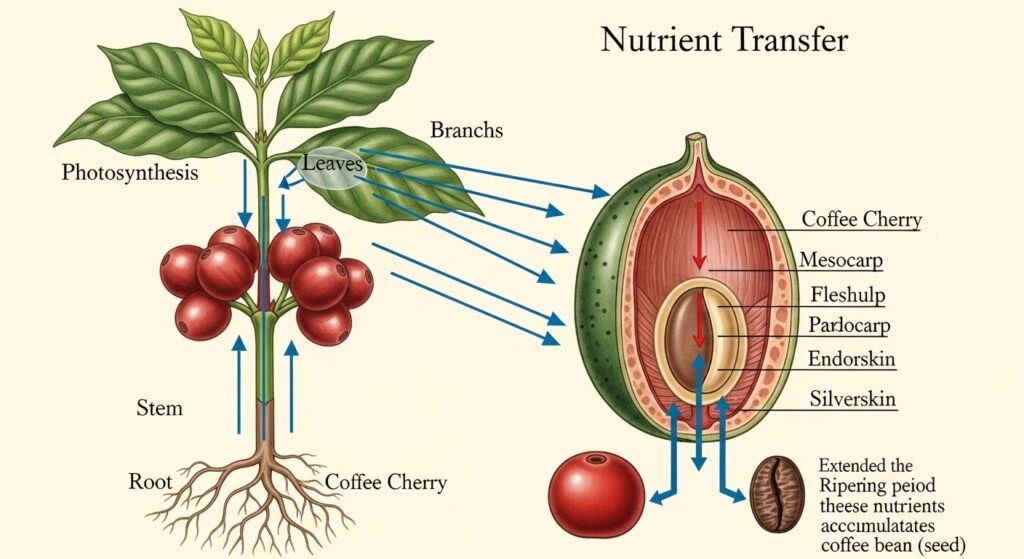
The Sugar Factory: This extended time allows the seed (the coffee bean) to act as a more efficient sponge, absorbing the mucilage’s sugars and transforming them into precursors for the .
2. Physical Density: The Hard Bean (HB) Factor
One of the most measurable effects of altitude is the physical density of the bean. In the trade, high-altitude coffees are often classified as Strictly Hard Bean (SHB) or Strictly High Grown (SHG).
Because the fruit develops slowly in the thin mountain air, the cellular structure of the bean becomes incredibly compact and dense. This density has massive technical implications for the roaster and the barista:
-
Roasting: Dense beans require more heat energy to penetrate the core. A high-altitude bean from can withstand intense roasting temperatures without burning, allowing for a more developed flavor profile.
-
Grinding: These beans are physically harder. If your , the hardness of these beans will cause more wear on the burrs and produce more “fines” (dust), which can ruin the clarity of the cup.
3. The Chemistry of Acidity: The Phosphoric and Citric Zing
High altitude is the primary driver of acidity in coffee. At higher elevations, the plant produces more organic acids as a protective response to the harsher climate and lower oxygen levels.
-
Citric and Malic Acids: These are the “bright” notes that remind us of lemon, orange, or green apple. They are highly concentrated in .
-
Phosphoric Acid: Often found in the volcanic soils of high-altitude Kenya, this acid provides a sparkling, effervescent quality to the Aftertaste.
If you use , these precious mountain acids will be neutralized, leaving the coffee tasting flat and “chalky.” To respect the altitude, you must respect the water.
4. Pest Resistance and Caffeine Concentration
Altitude acts as a natural filter for pests. The coffee berry borer and coffee leaf rust (Hemileia vastatrix) struggle to survive in the cooler temperatures of the high mountains.
Interestingly, caffeine is a natural insecticide produced by the plant to ward off these bugs. Because there are fewer pests at high altitudes, the plant “relaxes” its caffeine production. This is why many high-altitude Arabicas naturally contain less caffeine than low-altitude Robustas, allowing the to shine through without the overwhelming bitterness associated with high caffeine levels.
5. Soil Drainage and Mineral Access
Mountain slopes provide excellent natural drainage. Coffee plants dislike “wet feet”—they need the water to pass through the soil quickly. In high-altitude regions like , the steep terrain ensures that the roots are not suffocated by stagnant water.
This drainage forces the roots to grow deeper into the volcanic or mineral-rich mountain soil, accessing micronutrients that are unavailable on flat, lowland plains. These minerals are the building blocks of the that make mountain coffee so distinct.
6. Technical Brewing Challenges of Mountain Coffee
Because high-altitude beans are so dense and chemically complex, they are more difficult to brew. They do not give up their solubles easily.
-
Temperature: You often need water closer to boiling ($94^{\circ}C – 96^{\circ}C$) to “force” the flavor out of a dense SHB bean.
-
Grind Size: You may need to grind slightly finer than you would for a lowland Brazilian coffee to increase the surface area for extraction.
-
Equipment Care: High-density beans are tougher on equipment. Regular is essential to prevent the accumulation of the dense oils and silverskin (chaff) that these beans produce.

7. The “Cloud Forest” Microclimate
In many high-altitude regions, the coffee is grown in “Cloud Forests.” These are areas where the clouds sit at the level of the coffee trees for part of the day. This provides a natural “shade” that further slows down the ripening process and maintains a high level of humidity without the intense, direct heat of the sun.
This microclimate is what produces the world’s most expensive coffees, such as the Gesha variety from Panama or the . These beans are the ultimate expression of the mountain’s influence on the .
8. Why Altitude is Changing: The Climate Factor
The definition of “High Altitude” is shifting. Due to global warming, the traditional “optimal zones” for coffee are moving higher up the mountains. Areas that used to be too cold for coffee are now becoming prime real estate, while traditional lowland farms are struggling with heat stress and pests.
This evolution means that the future of specialty coffee is literally climbing higher. The technical expertise required to farm at these new heights involves sophisticated , ensuring that the mountain continues to produce the quality we expect.
Conclusion: The Peak of Flavor
Altitude is the architect of specialty coffee. It provides the stress necessary to create density, the time necessary to create sugar, and the environment necessary to create acidity. When you drink a high-altitude coffee, you are tasting the result of a plant struggling and succeeding in a harsh, beautiful environment.
To honor this journey, treat these beans with technical respect. Use Filtered Water, keep your Equipment Spotless, and take the time to . The secrets of the mountain are locked inside the bean; it is your job as the brewer to unlock them.

Brown Christopher is 47 years old and has been passionate about coffee since he was 15. For more than three decades, he has explored coffee culture, brewing methods, and the flavors behind every cup. Through this blog, he shares simple tips and knowledge to help beginners better understand and enjoy coffee in their daily lives. ☕