
In the fundamental world of coffee extraction, there is an ironclad rule: to dissolve the organic compounds, aromatic oils, and soluble solids locked within the bean’s cellular structure, you must apply energy. Historically, this energy has been provided by thermal heat. However, Cold Brew defies this classic thermodynamic logic by removing the heat variable and replacing it with a drastic alternative: Time.
While a Well-Calibrated Espresso uses intense pneumatic pressure and water at $94^{\circ}C$ to achieve extraction in 30 seconds, Cold Brew utilizes room temperature or chilled water and an immersion period that spans anywhere from 12 to 24 hours. This fundamental shift in the physics of extraction alters the chemical profile of the beverage entirely. The result is a sensory experience that minimizes perceived acidity and maximizes natural sweetness and body. Understanding this process is not just about making a cold drink; it is about mastering the molecular behavior of coffee when heat is absent.
1. The Thermodynamics of Cold Extraction
To understand why Cold Brew tastes fundamentally different from hot coffee, we must look at the solubility of specific molecules. Coffee is a complex biological matrix containing hundreds of compounds, including lipids, organic acids, sugars, and alkaloids like caffeine.
Heat acts as a catalyst, accelerating the movement of water molecules and allowing them to break down coffee’s cellular walls quickly. Volatile acids and delicate oils are extracted almost instantly at high temperatures. However, high heat also triggers the oxidation and degradation of certain compounds, such as chlorogenic acids. When exposed to heat for prolonged periods, these acids transform into quinic and caffeic acids, which are responsible for the “burnt” or “harsh” bitterness found in old hot coffee.
In Cold Brew, by eliminating heat, these volatile acids and heavy, bitter oils remain largely trapped within the grounds. Cold water is a much less aggressive solvent. It focuses on extracting the most highly soluble compounds—primarily simple sugars and caffeine—while leaving behind the majority of the sharp citric acidity and astringent tannins. This chemical selectivity results in a beverage that contains up to 60% less titratable acidity than its hot-brewed counterpart.
2. The Critical Importance of Surface Area and Grind Size
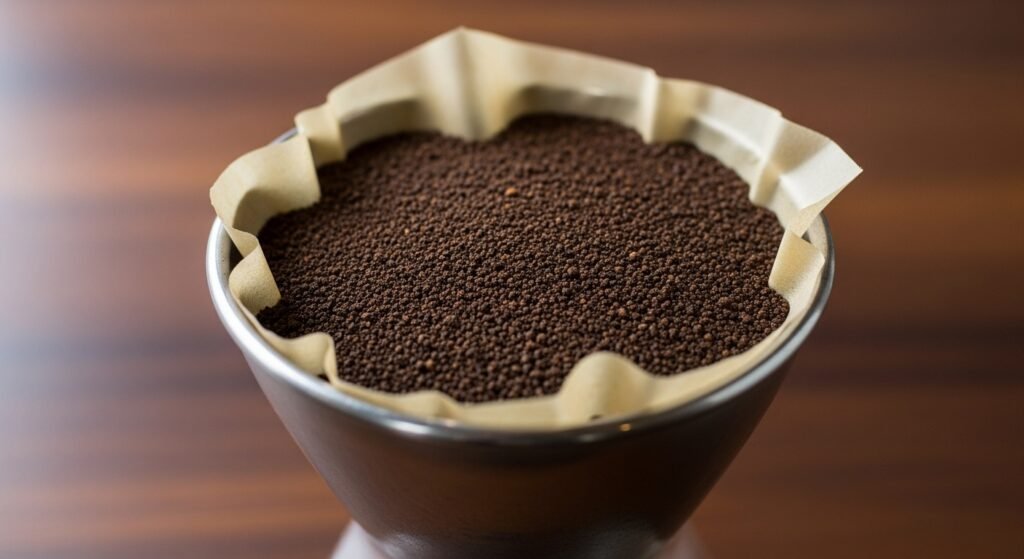
Because cold water is an inefficient solvent, we must compensate for the lack of thermal energy by manipulating the physical state of the coffee. In Cold Brew, the grind size is the most important mechanical variable. It must be extra-coarse, resembling sea salt or cracked peppercorns.
-
The Problem with Fine Grinds: If the grind is too fine, the surface area increases exponentially. During an 18-hour immersion, the water would over-extract every available compound, leading to a muddy, “earthy,” and overwhelmingly bitter brew that lacks clarity.
-
The Resistance of the Bean: Dense, High-Altitude Beans offer more resistance to cold water penetration. This density requires a slightly longer immersion time or a slightly more aggressive grind adjustment compared to softer, low-altitude beans to ensure the water reaches the core of the particles.
3. Water Quality: The Solvent of Long Exposure
In Cold Brew, the water remains in contact with the coffee for a period up to 50 times longer than in a French Press or a pour-over. This means that any chemical imbalance in your Water Quality will be amplified exponentially.
If your water has high levels of chlorine or heavy minerals, the Cold Brew will develop a metallic, medicinal, or chemical taste. Conversely, if the water is excessively soft (distilled or RO without minerals), it will struggle to pull out the complex sugars, resulting in a cup that feels “empty” and lacks a satisfying finish. For a professional-grade Cold Brew, the water must be filtered and possess a specific mineral balance—particularly magnesium and calcium—to favor sweetness over bitterness.
4. The Immersion Timeline: 12, 18, or 24 Hours?
Time is the “engine” of Cold Brew. Managing the immersion window is how a barista controls the strength and clarity of the final product.
-
12 Hours: This produces a lighter, tea-like body. Floral and delicate fruit notes are still perceptible. This is the ideal window for showcasing Bright African Terroirs.
-
18 Hours: The “sweet spot” for most specialty baristas. At this stage, caramelized sweetness reaches its peak, and the body becomes syrupy and chocolate-forward.
-
24 Hours: You enter the zone of over-extraction. The beverage may start to develop “woody,” “papery,” or “musty” flavors due to prolonged oxidation, even at cold temperatures.
5. Concentrate vs. Ready-to-Drink (RTD)
There are two distinct philosophies in Cold Brew production:
-
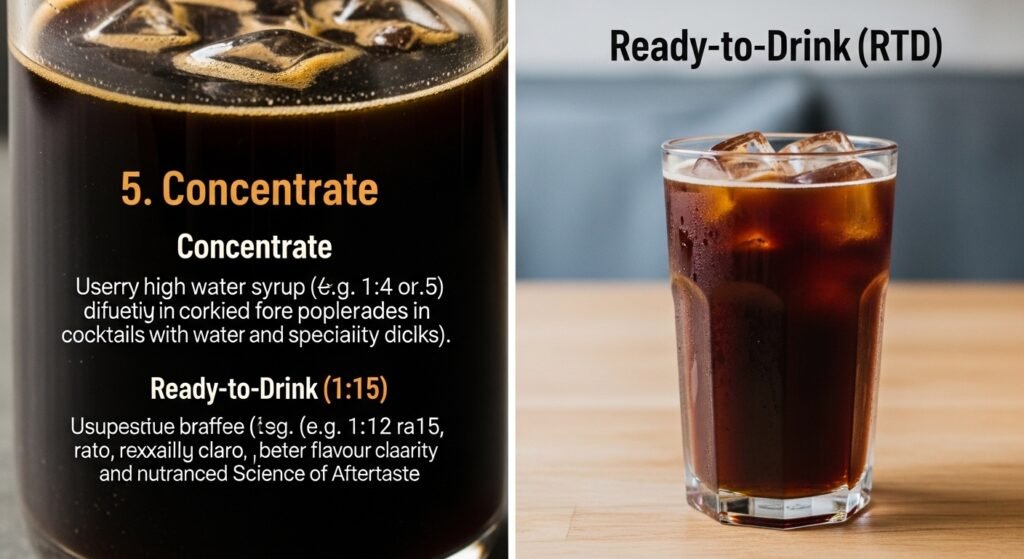
Concentrate: Uses a very high coffee-to-water ratio (e.g., 1:4 or 1:5). The result is a potent coffee syrup that must be diluted with water or milk. This is popular in cafes for its versatility in cocktails and specialty drinks.
-
Ready-to-Drink (RTD): Uses a standard brewing ratio (e.g., 1:12 or 1:15), resulting in a beverage ready for immediate consumption. This method generally offers better flavor clarity and a more nuanced Science of Aftertaste.
The concentrate approach is convenient but requires extreme precision during the final filtration to ensure that the heavy sediment does not ruin the mouthfeel.
6. The Physics of Nitrogen (Nitro Cold Brew)
A fascinating evolution in cold extraction science is the infusion of nitrogen gas. Nitrogen is an insoluble gas in water (unlike $CO_2$). When Cold Brew is served through a specialized “stout tap” under high pressure, the nitrogen creates millions of microscopic bubbles.
This does not change the chemical flavor, but it fundamentally transforms the tactile perception. Nitro Cold Brew features a “cascading” visual effect and a creamy, velvet-like texture. This creaminess tricks the brain into perceiving even higher levels of sweetness without the addition of dairy or sugar. It is the ultimate application of texture and Sensory Perception in the coffee industry.
7. Hygiene and Oxidation: The Invisible Risk
Because Cold Brew is never heated, it does not undergo a “thermal kill step” that would eliminate bacteria. This makes it a sensitive biological product. Furthermore, the long brewing time provides an extended window for oxidation.
It is vital that all equipment—vessels, filters, and valves—are sanitized according to a Strict Maintenance Protocol. Residual coffee oils from previous batches can turn rancid, imparting a “moldy” or “fishy” flavor to the new brew. Professionally made Cold Brew should always be kept refrigerated and consumed within 7 to 10 days to maintain flavor integrity and food safety.
8. Matching Terroir to the Cold Extraction Method
Not all beans are suited for the Cold Brew process.
-
Brazil and Central America: With their natural notes of chocolate, nuts, and brown sugar, these origins are the traditional favorites for Cold Brew. The long immersion amplifies these foundational bass notes.
-
East Africa (Ethiopia/Kenya): These produce exotic, tea-like Cold Brews with flavors of peach and berries. However, they require double-filtration (paper and metal) to maintain clarity. The delicate Profiles of African Coffees can easily be overwhelmed if the immersion time exceeds 16 hours.
9. Cold Brew vs. Iced Coffee: The Chemical Divide
It is a common consumer mistake to use these terms interchangeably, but the chemistry is opposite.
-
Iced Coffee: Is hot coffee brewed quickly and chilled over ice. It retains the vibrant acidity and volatile aromatics of hot coffee but suffers from rapid dilution and quick oxidation.
-
Cold Brew: Is a stable, low-acid, high-body extract that maintains its flavor profile for days. It is a more “engineered” beverage that focuses on sweetness over brightness.
10. The Chemistry of Caffeine in Cold Brew
Many drinkers feel a stronger “buzz” from Cold Brew. This isn’t a myth; it is a result of the coffee-to-water ratio. Because Cold Brew is often brewed as a concentrate or with a higher dry-coffee weight, the caffeine concentration per ounce is significantly higher than in standard drip coffee. Caffeine is highly soluble even in cold water, and the 18-hour contact time ensures that almost all available caffeine is pulled into the solution.
11. Conclusion: Engineering the Perfect Chill
Cold Brew is a testament to the fact that patience can be a powerful technical tool. By removing heat, we invite a different set of chemical reactions to the table—reactions that favor the heavy, the sweet, and the smooth.
To produce a world-class Cold Brew, you must respect the variables: use a Consistent Coarse Grind, prioritize Water Mineral Balance, and maintain Flawless Equipment Hygiene. When you replace the violence of heat with the grace of time, you unlock a side of the coffee bean that is otherwise impossible to see. Whether served over ice or infused with nitrogen, Cold Brew remains the definitive method for those who value body and sweetness above all else.
[Image showing the final filtered Cold Brew being poured into a clean glass carafe, highlighting the clarity and dark color of the extract]

Brown Christopher is 47 years old and has been passionate about coffee since he was 15. For more than three decades, he has explored coffee culture, brewing methods, and the flavors behind every cup. Through this blog, he shares simple tips and knowledge to help beginners better understand and enjoy coffee in their daily lives. ☕