
In the world of professional tasting, the experience of coffee does not end when you swallow the liquid. In fact, for many connoisseurs, the most critical phase of the evaluation is just beginning. This phase is known as the Aftertaste (or finish). While the initial flavors of a High-Altitude Kenyan or Ethiopian Bean might provide immediate notes of jasmine or citrus, the aftertaste is a secondary chemical event that occurs in the back of the throat and the nasal cavity.
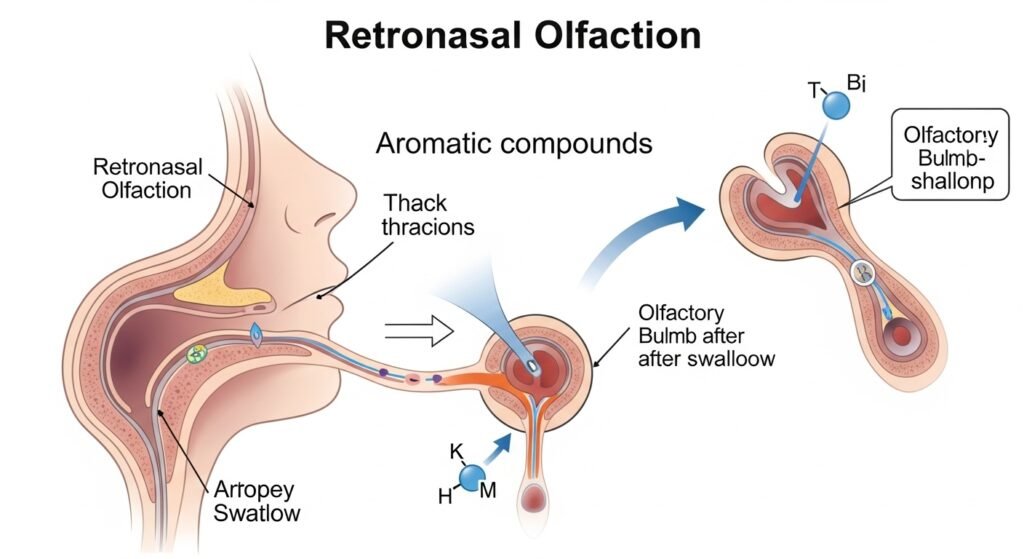
Scientifically, aftertaste is the result of less-volatile molecules that remain in the mouth after the liquid has passed. These molecules—mostly lipids and heavy polyphenols—slowly release gases that travel through the “retronasal” passage to the olfactory bulb. Understanding this process is essential for anyone who wants to Calibrate Their Espresso or improve their sensory vocabulary. A truly exceptional coffee is defined not by its first impression, but by the elegance of its departure.
1. The Chemical Anatomy of the Finish
The aftertaste is not a ghost of the flavor; it is a distinct chemical reality. When we drink coffee, we are dealing with a complex solution of water-soluble and non-water-soluble compounds. Most of the bright, acidic notes (citric and malic acids) are highly soluble and wash away quickly. However, the oils (lipids) and certain bitter-tasting compounds (quinic acids and furfuryl alcohol) are hydrophobic.
Because these oils do not want to mix with the water in your saliva, they cling to the soft tissues of the tongue and the mucous membranes in the throat. As these oils sit on your palate, they slowly break down and release aromatic vapors. This is why you might taste “dark chocolate” or “toasted almond” thirty seconds after you have finished your sip. If your Water Quality is Poor, these heavy compounds may not emulsify correctly, leading to a “short” or “thin” aftertaste that vanishes almost instantly.
2. Retronasal Olfaction: Tasting with Your Nose
One of the most profound realizations for a coffee enthusiast is that the “taste” of coffee is actually 80% smell. While the tongue can only perceive five basic tastes (sweet, sour, salty, bitter, and umami), the nose can identify thousands of distinct aromatic nuances.
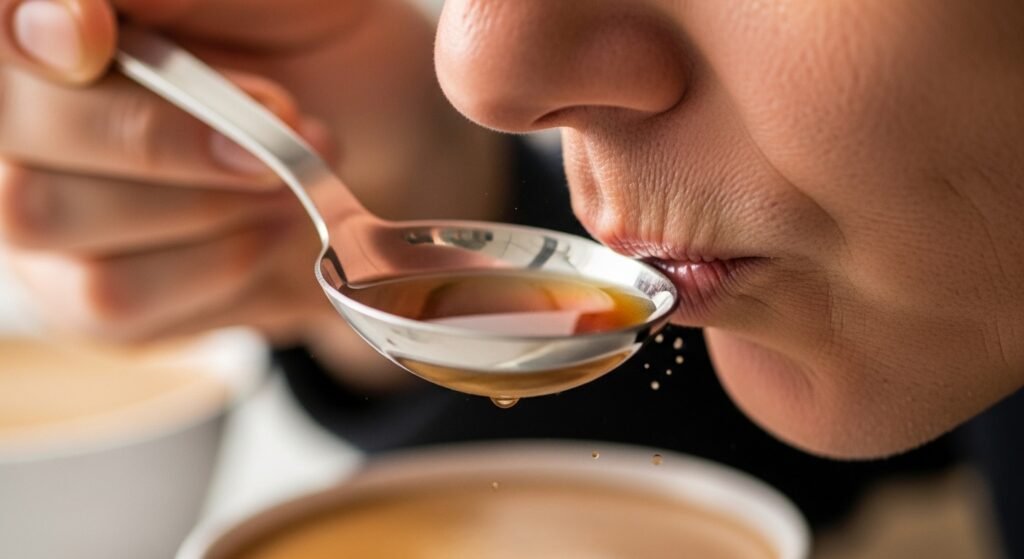
During the aftertaste phase, we rely on Retronasal Olfaction. After you swallow, the motion of the pharynx pushes air from the back of the oral cavity up into the nasal passage. This air is saturated with the vapors released by the oils stuck to your throat. This is why professional cuppers will often “slurp” or draw air into their mouths; it increases the vaporization of these molecules. If the beans come from a Dense High-Altitude Environment, they often contain a higher concentration of these aromatic precursors, leading to a much more complex retronasal experience.
3. The Distinction Between “Long” and “Clean”
In technical sensory analysis, baristas look for two specific qualities in a finish:
-
Length: How long the sensation lasts. A “long” finish is generally prized, provided it is pleasant. Some high-end Colombian coffees can have a finish that lasts for over ten minutes.
-
Clarity/Cleanliness: Does the flavor remain true to the origin, or does it turn into a generic “coffee” bitterness?
A negative aftertaste is often described as “dirty,” “ashy,” or “metallic.” These sensations are frequently caused by Equipment that has not been Properly Cleaned. When old, polymerized oils from previous brews remain in your group head or portafilter, they mix with the fresh oils of your new shot. These rancid oils are incredibly sticky and dominant, ensuring that the last thing you taste is stale bitterness rather than the fresh profile of the bean.
4. Bitterness vs. Astringency: The Aftertaste Trap
A common error in evaluating the finish is confusing bitterness with astringency.
-
Bitterness is a basic taste (like dark chocolate or caffeine).
-
Astringency is a tactile sensation of dryness or puckering, similar to the feeling of drinking over-steeped tea or eating an unripe persimmon.
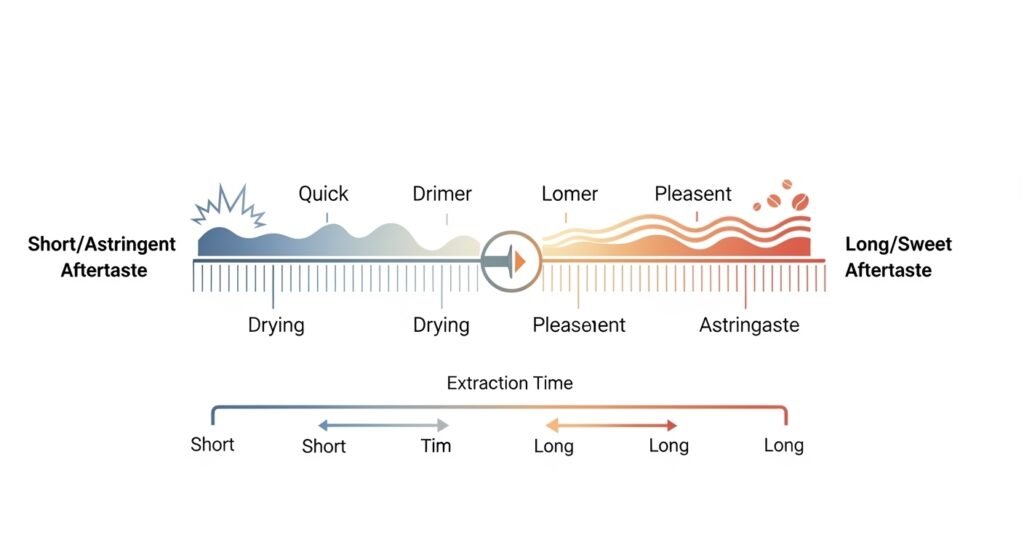
Astringency in the aftertaste is a major red flag for Over-extraction. It occurs when you have pulled too many tannins and polyphenols out of the coffee grounds. These compounds bind to the lubricating proteins in your saliva, causing them to clump together and leaving your mouth feeling dry and “sand-like.” This completely destroys the Science of Aftertaste because it physically blocks your ability to perceive the delicate, sweet oils that should be lingering there.
5. The Influence of Roast Level on Longevity
The roast profile acts as the “volume knob” for aftertaste.
-
Light Roasts: These provide a “bright” and “clean” aftertaste. The finish often reflects fruit juices or florals. However, because light roasts have less developed oils, the finish may be “shorter” in duration.
-
Dark Roasts: These produce a “heavy” and “long” aftertaste. The roasting process creates more lipids and carbonized compounds that cling aggressively to the palate. However, the risk here is a “cloying” or “smoky” finish that masks the Natural Terroir of the High-Altitude Beans.
Mastering the balance between the roast and the Water Mineralization is what allows a roaster to create a coffee that lingers with sweetness rather than ash.
6. Biological Factors: Why Everyone Tastes Differently
Our genetics play a role in how we perceive the “finish.” For example, “supertasters” have a higher density of fungiform papillae on their tongues, making them much more sensitive to bitter compounds in the aftertaste. Furthermore, the composition of your own saliva (which varies in enzyme levels and pH) can affect how quickly the oils on your palate are broken down and washed away.
This is why, when you Host a Coffee Cupping at Home, it is common for different people to describe the finish in different ways. One person may find the lingering notes of a Kenyan Coffee to be pleasantly citrusy, while another may find it slightly too sharp.
7. How to Improve Your Perception of Aftertaste
If you want to train your palate to recognize the nuances of the finish, try the following technical exercise:
-
Take a sip of coffee and let it coat your entire tongue.
-
Swallow and immediately close your mouth.
-
Exhale slowly through your nose. This forces the retronasal vapors over your olfactory bulb.
-
Wait 15 seconds. What is the dominant sensation? Is it sweet, like caramel, or dry, like wood?
-
Wait another 30 seconds. Does the flavor evolve?
This exercise highlights that The Science of Aftertaste is a dynamic process. It is the final “signature” of the barista’s skill and the farmer’s hard work. If the Extraction was Calibrated Correctly, the sugars will linger longer than the acids, resulting in a sweet, honey-like finish that makes you want to take another sip.
8. Conclusion: The Final Impression
The aftertaste is where the true value of specialty coffee is revealed. It is the phase where marketing and “hype” fade away, leaving only the chemical reality of the cup. To ensure your coffee has a world-class finish, you must pay attention to the entire chain of production: from selecting High-Altitude Beans to ensuring your Brewing Water is Chemically Balanced.
Never underestimate the power of a lingering flavor. In a world of fast consumption, a coffee that stays with you for ten minutes after the cup is empty is a rare and beautiful thing. By focusing on the science of the finish, you move beyond simply “drinking” coffee and begin to truly experience it.
The depth of a coffee’s character is often hidden in these final moments, and as we have seen throughout this series, providing a high-quality experience for your palate requires a deep commitment to Maintaining Your Equipment and Your Grinder to Avoid Rancid Oil Buildup that Destroys the Aromatic Clarity of Your Best Beans.

Brown Christopher is 47 years old and has been passionate about coffee since he was 15. For more than three decades, he has explored coffee culture, brewing methods, and the flavors behind every cup. Through this blog, he shares simple tips and knowledge to help beginners better understand and enjoy coffee in their daily lives. ☕