
In the traditional History of Coffee, extraction has always been synonymous with heat. High temperatures act as a catalyst, vibrating water molecules to quickly dissolve the soluble compounds within the bean. However, Cold Brew flips this fundamental physics on its head. By removing heat entirely, we change the chemical composition of the final cup, resulting in a beverage that is naturally sweeter and significantly less acidic.
Understanding the science of cold extraction is essential for the Modern Barista. It requires a different approach to Grind Calibration and a deep respect for the Water Quality used, as the long contact time amplifies every mineral interaction.
1. Solubility and Temperature: The Heat Catalyst
Most of the desirable flavors in coffee—sugars, some acids, and caffeine—are highly soluble in water. Heat speeds up this process. When you brew a V60 or an Espresso, you are using “kinetic energy” to pull flavors out in minutes or seconds.
In Cold Brew, we have zero kinetic energy from heat. To compensate, we use Time. By extending the steeping process to 12, 18, or even 24 hours, we allow the water to slowly penetrate the Dense High-Altitude Beans. This slow journey results in a different “flavor yield.”
2. Why is Cold Brew Less Acidic?
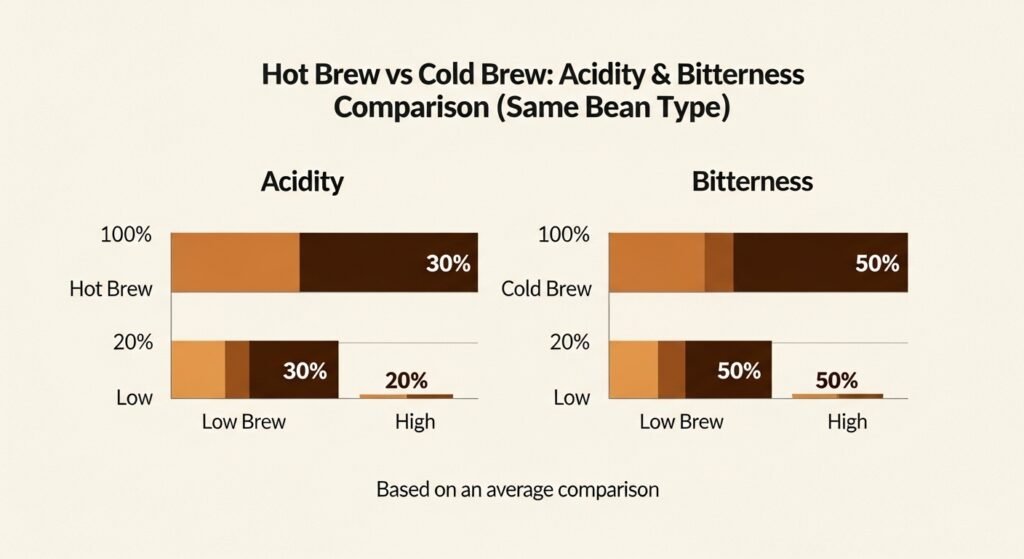
This is the most famous characteristic of Cold Brew. Many of the organic acids in coffee, such as chlorogenic acid and certain aliphatic acids, only dissolve at temperatures above 90°C.
Because cold water never reaches this threshold, these acids remain trapped inside the coffee grounds. The result is a drink that has approximately 60% less titratable acidity than hot coffee. For drinkers with sensitive stomachs, this makes Cold Brew a revelation. However, this also means that the bright, citrusy notes of Kenyan or Ethiopian Coffees are muted, replaced by deep notes of chocolate, molasses, and dark fruit.
3. The Lipid Barrier: Smoothness vs. Bitterness
Coffee contains natural oils (lipids) that carry much of the Aftertaste. In hot brewing, these oils can sometimes oxidize quickly or emulsify into a bitter “crema.”
In Cold Brew, the extraction of lipids is much slower. This prevents the extraction of the heavier, more bitter compounds that usually appear at the end of a hot brew. This is why even a slightly Over-Extracted Cold Brew rarely tastes as bitter as a “burnt” cup of hot coffee.
[IMAGEM1 – A chart comparing the acid and bitterness levels of Hot Brew versus Cold Brew over the same coffee bean type.]
4. Grind Size: The Importance of Surface Area
Because the extraction is so slow, you must use a Coarse Grind (resembling Kosher salt).
-
If the grind is too fine: The water creates a “sludge” that restricts flow and leads to a “muddy” flavor profile.
-
The Role of the Grinder: To achieve a clean Cold Brew, your grinder must produce consistent particles. If your Grinder is Dirty or the Burrs are Worn, you will get too many “fines” (dust), which will over-extract during the 24-hour soak, ruining the Science of Aftertaste.
5. Water Chemistry in Long-Steep Extractions
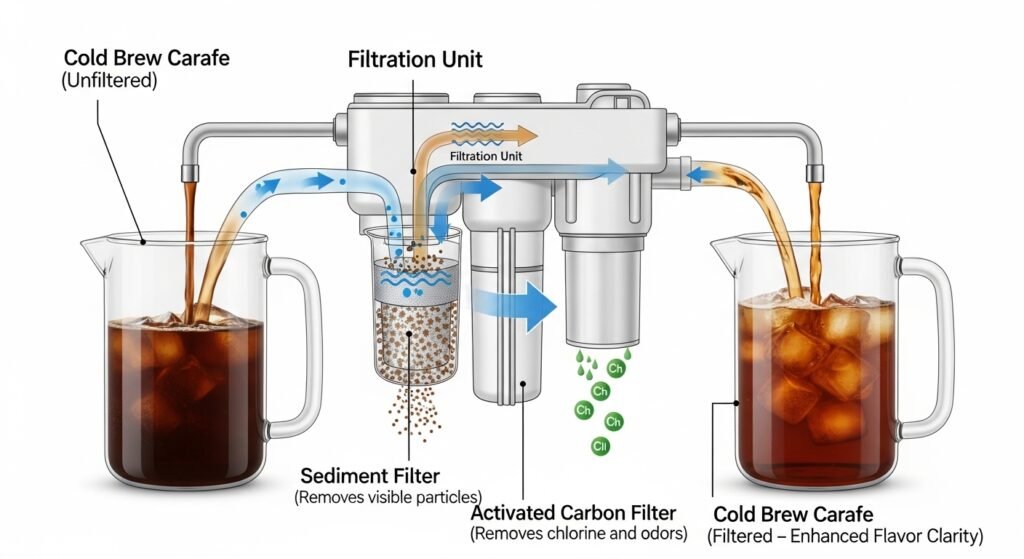
In a 5-minute pour-over, water minerals have a short time to work. In a 24-hour Cold Brew, the water is in contact with the beans for an eternity.
-
The Mineral Trap: If your Water is Too Hard (high in Calcium (Ca²⁺) and Magnesium (Mg²⁺)), the Cold Brew can become overly “heavy” and chalky.
-
The Filtration Rule: Always use filtered water with a balanced TDS. Because the concentration of coffee is so high in Cold Brew, any “off-flavors” in your water (like Chlorine) will be magnified tenfold.
6. Cold Brew Concentrate vs. Ready-to-Drink
Most professional Cold Brew is made as a Concentrate (a 1:4 or 1:8 ratio). This creates a powerful base that can be diluted with water, milk, or even used in cocktails like a Modern Carajillo.
-
Oxidation: Even though it’s cold, Cold Brew still oxidizes. Once filtered, it should be kept in a sealed container in the fridge and consumed within 7 to 10 days to preserve the Delicate Flavor Compounds.
7. Immersion vs. Cold Drip (Kyoto Style)
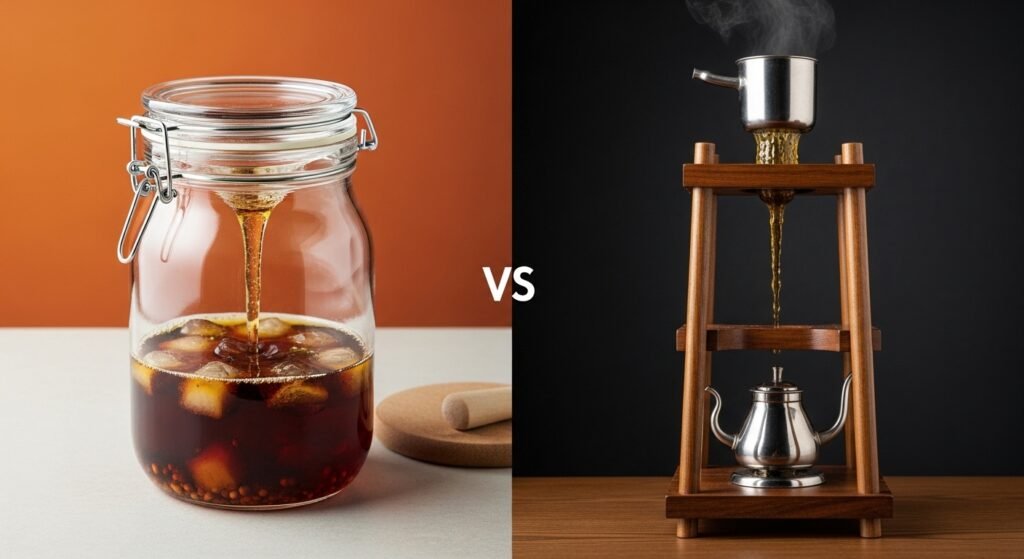
There are two main ways to make cold coffee:
-
Full Immersion: The grounds sit in water for 12–24 hours. This produces a heavy, syrupy body.
-
Cold Drip (Kyoto Style): Water drips slowly through a bed of coffee over 6–12 hours. This produces a much lighter, more “transparent” cup that highlights the Regional Terroir better than immersion.
8. Conclusion: The Patience of the Bean
Cold Brew is the ultimate test of patience. It is a method that strips away the aggression of heat to reveal the “bass notes” of the coffee bean. By understanding the Physics of Solubility and respecting the Long Maturation of High-Altitude Beans, you can create a beverage that is incredibly smooth and versatile.
Whether you are drinking it black over ice or using it as a sophisticated ingredient in mixology, Cold Brew proves that in the world of coffee, sometimes the best things come to those who wait.
The secret to a world-class Cold Brew is Manipulating the Total Dissolved Solids by Balancing the Ratio of Coarse Grounds to Filtered Water and Allowing the Natural Sugars of the Bean to Slowly Emulsify Without the Interference of Thermally-Induced Acids.

Brown Christopher is 47 years old and has been passionate about coffee since he was 15. For more than three decades, he has explored coffee culture, brewing methods, and the flavors behind every cup. Through this blog, he shares simple tips and knowledge to help beginners better understand and enjoy coffee in their daily lives. ☕