
Brazil is the giant of the coffee world, responsible for nearly a third of global production. However, for a long time, the international market viewed Brazilian coffee as a “base” for blends—valued for its body and chocolate notes, but lacking the complexity of High-Altitude African Heirlooms . This narrative has changed completely in the last two decades. Today, Brazil is a leader in specialty coffee, offering a diverse palette of flavors that range from the classic nutty profile to vibrant, floral, and fermented wonders.
This transformation is driven by a deep understanding of Regional Terroirs. From the rolling hills of Sul de Minas to the rugged mountains of Espírito Santo and the unique plateaus of Bahia, each region utilizes specific Mineral Water Profiles and Agricultural Techniques to craft a unique identity. To truly appreciate these differences, one must Host a Comparative Cupping of Brazilian Origins , focusing on the structural density and sweetness of each bean.
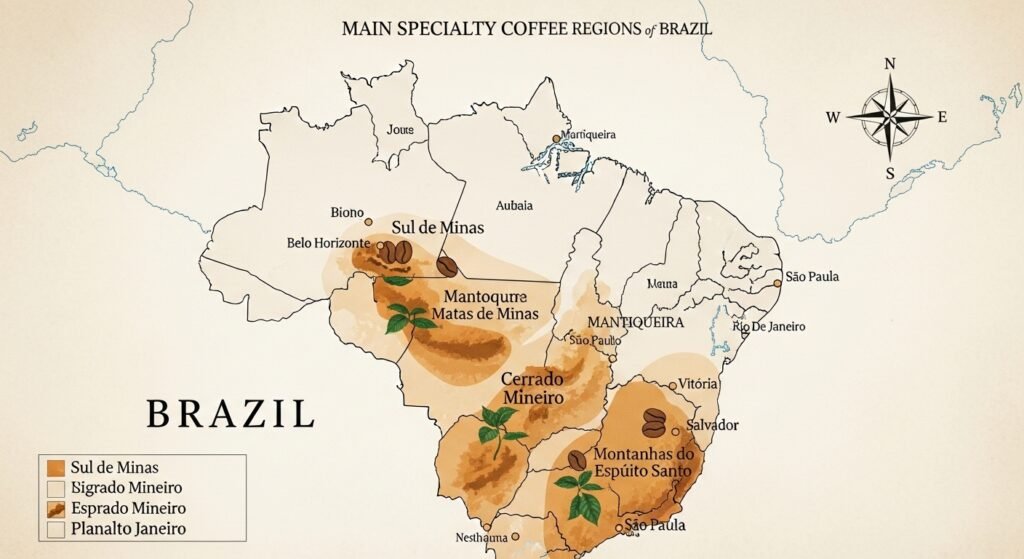
Sul de Minas and Mantiqueira: The Traditional Heartland
Minas Gerais is the powerhouse of Brazilian coffee, and the Sul de Minas region is its historic core. Within this vast area, the Mantiqueira de Minas micro-region stands out as a “Denomination of Origin” (D.O.).
The high altitude (often above 1,100m) and the distinct seasons of the Mantiqueira mountains provide the perfect conditions for the Yellow Bourbon variety. These coffees are characterized by a “creamy” body and a sweetness reminiscent of dulce de leche or brown sugar. Because these beans are Denser than Lowland Coffees , they require a Precise Calibration during the Roasting and Brewing Phases to ensure the sugars are fully caramelized without becoming bitter.
Cerrado Mineiro: The Power of Consistency
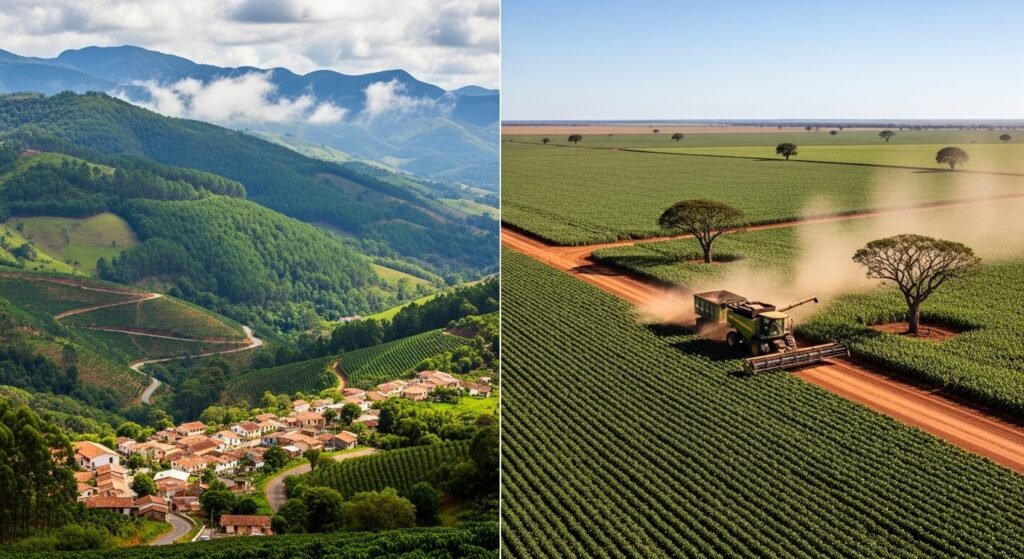
Located in the northwest of Minas Gerais, Cerrado Mineiro was the first region in Brazil to receive a Protected Designation of Origin. Unlike the mountainous Mantiqueira, the Cerrado is a high plateau (800m to 1,300m) with flat topography.
The main advantage of the Cerrado is its predictable climate: hot, wet summers and very dry winters. This allows for “Natural” processing, where the cherry dries on the tree or on large patios. This results in a coffee with low acidity, intense body, and strong notes of roasted nuts and chocolate. If your Equipment is Clogged with Stale Oils , you will miss the clean, “round” finish that makes Cerrado coffee the world’s favorite base for traditional Italian espresso.
Montanhas do Espírito Santo: The Land of the “Capixaba” Specialty
If you are looking for vibrant acidity and experimental processing, the Montanhas do Espírito Santo is the place to watch. This region is dominated by small family farms on extremely steep terrain.
Due to the high humidity and cool temperatures of the Atlantic Forest influence, farmers here have mastered the art of “Pulped Natural” and “Fully Washed” processing. This emphasizes a floral and citric acidity that was previously thought impossible in Brazil. When Analyzing the Science of Aftertaste in Espírito Santo Coffees , you will often find notes of green apple, cane juice, and even tropical fruits, reflecting the biodiversity of the surrounding forest.
Planalto da Bahia: The Emerging Star
Deep in the Northeast of Brazil, the Planalto da Bahia (specifically the Chapada Diamantina) has become a consistent winner of the Cup of Excellence. The high altitude (up to 1,500m) and the unique microclimate of the northern plateaus produce coffees that are incredibly refined.
Bahian coffees are famous for their “elegance.” They often possess a tea-like body and floral aromatics similar to Washed Ethiopian Lots . This level of sophistication requires Water of Exceptional Purity and Mineral Balance to be fully appreciated; otherwise, the delicate floral molecules will be suppressed by mineral interference.
Matas de Minas: The Artisanal Renaissance
Bordering the state of Espírito Santo, Matas de Minas is a region of steep slopes and manual harvesting. Historically a producer of commodity coffee, it has undergone a massive quality revolution.
Today, it is known for producing “honey processed” coffees—where the skin is removed but the sticky mucilage is left on the bean during drying. This process creates a wild, fruity sweetness that sits perfectly between the chocolatey Cerrado and the citric Espírito Santo. It is a favorite for Home Cupping Sessions because it demonstrates how processing can transform the same botanical variety into two completely different sensory experiences.
Technical Implications of Regional Diversity
From a brewing perspective, you cannot treat all Brazilian coffees the same.
-
Cerrado/Sul de Minas: Best suited for espresso or immersion methods (French Press) that emphasize body and sweetness.
-
Espírito Santo/Bahia: These regions shine in pour-over methods (V60/Chemex) that highlight their delicate acidity and floral top notes.
Regardless of the region, the Maintenance of Your Grinder Burrs is non-negotiable. Brazilian coffees, especially naturals, tend to produce more “chaff” (the silvery skin of the bean). If this chaff builds up in your equipment, it will create a papery, dry sensation in the Aftertaste, ruining the hard work of the mountain farmers.
Conclusion: Brazil as a Coffee Continent
Exploring the coffee regions of Brazil is an exercise in scale and diversity. We have moved from being a “volume producer” to being a “quality curator.” By understanding the specific terroirs of Minas, Bahia, and Espírito Santo, we can appreciate the immense labor involved in every bag.
The next time you choose a Brazilian coffee, look for the specific region. Don’t just settle for “Brazil.” Look for the altitude, the processing method, and the unique notes of the terroir. When you Respect the Technical Variables of the Origin , you unlock a world of flavor that is as vast and varied as the country itself. Brazil is not just a source of coffee; it is the source of the future of specialty coffee.

Brown Christopher is 47 years old and has been passionate about coffee since he was 15. For more than three decades, he has explored coffee culture, brewing methods, and the flavors behind every cup. Through this blog, he shares simple tips and knowledge to help beginners better understand and enjoy coffee in their daily lives. ☕