
The Whispers of My Juniper: A Tale of Routine and Resilience
For years, my bonsai, particularly a stubborn old juniper named “Kiyomi” (meaning “pure beauty” in Japanese), had been… well, let’s just say it hadn’t been thriving. It wasn’t dying, not exactly, but it wasn’t the picture of health I envisioned when I first acquired it. The needles were a little dull, the growth was slow and uneven, and it just lacked that vibrant energy that a healthy bonsai radiates. I’d tried everything I could think of: different soils, varying watering schedules, even moving it to different locations in my garden. Nothing seemed to make a significant difference. I chalked it up to Kiyomi being a particularly challenging specimen, perhaps set in its ways, a bonsai equivalent of a grumpy old man refusing to embrace change.
Then, life threw me a curveball. A demanding new project at work completely upended my carefully constructed routine. My sleep schedule became erratic, my diet suffered, and the consistent, predictable rhythm of my days dissolved into a chaotic scramble. It was during this period of upheaval that I noticed something remarkable happening with Kiyomi. It began to flourish.
Now, I know what you’re thinking: correlation doesn’t equal causation. And you’re right. But the change in Kiyomi was so dramatic, so undeniable, that I couldn’t dismiss it as mere coincidence. It forced me to look beyond the obvious, to question my assumptions about bonsai care, and, perhaps more importantly, to examine my own life and the impact my routine (or lack thereof) was having on everything around me.
The Unexpected Connection: Me, My Routine, and My Bonsai
For years, I had approached bonsai care with a rigid, almost scientific approach. I followed the “rules” meticulously, adhering to strict watering schedules, fertilizing at precise intervals, and pruning according to established guidelines. I treated Kiyomi like a laboratory subject, carefully controlling every variable in an attempt to achieve the “perfect” bonsai. What I failed to realize was that bonsai, like all living things, respond to more than just physical inputs. They are sensitive to their environment, to the subtle rhythms of nature, and, perhaps, even to the energy of their caretaker.
My old routine, while well-intentioned, had become a cage. I was so focused on the “right” way to do things that I lost sight of the bigger picture. I wasn’t observing Kiyomi closely, I wasn’t responding to its individual needs, and I certainly wasn’t connecting with it on a deeper level. My rigid schedule had created a disconnect, a barrier between me and the tree.
When my routine fell apart, I was forced to become more present, more mindful. I no longer had the luxury of adhering to a strict schedule. Instead, I had to rely on my intuition, on my senses, to guide me. I started watering Kiyomi only when the soil felt dry to the touch, rather than on a predetermined day. I fertilized it based on its growth patterns, rather than according to the calendar. And I pruned it not according to a textbook, but according to what I felt it needed, guided by its natural shape and form.
This shift in approach, this move away from rigid control and towards mindful observation, seemed to unlock something within Kiyomi. It was as if the tree had been waiting for me to break free from my routine, to start paying attention, to truly see it for what it was.

Deconstructing the “Rules”: Finding Freedom in Flexibility
The experience with Kiyomi taught me a valuable lesson: that sometimes, the best way to care for a bonsai is to break the rules. Not recklessly, of course, but thoughtfully, deliberately, and with a deep understanding of the underlying principles. The “rules” of bonsai care are not immutable laws, but rather guidelines, suggestions based on years of experience. They are a starting point, not an end point.
For example, the common wisdom is that junipers should be watered regularly, keeping the soil consistently moist. But Kiyomi seemed to thrive on a slightly drier regime. Perhaps its root system was more susceptible to root rot, or perhaps it simply preferred to be slightly stressed. Whatever the reason, the “rule” of consistent moisture didn’t apply in this case.
Similarly, the recommended fertilization schedule for junipers is often based on a specific type of fertilizer and a specific interval. But I found that Kiyomi responded better to a weaker solution, applied less frequently. Again, this may have been due to the specific characteristics of the tree, or to the composition of the soil, or to any number of other factors. The point is that the “rule” wasn’t working, and I had to adapt to meet the tree’s individual needs.
Breaking the rules requires courage, intuition, and a willingness to experiment. It also requires a deep understanding of the principles of bonsai care. You can’t simply ignore the rules without knowing why they exist in the first place. You need to understand the underlying physiology of the tree, the properties of the soil, and the effects of different environmental factors. Only then can you make informed decisions about when and how to deviate from the established norms.
The Art of Observation: Listening to Your Bonsai
The most important tool in a bonsai artist’s arsenal is not a pair of shears or a bag of fertilizer, but rather the ability to observe. To truly see the tree, to understand its needs, to anticipate its reactions. This requires patience, mindfulness, and a willingness to let go of preconceived notions.
Start by simply spending time with your bonsai. Sit with it, look at it from different angles, and observe its overall shape and form. Pay attention to the color and texture of the needles, the thickness and direction of the branches, and the appearance of the soil. Look for any signs of stress, such as yellowing needles, wilting leaves, or stunted growth. These are all clues that the tree is trying to tell you something.
Next, start to pay attention to the subtle changes that occur over time. How does the tree respond to different watering schedules? How does it react to different types of fertilizer? How does it grow in different locations? Keep a journal of your observations, noting the date, the time, and any relevant environmental factors. Over time, you’ll start to develop a deeper understanding of your bonsai’s individual needs and preferences.
Finally, trust your intuition. Sometimes, you’ll get a feeling that something is not quite right, even if you can’t put your finger on it. Don’t ignore these feelings. Investigate them, explore them, and see where they lead you. Your intuition is a powerful tool, honed by years of experience and observation. Learn to trust it, and it will guide you towards a deeper understanding of your bonsai.

The Ripple Effect: How Fixing My Routine Benefited Everything
The unexpected flourishing of Kiyomi was a wake-up call. It forced me to confront the chaos in my own life and to recognize the importance of routine, not as a rigid set of rules, but as a framework for creating stability and balance. Ironically, it was the initial *lack* of routine that kickstarted the change, but then a more mindful and deliberate approach to structuring my day took root. As my life became more structured and mindful, so did my approach to bonsai care, creating a virtuous cycle.
I started by re-establishing a consistent sleep schedule, going to bed and waking up at the same time each day, even on weekends. This simple change had a profound impact on my energy levels and my overall mood. I found myself feeling more alert, more focused, and more patient. This newfound clarity allowed me to approach my bonsai with a fresh perspective, to see them with new eyes.
I also started to pay more attention to my diet, eating more whole foods and less processed junk. This improved my physical health and my mental clarity, making it easier to stay present and mindful throughout the day. I found that I had more energy to devote to my bonsai, more patience to observe them closely, and more creativity to experiment with new techniques.
Finally, I made a conscious effort to carve out time each day for relaxation and reflection. This might involve meditating, reading, or simply sitting in my garden, listening to the birds and enjoying the beauty of nature. This practice helped me to reduce stress, to clear my mind, and to connect with my inner self. As I became more centered and grounded, so did my bonsai. They seemed to respond to my newfound sense of calm, growing more vigorously and displaying more vibrant colors.
Beyond the Bonsai: Lessons for Life
The lessons I learned from Kiyomi extend far beyond the realm of bonsai. They are lessons about the importance of observation, the power of intuition, and the transformative effects of routine and mindfulness. They are lessons about the interconnectedness of all things, and the subtle ways in which our actions can impact the world around us.
Just as a bonsai responds to the care and attention of its caretaker, so too does our life respond to the choices we make. When we cultivate a sense of order and balance in our lives, we create the conditions for growth and flourishing. When we pay attention to our inner needs and our outer environment, we gain a deeper understanding of ourselves and the world around us. And when we trust our intuition and follow our hearts, we unlock our full potential and live a life of purpose and meaning.
So, the next time you’re struggling to care for your bonsai, or struggling to find balance in your life, remember the story of Kiyomi. Remember that sometimes, the best way to achieve your goals is to break the rules, to trust your intuition, and to connect with the deeper rhythms of nature. And remember that the journey of a thousand miles begins with a single step, or, in this case, a single, carefully pruned branch.

The Ongoing Journey: Patience and Perseverance
The story of Kiyomi is not a story with a definitive ending. It’s an ongoing journey, a continuous process of learning, adapting, and growing. Bonsai care is not a destination, but a path, a way of life. There will be ups and downs, successes and failures, moments of frustration and moments of joy. The key is to remain patient, to persevere through the challenges, and to never stop learning.
Even now, after years of experience, I still make mistakes. I still overwater, I still under-fertilize, and I still occasionally prune a branch that I later regret. But I’ve learned to accept these mistakes as part of the process. I’ve learned to forgive myself for my imperfections, and to focus on the lessons that I can learn from each experience. And I’ve learned to trust that, with patience and perseverance, even the most challenging bonsai can eventually flourish.
The same is true of life. We all make mistakes, we all face challenges, and we all experience moments of doubt and uncertainty. But it’s how we respond to these challenges that defines us. Do we give up, or do we persevere? Do we allow our mistakes to define us, or do we learn from them and grow stronger? Do we lose faith in ourselves, or do we trust in our ability to overcome adversity?
A Living Metaphor: My Bonsai as a Reflection of Self
My bonsai are more than just plants to me; they are living metaphors for life itself. They represent the beauty of impermanence, the power of resilience, and the importance of balance. They remind me that growth is a process, not a destination, and that even the most challenging circumstances can be overcome with patience, perseverance, and a little bit of mindful attention.
When I look at Kiyomi, I see a reflection of myself. I see the struggles I’ve faced, the challenges I’ve overcome, and the growth I’ve experienced. I see the imperfections that make me unique, the strengths that sustain me, and the potential that lies within me. And I am reminded that, just like a bonsai, I am a work in progress, constantly evolving, constantly growing, and constantly striving to reach my full potential.
And so, I continue to care for my bonsai, not just as a hobby, but as a practice, a way of connecting with nature, with myself, and with the deeper rhythms of life. I prune, I water, I fertilize, and I observe. I listen to the whispers of my trees, and I learn from their wisdom. And I am grateful for the opportunity to share my journey with you, in the hope that it may inspire you to cultivate your own garden of growth, both within and without.

The journey with Kiyomi has been a profound one, a testament to the power of observation, the importance of routine (both its presence and its mindful disruption), and the interconnectedness of life. It’s a reminder that even the smallest changes in our own lives can ripple outwards, impacting the world around us in unexpected and beautiful ways. And it’s a story I’ll continue to tell, not just as a tale of bonsai care, but as a guide to living a more mindful, balanced, and fulfilling life.
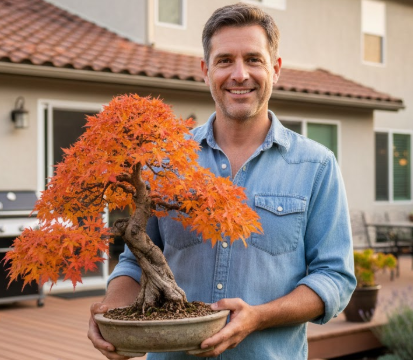
My name is Christopher Brown, I am 38 years old and I live in the United States. I am deeply passionate about the art of bonsai and have been cultivating trees for several years. What started as a simple curiosity turned into a daily practice and an important part of my life.
On this blog, I share my real experiences with bonsai — including what works, what doesn’t, and the lessons I learn along the way. I enjoy experimenting with techniques, observing the growth of each tree, and documenting the process with honesty and patience.
My goal with InfoWeHub is to help beginners feel more confident, avoid common mistakes, and discover the beauty of bonsai cultivation. If you are starting your journey or already love this art, you are welcome here.