
If you ask any veteran barista or green coffee buyer about the most polarizing origin in the world, they won’t point to Brazil or Colombia. They will point to Kenya. In my three decades of cupping, no other bean has the power to stop a room like a high-grade Kenyan SL28 or SL34. We call them “slingshots” because the flavor doesn’t just sit on your tongue; it hits you with a high-velocity burst of phosphoric acidity that can feel like a physical sensation.
For the uninitiated, the first sip of a top-tier Kenyan coffee can be a shock. It doesn’t taste like the chocolatey, nutty comfort of a Volcanic Soils and High Altitudes: Why Central America Rules the World. Instead, it tastes like blackcurrants, pink grapefruit, and—most famously—savory sun-ripened tomatoes. This “tomato” note is the holy grail for some and a deal-breaker for others. But to understand why this happens, we have to look at the unique intersection of genetics, soil chemistry, and a processing method that is arguably the most rigorous on the planet.
The Genetic Blueprint: Scott Agricultural Laboratories
To understand the Kenyan profile, we have to go back to the 1930s. During my early years in the 90s, we were just beginning to appreciate the work of Scott Agricultural Laboratories (SL). They were tasked with finding varieties that were drought-resistant and high-yielding, but what they accidentally created were flavor powerhouses.
The SL28 and SL34 varieties are the backbone of the Kenyan reputation. They are effectively the “Bourbon” line of the coffee world but adapted to the specific African plateau. These trees have a unique biological efficiency in synthesizing phosphoric acid. While most coffees rely on citric or malic acids (think lemons and apples), Kenyan beans are rich in phosphorus. This is what gives the coffee its “sparkling” mouthfeel—a zing that lingers and cleanses the palate, much like a fine Champagne.
When you are How to Develop a Professional Palate: A 30-Year Guide, identifying this phosphoric “sparkle” is a key milestone. It is a sharpness that feels more “mineral” than “fruity,” and it is the signature of the Kenyan terroir.
The Power of Red Volcanic Soil
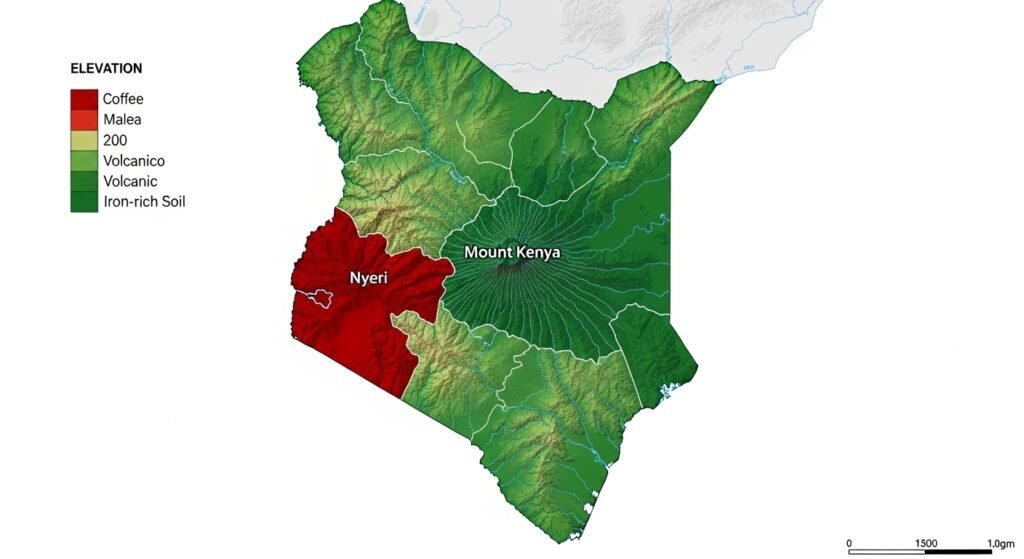
Kenya’s coffee-growing regions, particularly around Nyeri, Murang’a, and Kirinyaga, sit on the shoulders of ancient volcanoes. The soil here is a deep, iron-rich red. This isn’t just a visual curiosity; it is a nutrient-dense environment that forces the trees to work hard.
High in nitrogen and organic matter, this red soil allows the trees to develop deep root systems. In my travels to these regions, I’ve seen how the combination of this soil and the high-altitude sunlight (often above 1,700 meters) slows down the maturation of the cherry. This slow growth allows the sugars to bond with the phosphoric minerals in the soil.
The result? A bean that is incredibly dense and packed with precursor compounds that will later turn into that savory, complex acidity. Without this specific soil, an SL28 planted in another country—like El Salvador or Vietnam—rarely produces the same “slingshot” effect. It becomes a different beast entirely, losing that savory edge that defines the origin.
The “Kenyan Process”: Double Fermentation
If the genetics and soil provide the raw materials, the “Kenyan Process” (Double Washed) is the master sculptor. In 30 years, I haven’t seen a more meticulous processing method.
After the cherries are depulped, they undergo a primary fermentation for up to 24 hours. Then, they are washed and fermented a second time for another 12 to 24 hours in clean water. This “double soak” is what creates the “Clean Cup” that professional cuppers rave about.
-
Clarity: The double fermentation strips away every trace of mucilage, leaving a bean that is surgically clean.
-
Flavor Refinement: This process is believed to “polish” the acidity, removing any muddy or fermented notes and leaving only the bright, vibrantly articulated fruit flavors.
-
The Savory Note: It is during this extended soaking period that many believe the savory, tomato-like precursors are accentuated.
This level of processing is expensive and water-intensive, which is why you won’t see it used for lower-grade commodity coffee. It is reserved for the best, and it is why The Third Wave Defined: My Witness Account of the Specialty Shift embraced Kenya as its “Grand Cru.”
The “Tomato” Debate: Is it a Defect or a Delight?
Let’s address the elephant in the room: the tomato note. In the world of sensory analysis, a “savory” coffee can be confusing. When I first encountered it, I thought the batch was under-roasted. But as I cupped more, I realized that in a balanced Kenyan coffee, the tomato isn’t a “vegetable” flavor; it’s more like the sweetness of a sun-gold cherry tomato or a rich reduction.
This savory element provides a counterweight to the intense citrus. It gives the coffee “gravitas.” Without it, the acidity would be too sharp, like drinking straight lime juice. The tomato note adds a layer of umami that makes the coffee feel complete. However, if the roast is too light or the extraction is off, this note can become metallic or unpleasantly salty.
To avoid this, you need a brewing method that provides balance. I often find that the Geometry of Flavor: Why I Still Prefer the V60 After 30 Years is the best way to handle a Kenyan bean. The paper filter traps some of the heavier oils, allowing the bright acidity to lead while the savory notes provide a subtle, supporting base.
Grading the Best: What “AA” Really Means
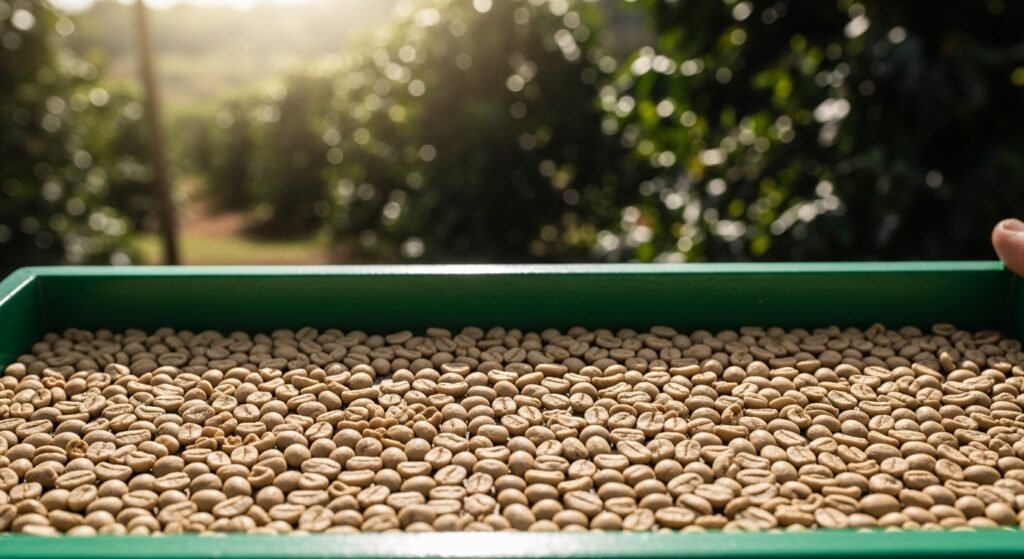
When you buy Kenyan coffee, you’ll see letters like AA, AB, or PB. Many consumers think these are quality scores, but they are actually size grades.
-
AA: These are the largest beans, separated by a specific screen size.
-
AB: A mix of slightly smaller beans.
-
PB (Peaberry): A single, round bean that grows inside a cherry instead of the usual two flat-faced beans.
While “AA” is often the most expensive because the large beans roasts more evenly, don’t sleep on the “PB” lots. Peaberries from Kenya are legendary for their concentrated flavor density. In my experience, a Kenyan Peaberry often has an even more intense “slingshot” acidity than the larger AA counterparts.
Conclusion: A Masterclass in a Cup
Kenya is not a “beginner’s” coffee. It is a challenging, rewarding, and deeply complex experience that requires patience and a trained palate. It represents the pinnacle of what happens when a country decides to prioritize quality over quantity at every single step of the chain.
After 30 years, I still get excited when a fresh harvest of Kenyan coffee arrives at the lab. I still love the way it cuts through the fog of a busy morning. It is a reminder that coffee can be more than just a drink; it can be an explosion of terroir, chemistry, and history.


Brown Christopher is 47 years old and has been passionate about coffee since he was 15. For more than three decades, he has explored coffee culture, brewing methods, and the flavors behind every cup. Through this blog, he shares simple tips and knowledge to help beginners better understand and enjoy coffee in their daily lives. ☕