
If you had told me in the mid-1990s that one of the most respected brewing devices of the future would be a plastic tube invented by a man who made Frisbees, I would have laughed you out of the roastery. Back then, we were obsessed with heavy brass espresso machines and delicate glass carafes. We equated “quality” with “fragility” and “complexity.” But in 2005, Alan Adler—the inventor of the Aerobie flying ring—released the AeroPress, and the specialty coffee world has never been the same since.
As someone who has spent 30 years witnessing The Third Wave Defined: My Witness Account of the Specialty Shift, I’ve seen countless gadgets promise to “revolutionize” coffee. Most end up in the back of a cupboard, covered in dust. The AeroPress is the exception. It is a paradox: it looks like a toy, it’s made of BPA-free plastic, and it’s virtually indestructible. Yet, it offers a level of control over pressure, immersion, and filtration that even the most expensive machines struggle to replicate. Whether I’m brewing a delicate Kenyan Slingshot or a chocolatey Brazilian, the AeroPress has become my most trusted companion.
The Science of Hybrid Brewing
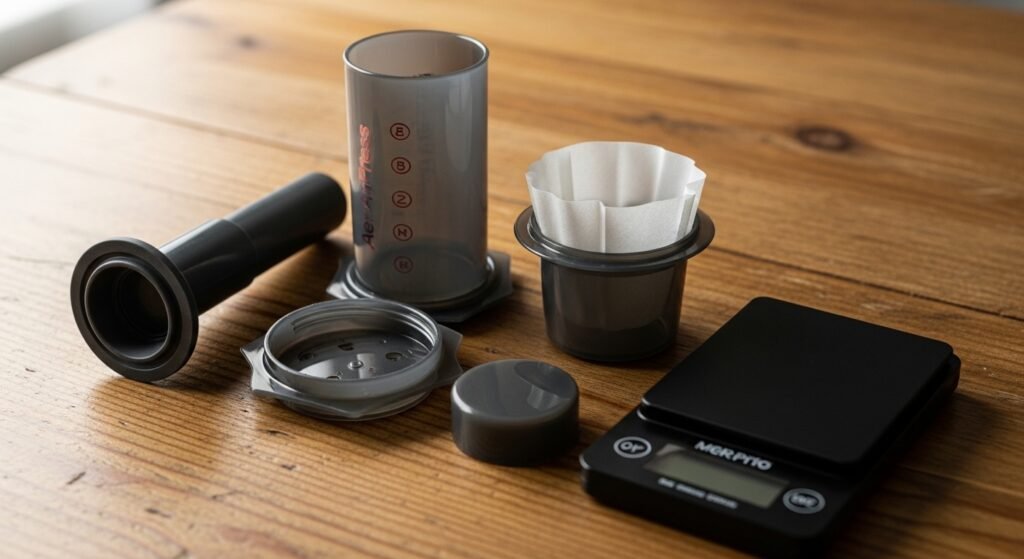
What makes the AeroPress so unique from a technical standpoint is that it is a hybrid brewer. Most methods are either immersion (like a French Press) or percolation (like a V60). The AeroPress does both.
-
Immersion Phase: The coffee grounds and water sit together in the chamber, allowing for a uniform extraction of sugars and soluble solids. This prevents the “channeling” issues often found in pour-overs.
-
Pressure Phase: When you press the plunger, you introduce air pressure. This isn’t the 9 bars of an espresso machine, but it is enough to force the water through the coffee bed and a paper filter at a higher velocity than gravity alone.
This pressure phase is why the AeroPress can produce such high clarity while maintaining a heavy body. It’s a method that rewards experimentation. You can change the steep time, the grind size, and the water temperature to suit the specific terroir, such as the Volcanic Soils and High Altitudes of Central America. It is the only brewer I know that can make a decent “espresso-style” concentrate and a tea-like filtered coffee with the exact same equipment.
The “Inverted” vs. “Standard” Debate
In my 30 years, I have seen the “AeroPress Championships” grow into a global phenomenon. And at the heart of the community is a fierce debate: Standard vs. Inverted.
-
Standard Method: You place the AeroPress on top of your mug, add coffee and water, and let it drip through naturally before pressing. This is how the inventor intended it.
-
Inverted Method: You turn the device upside down, steep the coffee with the plunger already inserted, then flip it onto the mug at the end.
I personally prefer the inverted method for one reason: total control over immersion. In the standard method, some water inevitably drips through the filter before the brewing time is up. Inverted brewing ensures that every drop of water stays in contact with the coffee for exactly the same amount of time. This precision is vital when you are trying to Develop a Professional Palate, as it allows you to isolate variables with surgical accuracy.
Why Plastic Actually Matters (It’s Not Just About Price)
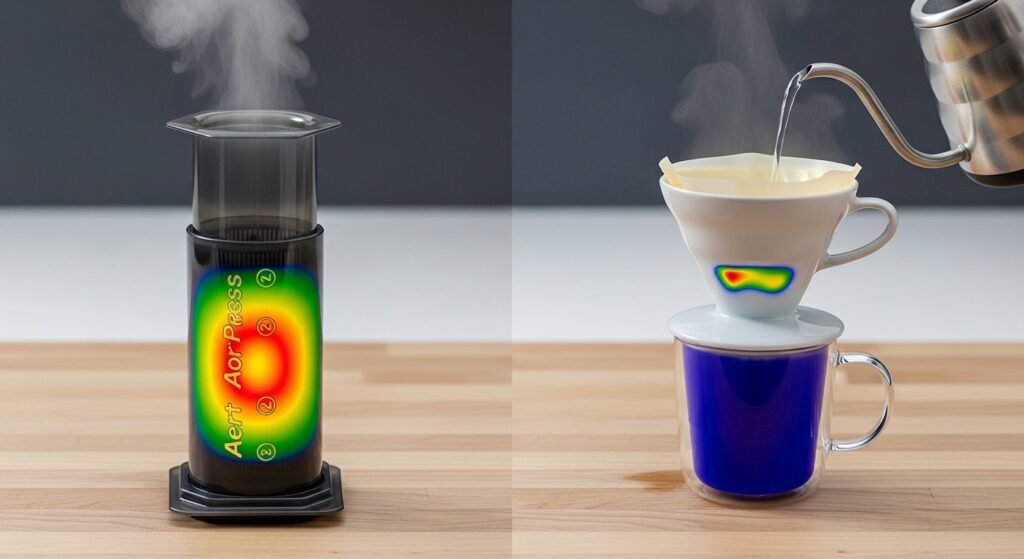
There is a common misconception that glass or ceramic is always better for coffee. In 30 years of sensory analysis, I’ve learned that thermal stability is the enemy of a good brew. Glass and ceramic are “heat sinks”—they suck the energy out of the water the moment they touch it.
The AeroPress is made of polypropylene, which is an incredible insulator. It doesn’t steal the heat from your water. This means your extraction stays consistent from the first second to the last. This is especially important when you are brewing at lower temperatures (around $80^{\circ}C$ to $85^{\circ}C$), a technique often used to reduce bitterness in darker roasts. Because the plastic retains the heat, you get a much more efficient extraction than you would in a cold ceramic V60.
The Paper Filter: The Gatekeeper of Flavor
The AeroPress uses a small, circular paper filter. This is the unsung hero of the device. It is thick enough to catch the “fines” and many of the heavier oils, resulting in a cup that is remarkably “clean.”
However, many of my old-school colleagues miss the oils of a French Press. For them, I recommend a metal mesh filter. But if you are using the AeroPress to Identify Complex Acidity, stick to the paper. It highlights the “brightness” and the floral top notes that define high-altitude beans. The paper filter acts as a lens, focusing the flavors so you can distinguish between a lemon-citric acid and a malic-apple acid.
A Travel Companion Like No Other
Over the last three decades, I have brewed coffee in hotel rooms, on trains, and even on the side of a mountain in Ethiopia. In all those scenarios, the AeroPress was the only logical choice.
It weighs next to nothing, and as I mentioned before, it is indestructible. You can drop it on a concrete floor, and it won’t even scratch. For the traveling coffee professional, it is the ultimate insurance policy against bad hotel coffee. Pair it with a high-quality Hand Grinder, and you have a world-class coffee bar that fits in your backpack.
Lessons from 10,000 Presses
If I have learned one thing from using this device since its release, it is this: don’t press too hard.
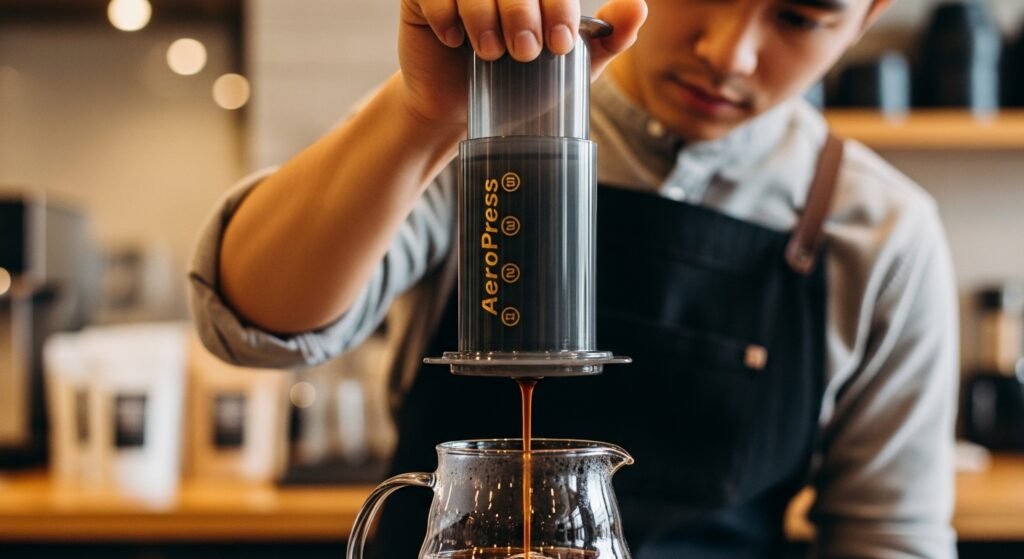
When you reach the end of the plunger, you will hear a “hiss” as air escapes. Many baristas stop right before the hiss, believing that pressing into the puck at the end introduces bitterness. In my testing, the difference is subtle, but the pressure you apply matters. A slow, steady 30-second press yields a much sweeter, more balanced cup than a violent, 5-second shove. Coffee rewards patience, even when using a “fast” brewer like this one.
Conclusion: The Ultimate Tool for the Modern Brewer
The AeroPress paradox is a reminder that we shouldn’t judge a tool by its appearance. It may look like a piece of lab equipment or a children’s toy, but it is one of the most sophisticated brewing instruments ever created.
It has democratized specialty coffee. You don’t need a $2,000 espresso machine or a $200 goose-neck kettle to make an incredible cup. You just need a $40 plastic tube and a little bit of curiosity. It encourages us to play, to fail, and to discover.
After 30 years, I still find myself reaching for the AeroPress several times a week. It reminds me that at the heart of the Third Wave Movement is a spirit of innovation and a rejection of “the way things have always been done.” If you don’t have one in your kit yet, you are missing out on one of the greatest joys in modern coffee.

Brown Christopher is 47 years old and has been passionate about coffee since he was 15. For more than three decades, he has explored coffee culture, brewing methods, and the flavors behind every cup. Through this blog, he shares simple tips and knowledge to help beginners better understand and enjoy coffee in their daily lives. ☕