
If you step into a high-end coffee shop today, you see a world of digital scales, laser-etched filters, and beans that cost more than a bottle of fine wine. But as someone who has spent 30 years in this industry, I find it vital to look back at where this obsession began. Long before The Third Wave Defined: My Witness Account of the Specialty Shift took over our palates, coffee had a much humbler mission: it had to conquer the American kitchen.
The “First Wave” of coffee isn’t about flavor notes or acidity. It is a story of industrialization, war, and the democratization of a beverage that was once reserved for the elite. In the late 19th and early 20th centuries, the goal wasn’t to taste “blackcurrant” or “jasmine.” The goal was to provide a consistent, reliable, and affordable source of energy for a growing nation. To understand why we now obsess over the Geometry of Flavor: Why I Still Prefer the V60 After 30 Years, we must first understand the era of the vacuum-sealed tin and the percolator.

The Pioneers of the Pantry: Folgers and Maxwell House
Before the 1860s, if you wanted coffee in America, you usually bought green beans and roasted them yourself in a frying pan over a fire. The results were, predictably, terrible. Charred on the outside and raw on the inside, this was coffee at its most primitive.
The First Wave began when entrepreneurs like James Folger and Joel Cheek realized that the American public was hungry for convenience. They took the roasting process out of the home and into the factory. They standardized the roast, ground the beans, and most importantly, they mastered the art of preservation.
The invention of the vacuum-packed tin was the “iPhone moment” of the 19th-century coffee world. It allowed coffee to be shipped across the vast American frontier without turning into sawdust. For the first time, a cowboy in Montana and a banker in New York could drink the exact same product. This wasn’t about the nuances of Volcanic Soils and High Altitudes: Why Central America Rules the World; it was about the miracle of a consistent morning ritual.
War and the “Joe”: Coffee as a Military Necessity
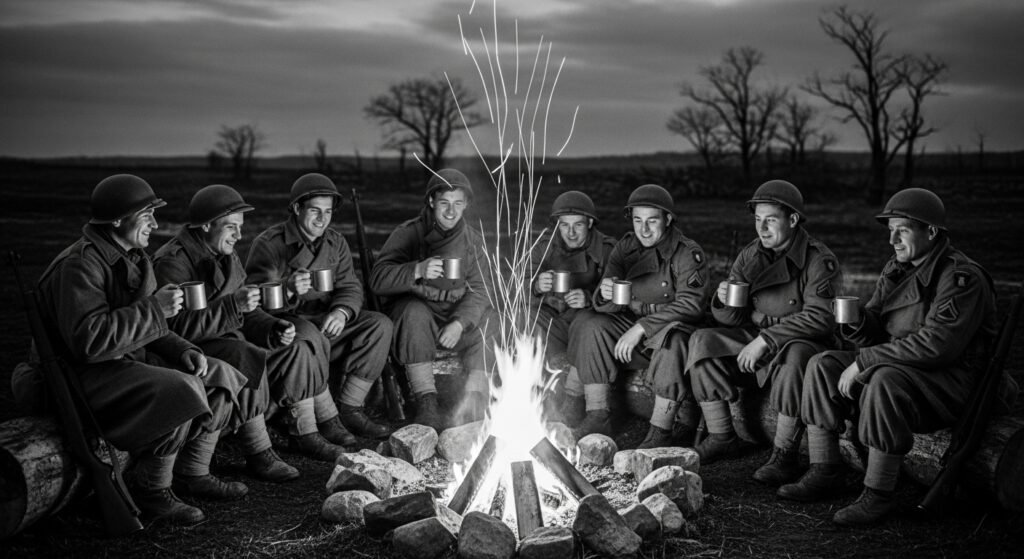
You cannot talk about the First Wave without talking about the American military. In my research and my years talking to older veterans, I’ve seen how war cemented coffee’s place in the American soul. During the Civil War and later in the World Wars, coffee was considered a vital ration. It wasn’t just a drink; it was morale in a tin.
The term “Cup of Joe” is often attributed to the Secretary of the Navy, Josephus Daniels, who banned alcohol on ships, leaving coffee as the strongest drink available. Whether or not that legend is entirely true, the impact was real. Millions of soldiers returned home from the trenches with a lifelong addiction to the caffeine and the comfort of a hot cup.
This created a massive, captive market. The industrial roasters responded by prioritizing volume and price. This era saw the rise of “Robusta” fillers—cheaper, hardier beans that lacked the refinement of Arabica but provided the punch needed to fuel a workforce. In this period, “strong” meant bitter and dark, a far cry from the Kenyan Slingshots: That Unforgettable Tomato Acidity Explained we celebrate today.
The Era of the Percolator: Brewing for the Masses
In the First Wave, the “how” was just as important as the “what.” The dominant brewing method was the percolator. If you haven’t seen one, it’s a pot that continuously cycles boiling water through the grounds until the entire kitchen smells like burnt toast.
As a young enthusiast in the early 90s, I remember my grandfather’s percolator. It was a violent way to treat coffee. By boiling the water, the machine stripped away all the delicate aromatic oils and left only the harsh, ashy flavors. But for the mid-century American family, the percolator was a symbol of modernity. It was automatic, it was loud, and it signaled that the day had begun.
This “boil-everything” approach is exactly why we had to develop a more Professional Palate: A 30-Year Guide later on. We had to unlearn the idea that coffee was supposed to be a bitter, scalding liquid. We had to rediscover that coffee could be sweet and fruit-forward.
The Rise of Instant Coffee: The Ultimate Convenience
The First Wave reached its peak with the invention of instant coffee. Developed during wartime but perfected for the busy post-war suburbanite, instant coffee represented the final victory of convenience over quality.
Brands like Sanka and Nescafé promised a cup of coffee in seconds. No grinding, no brewing, no cleanup. While we specialty coffee professionals often scoff at instant coffee, we must respect its historical importance. It made coffee accessible to every single person, regardless of their equipment or skill. It was the “gateway drug” that eventually led people to wonder: Is there something better than this?
Why the First Wave Had to End
By the 1960s, the First Wave had a problem. In the race to the bottom on price, the quality had become abysmal. Roasters were using more and more low-grade beans, and the American public was beginning to grow tired of the “brown water” served in diners.
This stagnation is what paved the way for Alfred Peet and, eventually, Starbucks. People were ready for the Second Wave—the era of the dark-roasted, whole-bean experience. They wanted to see the beans again. They wanted to smell the roast.
However, we owe the First Wave a debt of gratitude. They built the infrastructure. They created the supply chains that connect Volcanic Soils and High Altitudes: Why Central America Rules the World to your local supermarket. Without the mass-market success of those early tins, coffee would still be a niche luxury, not a global language.
Conclusion: The Foundation of Our Obsession
As I sit here with my precisely brewed V60, I can still appreciate the simplicity of that first era. The First Wave gave coffee its place at the table. It made it the “people’s drink.”
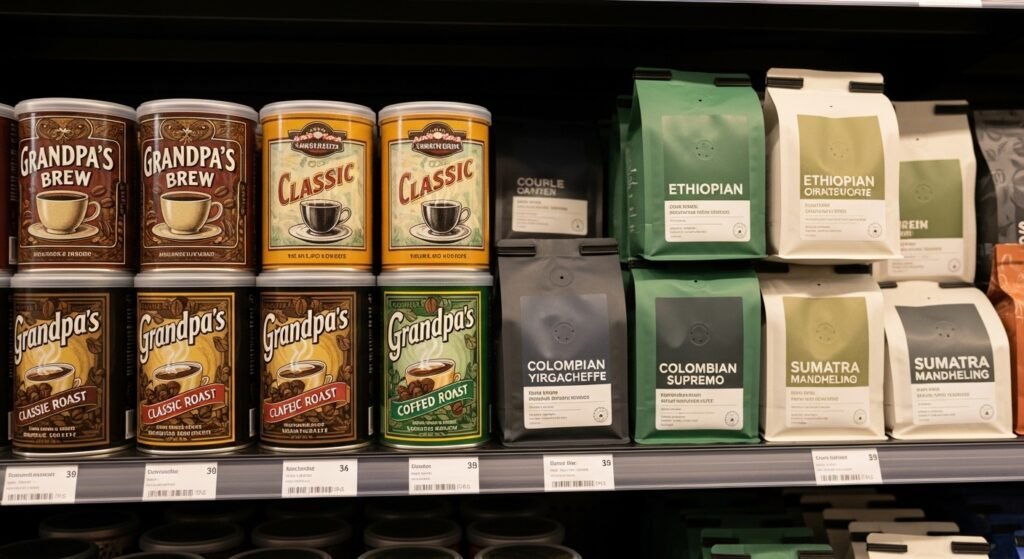
For my younger readers who have only ever known “Specialty Coffee,” I encourage you to look at those old metal tins with a bit of reverence. They represent a time when coffee was a pioneer, a soldier, and a companion to the working class. It was the era that taught us to love the ritual, even if the flavor hadn’t quite caught up yet.
Understanding the First Wave is essential for anyone How to Develop a Professional Palate: A 30-Year Guide. It gives you the “baseline.” It allows you to appreciate the incredible journey we’ve taken—from the boiling percolator to the delicate, nuanced extractions of today. Coffee didn’t just appear in our cups; it fought for its place there, one tin at a time.

Brown Christopher is 47 years old and has been passionate about coffee since he was 15. For more than three decades, he has explored coffee culture, brewing methods, and the flavors behind every cup. Through this blog, he shares simple tips and knowledge to help beginners better understand and enjoy coffee in their daily lives. ☕