
If you walk into a specialty coffee shop today, you will likely see a row of glass drippers, each with a slightly different silhouette. Some are sharp cones, others have flat bottoms, and some look like wavy accordions. To the casual observer, these might look like aesthetic choices—design pieces meant to decorate a minimalist counter. However, in the world of precision brewing, geometry is destiny. The shape of the vessel where water meets coffee is one of the most significant variables in determining the final balance of your brew.
When we talk about brewing, we often focus on the Water Quality or the Altitude of the Beans. But even with the perfect mineral balance and the finest high-altitude lot, the physical path that the water takes through the coffee bed dictates which flavors are emphasized and which are left behind. Understanding the physics of flow—and how different filter shapes manipulate it—is the key to unlocking the true potential of your favorite origin.
The Physics of the Cone: The V60 Phenomenon
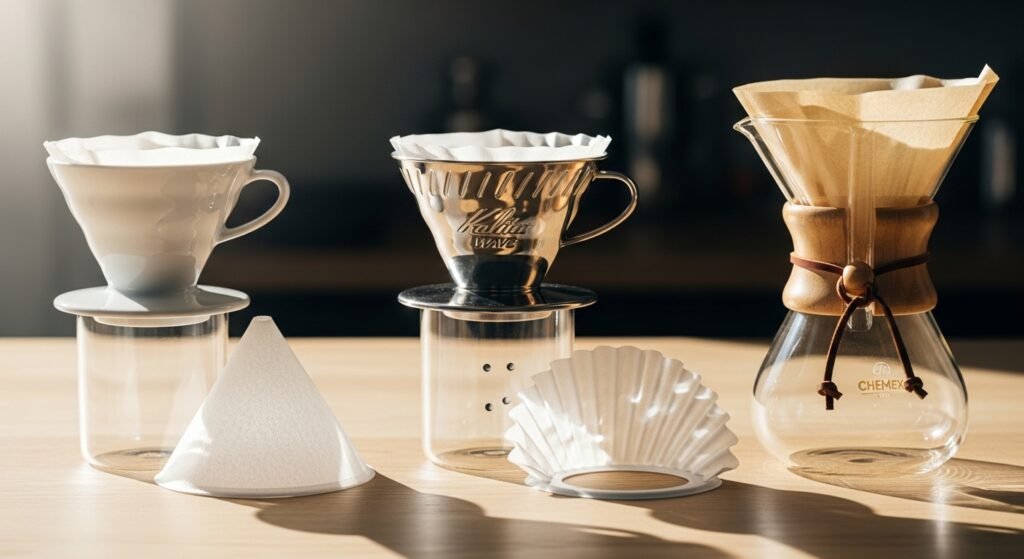
The conical dripper, epitomized by the Hario V60, is perhaps the most iconic tool in modern coffee. Its $60^{\circ}$ angle and large exit hole at the bottom create a very specific extraction dynamic.
In a cone-shaped filter, the coffee grounds settle into a deep, tapered bed. This means that as you pour water in the center, it must travel through a thicker layer of coffee than it does at the edges. This creates a “concentration of flavor” in the center of the cone. Because the water is forced through a dense path, it excels at highlighting the bright, acidic, and floral top notes of a coffee.
However, the V60 is notoriously difficult to master. Because the flow rate is determined entirely by the barista’s pour and the grind size, it is very easy to cause “channeling”—where water finds a path of least resistance and rushes through, leaving some grounds over-extracted and others under-extracted. This is why many enthusiasts spend so much time Calibrating Their Technique . If you get it right, you get a cup with unparalleled clarity; if you get it wrong, you get a muddy, inconsistent mess.
The Stability of the Flat Bottom: The Kalita Wave
On the other side of the geometric spectrum is the flat-bottom dripper, like the Kalita Wave or the December Dripper. Instead of a single large hole at the bottom of a cone, these devices have a flat floor with three small holes.
The physics here are completely different. In a flat-bottom brewer, the coffee grounds form a shallow, even bed. When you pour water, it stays in contact with all the grounds for a more uniform amount of time. There is no “deep center” for the water to navigate. This creates a much more forgiving extraction environment.
Flat-bottom brewers tend to emphasize sweetness and body. They produce a cup that is balanced, chocolatey, and consistent. While you might lose some of the “sparkling” acidity that a V60 provides, you gain a reliability that is hard to beat. It is the geometric equivalent of a safety net, ensuring that every sip has a similar Science of Aftertaste .
The Role of Paper Thickness and Porosity
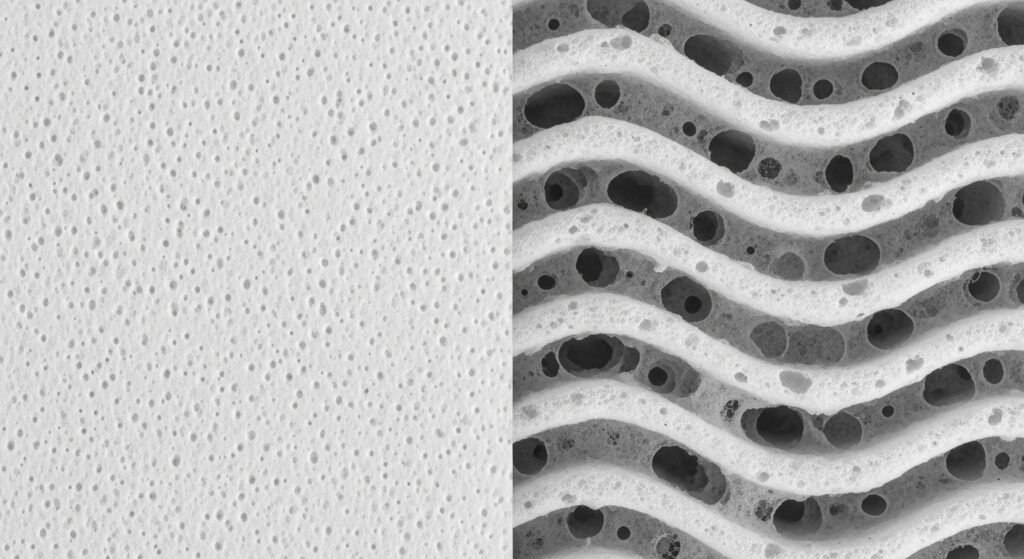
Geometry isn’t just about the shape of the plastic or ceramic dripper; it’s also about the paper itself. The thickness and weave of the filter act as a biological and chemical sieve.
-
Chemex Filters: These are up to 30% thicker than standard filters. They are designed to trap almost all the oils and “fines” (microscopic particles). This creates a cup that is remarkably tea-like and transparent. The geometry of the Chemex, combined with this heavy paper, slows down the flow, allowing for a long contact time without the bitterness often associated with immersion.
-
Wavy Filters: The ridges in a Kalita-style filter aren’t just for show. They create an air gap between the paper and the wall of the dripper. This prevents the “suction effect,” where the paper sticks to the glass and stalls the flow of water. By keeping the air moving, the ridges ensure that gravity—not vacuum pressure—dictates the extraction speed.
Flow Rate and Bed Depth: The Barista’s Lever
In my years of sensory testing, I have found that “Bed Depth” is the most underrated variable in brewing.
-
A deep bed (like in a V60) increases the contact time between water and coffee, favoring the extraction of heavier compounds.
-
A shallow bed (like in a flat-bottom) allows for a faster flow, which can be great for preventing bitterness in darker roasts.
When you choose a filter shape, you are essentially choosing how you want the water to “behave” as it passes through the coffee. In a cone, the water is focused and aggressive. In a flat bottom, the water is spread out and gentle.
This is why, when I host a Coffee Cupping, I often encourage people to brew the same coffee using two different shapes. It is a revelation to see how a bright Ethiopian bean can taste like jasmine tea in a V60 but transform into a sweet peach marmalade in a Kalita Wave.
Temperature Retention and Material Geometry
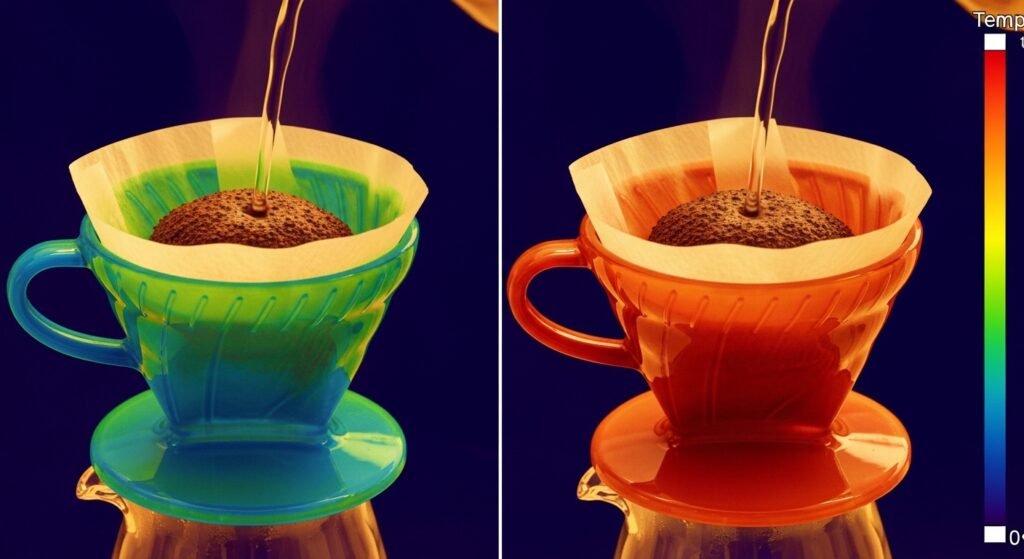
The material of the brewer—ceramic, glass, plastic, or metal—interacts with its shape to affect heat. Conical brewers often have more surface area exposed to the air, which can lead to faster heat loss. Plastic drippers, while perhaps less “premium” in feel, are actually the best for thermal stability because they don’t absorb the heat from the water.
If you are brewing at high altitudes where the Water Quality might be different, maintaining a stable temperature inside that geometric chamber is vital. A sudden drop in temperature in a V60 can stall the extraction of sugars, leaving you with a cup that is “hollow” or unpleasantly sharp.
Which Shape Should You Choose?
The “best” shape depends entirely on your palate and the coffee you have in your hand.
-
Choose a Cone (V60/Origami) if you have a high-quality, light-roasted coffee with complex acidity and floral notes. It is the best tool for “analytical” drinking where you want to identify every tiny nuance.
-
Choose a Flat Bottom (Kalita/Fellow Stagg) if you want a sweet, “comforting” cup of coffee, or if you are brewing a medium roast where balance is more important than acidity. It’s also the better choice for early mornings when your technique might not be perfect.
-
Choose a Chemex if you are brewing for multiple people and want the cleanest, most elegant mouthfeel possible.
Conclusion: The Architecture of the Morning
Brewing coffee is an art, but it is supported by the pillars of physics. Every time you place a filter into a dripper, you are setting up an architectural experiment. You are deciding how gravity will interact with your water and how the shape of the vessel will sculpt the flavor of the bean.
The geometry of flavor is a reminder that in coffee, every detail matters. From the Volcanic Soil the plant grew in to the $60^{\circ}$ angle of your dripper, each element plays a role in the symphony of the final cup. Don’t be afraid to experiment with different shapes. You might find that your favorite coffee has a side to its personality that you’ve never met before—all because of the shape of a piece of paper.
As you continue to refine your Professional Palate , remember that the equipment is there to serve the bean. The better you understand the physics of your tools, the more freedom you have to express the true heart of the coffee.

Brown Christopher is 47 years old and has been passionate about coffee since he was 15. For more than three decades, he has explored coffee culture, brewing methods, and the flavors behind every cup. Through this blog, he shares simple tips and knowledge to help beginners better understand and enjoy coffee in their daily lives. ☕