
In the early 1990s, when I started my journey in the specialty coffee industry, the landscape was unrecognizable compared to today. Back then, “manual brewing” usually meant a dusty French Press or a poorly maintained percolator in the back of a diner. We didn’t talk about flow rates, and the concept of a “gooseneck kettle” sounded like a specialized tool for a plumber. However, as the decades passed and the Third Wave of coffee washed over the world, one piece of equipment fundamentally changed how I perceive the liquid in my cup: the Hario V60.
Even with the rise of hyper-precise automated brewers and digital espresso profiles, there is something about the V60’s conical design that remains unmatched. It isn’t just about the aesthetics of the ceramic or the ritual of the pour; it is about the geometry of flavor. The $60^{\circ}$ angle, the internal spiral ribs, and the large exit hole create a specific fluid dynamic that rewards the experienced hand. After 30 years of tasting thousands of extractions, I still find that this method offers the most transparent window into the bean’s soul.

The Physics of the Cone: More Than Just a Shape
When you look at a V60, you are looking at a masterclass in hydraulic engineering. Unlike flat-bottom brewers that favor a more uniform, “safe” extraction, the V60 concentrates the water flow through the center of the coffee bed. This depth creates a complex layering of flavors.
The spiral ribs are not decorative; they are essential for airflow. By keeping the wet filter paper from sticking to the walls of the dripper, they allow air to escape, preventing the extraction from stalling. This is crucial for maintaining a consistent rate of fall. In my early years, we struggled with “choking” extractions in older ceramic drippers. The V60 solved this by using physics to ensure that the water never stops moving, which is the key to a bright, clean cup.
This clarity is especially important when you are dealing with high-quality beans. If you’ve spent time studying Kenyan Slingshots: That Unforgettable Tomato Acidity Explained, you know that a muddy extraction will kill those delicate phosphoric acids. The V60 preserves them by allowing for a faster, more controlled flow.
The Ritual of the Pour: Lessons from Three Decades
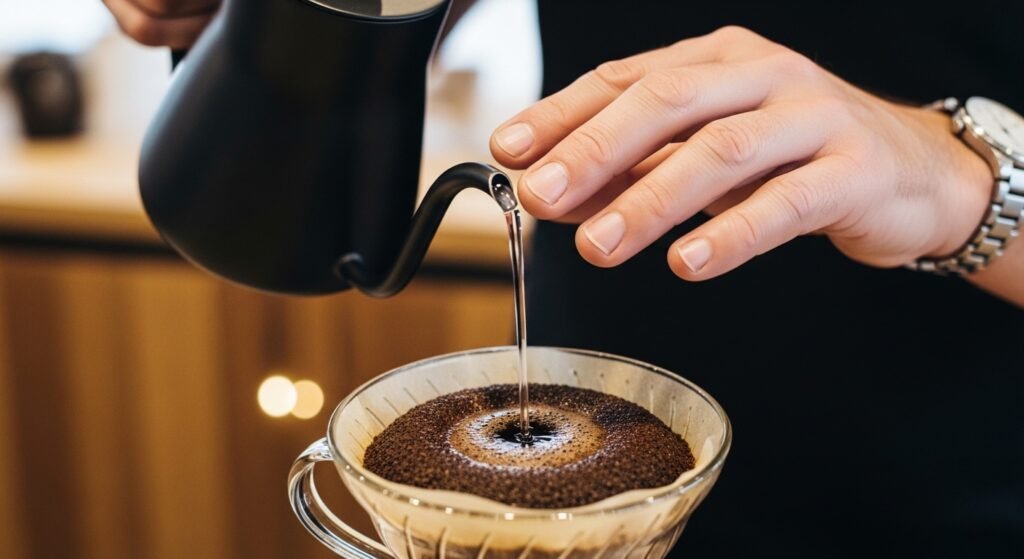
People often ask me why I don’t just use a machine. My answer is always the same: a machine can’t feel the resistance of the coffee bed. When I pour, I am looking for the “bloom”—that initial expansion of the grounds as they release carbon dioxide. The bloom tells me everything I need to know about the freshness of the roast and the density of the bean.
After three decades, my technique has evolved from rigid recipes to a more intuitive “feel.” I’ve learned that the height of your kettle and the force of your stream can drastically change the agitation. High agitation increases extraction, but it also risks bringing out dry, astringent tannins. This is where the precision of the gooseneck becomes a necessity rather than a luxury. It allows the brewer to place every drop of water with intention, acting like a conductor leading an orchestra.
Why Technique Trumps Technology
We live in an era where software can control every milliliter of water. Yet, the V60 remains a staple in World Barista Championships for a reason. It requires a human connection. If your grind is a fraction too coarse, the water will race through, leaving you with a sour, thin brew. If it’s too fine, you’ll end up with a bitter, over-extracted mess.
The V60 doesn’t hide your mistakes; it highlights them. This honesty is what makes it the ultimate teaching tool. For a seasoned professional, this “unforgiving” nature is a gift. It allows us to manipulate the variables—temperature, grind size, and pour speed—to find the “sweet spot” of a specific lot. This process of trial and error is a fundamental part of How to Develop a Professional Palate: A 30-Year Guide, as it forces you to link cause and effect in every sip.
The Paper Factor: Clarity vs. Body
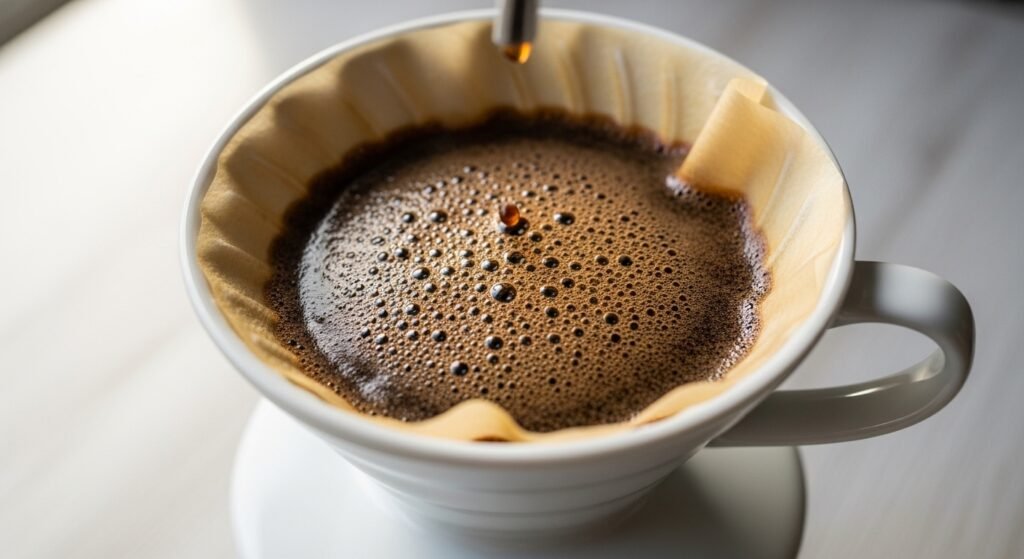
One of the most debated topics in my 30 years has been the filter paper. Many beginners overlook the paper, but it is effectively the “kidney” of your coffee. The V60’s thin, high-quality filters are designed to trap oils and fines while allowing the aromatic compounds to pass through.
This results in a “tea-like” body that I find incredibly refreshing. While I enjoy the heavy, silken texture of a French Press on a cold winter morning, the V60 is my daily driver because of its transparency. It allows the floral notes of a Geisha or the citrus snap of an Ethiopian heirloom to shine without being obscured by heavy oils or sediment.
A Legacy of Excellence
As I look back at how far the industry has come, I am struck by how some things remain constant. The Hario V60 is a testament to the fact that good design is timeless. It bridges the gap between the old world of “just a cup of joe” and the new world of “sensory analysis.”
Brewing a V60 is a meditative act. It requires you to slow down, to watch the water, and to breathe in the aromatics as they fill the room. In a world that is increasingly digital and automated, this manual ritual is a necessary anchor. It reminds us that the best things in life—and the best cups of coffee—take time, precision, and a bit of soul.
Whether you are a newcomer or a veteran like me, the V60 offers a lifetime of discovery. You never truly “master” it; you simply learn to dance with it a little better every morning. And that, after 30 years, is why it still sits on my counter every single day.

Brown Christopher is 47 years old and has been passionate about coffee since he was 15. For more than three decades, he has explored coffee culture, brewing methods, and the flavors behind every cup. Through this blog, he shares simple tips and knowledge to help beginners better understand and enjoy coffee in their daily lives. ☕