
If South American coffees are the comfort food of the brewing world—stable, chocolatey, and nutty—then African coffees are the avant-garde cinema. They are challenging, vibrant, and often completely transform a person’s perception of what coffee can be. For many, the first sip of a high-quality Ethiopian or Kenyan bean is a “lightbulb moment.” It is the point where they stop seeing coffee as a bitter caffeine delivery system and start seeing it as a complex botanical beverage, closer to a fine wine or a floral tea.
The East African terroir is unique. It combines extreme elevations, ancient heirloom varieties, and distinct processing methods that have been refined over centuries. Evaluating the Lingering Flavors of High-Altitude Beans Grown Above 2,000 Meters becomes an entirely different exercise when you are dealing with the volcanic soils of the Great Rift Valley. To truly appreciate these coffees, one must understand the individual personalities of the two heavyweights of the region: Ethiopia and Kenya.
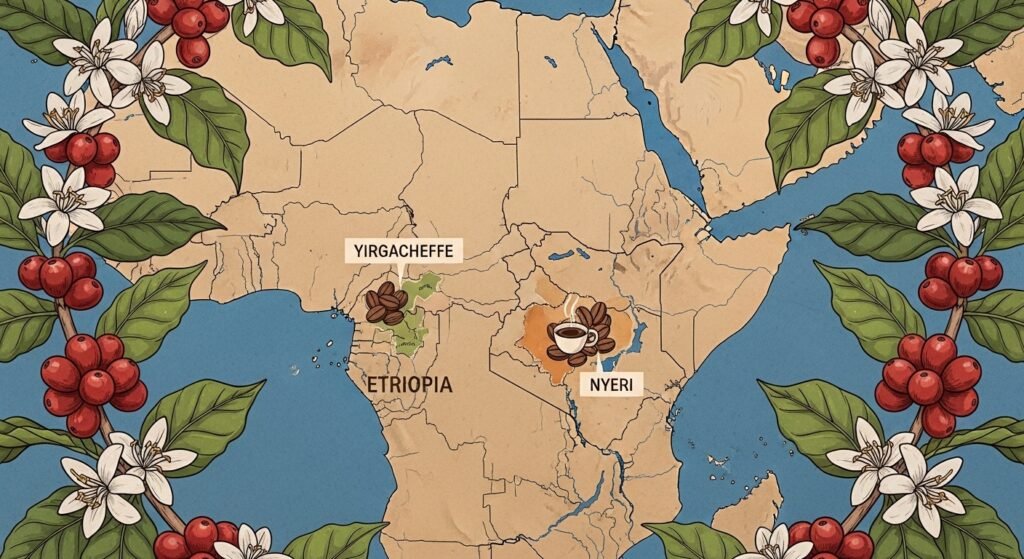
Ethiopia: The Birthplace of the Bean
Ethiopia is the genetic homeland of Arabica coffee. Unlike most other producing countries, where coffee was introduced as a colonial crop, coffee grows wild in the Ethiopian forests. This means Ethiopia possesses a genetic diversity that is unmatched anywhere else on Earth. Thousands of “landrace” varieties—often simply labeled as “Ethiopian Heirloom”—provide a palette of flavors that cannot be replicated in a laboratory.
The Flavor Profiles of Origin
In Ethiopia, the processing method (Washed vs. Natural) creates two completely different experiences:
-
Washed Ethiopia (e.g., Yirgacheffe/Sidamo): These are famous for their tea-like body and intense floral aromatics. You will find notes of jasmine, lemon zest, and bergamot. It is the ultimate test of your Water Quality and Its Invisible Role in High-Clarity Extractions . If your water is too hard, these delicate florals will simply vanish.
-
Natural Ethiopia (e.g., Guji/Harrar): These are “fruit bombs.” Because the coffee cherry is dried with the fruit still on the bean, the sugars ferment slightly, infusing the coffee with notes of dried blueberry, strawberry, and even tropical fruits like pineapple.
Kenya: The Precision of Acidity
If Ethiopia is about floral elegance, Kenya is about raw power and surgical precision. Kenyan coffee is often regarded by roasters as some of the highest-quality coffee in the world, largely due to the country’s exceptional research and grading systems.
The hallmark of a great Kenyan coffee is its “phosphoric acidity.” While most coffees have malic (apple) or citric (lemon) acidity, Kenyan beans often have a sparkling, effervescent quality that tingles on the tongue. This is often paired with a deep, savory sweetness that reminds tasters of blackcurrant, tomato, or dark berries.
This intense profile is why Understanding Why Some Professional Baristas Prefer Specific Filter Geometries is so important for Kenyan beans. A conical filter, like a V60, can help highlight that sharp, brilliant acidity, whereas a flat-bottom brewer might make it taste too heavy or “jammy.“
The “SL” Varieties and the Kenyan Auction System
Kenya’s success isn’t just a result of the soil; it’s a result of science. In the 1930s, Scott Laboratories (hence the name “SL”) developed varieties like SL-28 and SL-34. These plants were bred specifically to thrive in the high altitudes of the Aberdare Mountains and to produce a specific flavor profile.
Furthermore, the Kenyan auction system incentivizes quality. Farmers are paid based on the grade of the bean (AA being the largest and usually highest quality), which pushes the entire industry toward excellence. When you are Calibrating Your Extraction for an Intense African Espresso , you are working with a bean that has been meticulously sorted by size and density before it even left the port of Mombasa.
Processing: The Kenyan Washed Method
Kenya is famous for its “Double Washed” process. The cherries are pulped, fermented, washed, and then fermented again in clean water. This labor-intensive process is what gives Kenyan coffee its legendary “cleanliness.” There is zero “muddiness” in the cup. This transparency is what makes the Science of Aftertaste and Its Lingering Sweetness so apparent in these coffees. The flavor doesn’t just sit there; it evolves as it cools, shifting from tart citrus to sweet, dark honey.

Brewing the “Kings of the Rift”
When brewing Ethiopian or Kenyan beans, you have to be careful. Because they are often grown at very high altitudes, the beans are extremely dense. This means they can be harder to extract than a soft Brazilian bean.
-
Water Temperature: Use a high temperature (around $94^{\circ}C$ to $96^{\circ}C$) to penetrate the dense cellular structure of the bean.
-
Grind Size: Don’t be afraid to go slightly finer. You want to maximize the surface area to catch those fleeting floral aromatics.
-
The Brew Method: While these beans are incredible in a pour-over, they also make a Refreshing and Complex Cold Brew for a Summer Afternoon . An Ethiopian cold brew often tastes like a peach-infused iced tea rather than a traditional coffee.
The Cultural Significance of the Coffee Ceremony
In Ethiopia, coffee is more than an export; it is a social glue. The “Buna” ceremony is a daily ritual where the beans are roasted in a pan, ground by hand with a mortar and pestle, and brewed in a clay pot called a jebena.
This traditional approach reminds us that while we obsess over Maintaining Our Modern Equipment and Grinders , the heart of coffee remains in the communal act of sharing a drink that has been prepared with care. The aroma of frankincense and freshly roasted coffee in an Ethiopian home is a sensory experience that no modern cafe can fully replicate.
Conclusion: Expanding Your Horizon
The rise of African coffees has fundamentally changed the specialty industry. They have challenged our palates and forced us to rethink our brewing techniques. Whether you prefer the floral, “princess-like” elegance of a Washed Yirgacheffe or the bold, “knight-like” intensity of a Kenyan AA, these beans offer a level of excitement that is hard to find elsewhere.
By exploring these origins, you are doing more than just drinking a cup of coffee; you are participating in a historical and botanical journey. You are learning how soil, altitude, and genetics combine to create a masterpiece. So, the next time you see a bag labeled “Nyeri” or “Sidamo,” take the leap. Adjust your water, check your grind, and get ready for a flavor experience that will linger long after the last drop is gone.

Brown Christopher is 47 years old and has been passionate about coffee since he was 15. For more than three decades, he has explored coffee culture, brewing methods, and the flavors behind every cup. Through this blog, he shares simple tips and knowledge to help beginners better understand and enjoy coffee in their daily lives. ☕