
In the world of specialty coffee, the experience does not end when you swallow. In fact, for many connoisseurs, the most critical moment of a tasting session is the “finish” or “aftertaste.” While the initial sip provides immediate notes of acidity and sweetness, the aftertaste is a slow-moving chemical ghost that can haunt the palate for up to fifteen minutes. This lingering sensation is what separates a generic commodity bean from a High-Altitude, Strictly Hard Bean (SHG) from the Mountains of Colombia or Ethiopia .
But what is physically happening in our mouths? Aftertaste (scientifically known as “finish”) is the result of specific molecules that are less soluble in water and more likely to stick to the soft tissues of the throat and tongue. To truly Analyze the Science of Aftertaste and How It Defines Quality , we must look at the intersection of organic chemistry, fluid dynamics, and human biology. When a coffee lingers beautifully, it is a sign of a perfect harvest, a meticulous roast, and a Technically Flawless Brewing Execution .
The Chemistry of Persistence: Lipids and Colloids
The primary reason coffee lingers is the presence of lipids (oils) and colloids (microscopic particles). When you brew coffee, especially using methods that do not use thick paper filters—like the French Press or a Traditional Moka Pot —you are allowing a high concentration of coffee oils to enter the cup.
These oils act as carriers for aromatic compounds. Because oils are hydrophobic (water-fearing), they do not wash away easily with your saliva. Instead, they form a thin film on the surface of your tongue and the back of your throat. As your body heat warms this film, it continuously releases “volatiles” (aroma gases) that travel up the back of your throat to your olfactory sensors. This is why you can “taste” the coffee even when your mouth is empty.
The complexity of these oils is directly linked to the bean’s origin. For instance, African Coffees from Kenya and Ethiopia are famous for having “bright” and “clean” aftertastes, while Brazilian naturals often provide a heavy, chocolatey finish. This is due to the different concentrations of sucrose and trigonelline developed during the Slow Maturation Process at High Altitudes .
Retronasal Olfaction: The Real “Taste”
Most people believe they taste coffee primarily with their tongue. However, the tongue is limited to identifying only five basic tastes: sweet, sour, salty, bitter, and umami. The “flavor”—the notes of jasmine, blueberry, or toasted hazelnut—is actually perceived by the nose through a process called retronasal olfaction.
When you swallow, a small amount of air is pushed from your throat up into your nasal cavity. This air carries the molecules trapped in the coffee oils. If your equipment is dirty, these oils will be tainted. This is why Maintaining Your Grinder and Removing Rancid Oil Residue is so important; if old oils are present, your retronasal experience will be dominated by bitterness and “stale” notes, completely masking the bean’s natural profile.
The Role of Water and Mineral Balance
The longevity of the finish is also dictated by the solvent used to extract it. Water is the vehicle that carries the flavor. If your Water Quality is Poor or Lacks the Correct Mineral Balance , the aftertaste will be short and “clipped.“
-
Magnesium: This mineral is excellent at “grabbing” high-energy flavor molecules, ensuring they are pulled out of the bean and into the liquid.
-
Bicarbonates: If your water has too much bicarbonate (high alkalinity), it will neutralize the organic acids. This results in an aftertaste that feels “chalky” or “dry,” a common defect known as “astringency.“
When Hosting a Comparative Cupping at Home , pay close attention to the “mouthfeel” or “texture” of the water. A balanced water profile will make the coffee feel “silky” or “velvety,” which directly contributes to a more pleasant and enduring aftertaste.
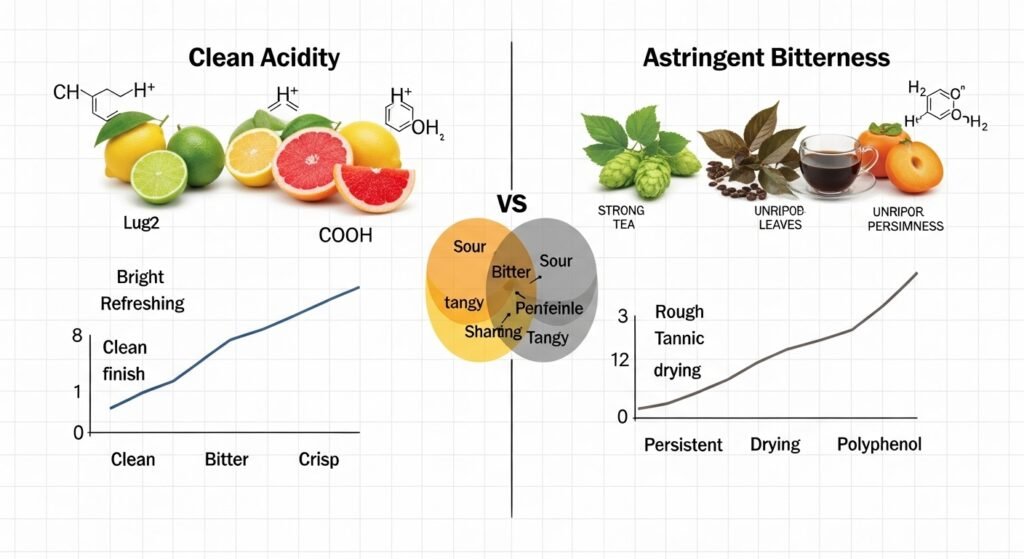
Bitterness vs. Astringency: The Dry Finish
A common confusion in sensory analysis is the difference between bitterness and astringency.
-
Bitterness is a taste perceived on the tongue, often caused by caffeine or over-roasted compounds.
-
Astringency is a physical sensation of dryness or puckering, similar to drinking over-steeped tea or unripe fruit.
Astringency in the aftertaste is usually a sign of over-extraction or poor-quality water. It happens when polyphenols (tannins) bind to the proteins in your saliva, removing the “lubrication” from your mouth. To fix this, you may need to Calibrate Your Extraction by Using a Coarser Grind or Lowering the Water Temperature . A high-quality specialty coffee should have a “succulent” finish that makes you want to take another sip, not a dry finish that leaves you reaching for a glass of water.
Aftertaste in Specialty Cocktails
The science of aftertaste is particularly important when using coffee as an ingredient. In a Sophisticated Modern Carajillo , the sugars and botanicals of the liqueur (like vanilla and citrus) must harmonize with the coffee’s finish.
If the coffee has a short, weak aftertaste, the cocktail will taste unbalanced—it will start with a coffee flavor that quickly disappears, leaving only the taste of alcohol. By Using Dense, High-Altitude Beans with a Strong Lipid Content , you ensure that the coffee’s “soul” survives the mixing process and lingers alongside the sweet notes of the liqueur.
Temperature and the Evolving Finish
As we noted in the Step-by-Step Guide to Coffee Cupping , coffee changes as it cools. The aftertaste you perceive when the coffee is $70^{\circ}C$ will be very different from what you perceive at $30^{\circ}C$.
-
Hot: The finish is dominated by toasted notes and volatile aromatics.
-
Cold: The finish reveals the true quality of the acids and sugars.
This is why “Cold Brew” has such a unique aftertaste. As we explore in the Science of Cold Brew , the lack of heat means fewer bitter compounds are extracted, resulting in an aftertaste that is incredibly sweet, smooth, and reminiscent of milk chocolate or molasses.
How to Train Your Palate for Aftertaste
Training yourself to recognize aftertaste requires patience. After you swallow a sip of coffee, try the following protocol:
-
Close your eyes: This reduces external sensory input.
-
Exhale slowly through your nose: This activates retronasal olfaction.
-
Wait: Count to ten. Does the flavor stay the same, or does it change? (e.g., does a citrus start turn into a chocolatey finish?)
-
Note the “tactile” sensation: Is your tongue smooth, or does it feel “sandy”?
By Applying This Level of Technical Rigor to Your Daily Routine , you will begin to notice the subtle differences between Ethiopian Washed Heirlooms and other origins. You will realize that the “sweetness” of a coffee is often found in the breath you take after the sip.
Conclusion: The Memory of the Bean
Aftertaste is the memory of the coffee. It is the final word in the conversation between the farmer, the roaster, and the barista. A long, sweet, and complex finish is the ultimate proof that every step of the process was handled with care—from the Mineral Balance of the Water to the Precision of the Grinder’s Burrs .
When you learn to appreciate the science of aftertaste, you stop rushing through your cup. You allow the coffee to occupy your senses, realizing that the best part of the experience might just be the flavor that stays with you long after the cup is empty.
Are you ready to slow down and listen to what your coffee is saying?

Brown Christopher is 47 years old and has been passionate about coffee since he was 15. For more than three decades, he has explored coffee culture, brewing methods, and the flavors behind every cup. Through this blog, he shares simple tips and knowledge to help beginners better understand and enjoy coffee in their daily lives. ☕