
Among manual brewing devices, the French Press is often the most underrated. While over the or the , the French Press is frequently relegated to the back of the cupboard, accused of producing “muddy” or “sediment-heavy” coffee.
However, when approached with scientific rigor, the French Press is a master of flavor extraction. As a full-immersion method, it allows for a uniform dissolution of sugars and oils that gravity-fed methods simply cannot match. To achieve a clean, syrupy, and vibrant cup, you must master the variables of and the specific .
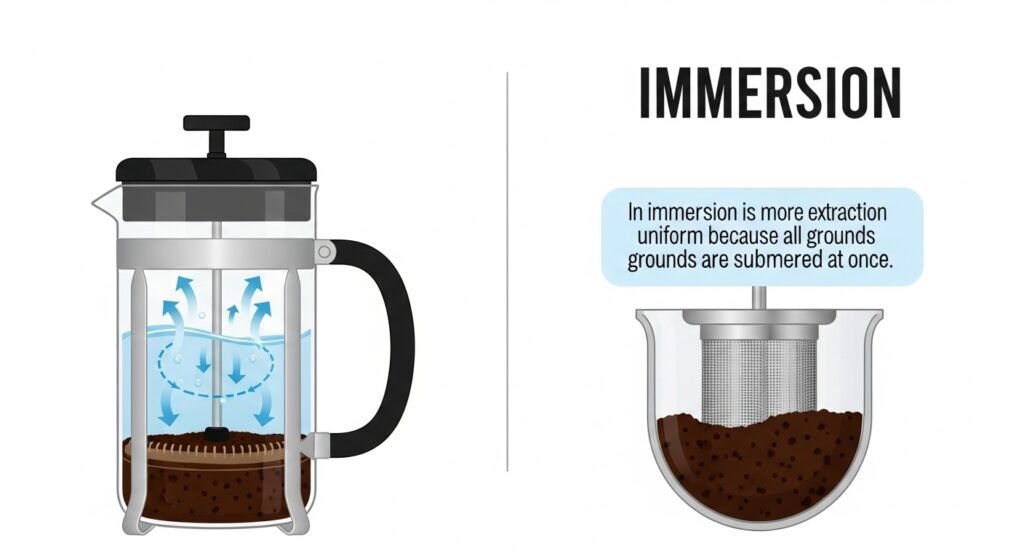
The Physics of Particle Size and Surface Area
The most common failure in French Press brewing is a poor grind. Because the coffee remains in contact with the water for several minutes, the particles must be coarse—resembling kosher salt or cracked peppercorns.
-
Consistency is Key: If your , it will produce “fines” (microscopic dust). These fines over-extract instantly, creating bitterness, and they bypass the metal mesh filter, creating that dreaded silty texture.
-
The Resistance Factor: Unlike paper filters, the metal mesh of a French Press allows the natural lipids (oils) to pass through. This is what creates the “heavy” that French Press lovers crave.
Thermal Dynamics: The 4-Minute Myth
Most instructions suggest a 4-minute steep. However, modern sensory science suggests that for , a longer, more stable steep produces a better result.
-
The Bloom (0:00 – 0:45): Pour twice the weight of the coffee in water. This releases $CO_2$. If your beans are fresh, you will see a thick “crust” form.
-
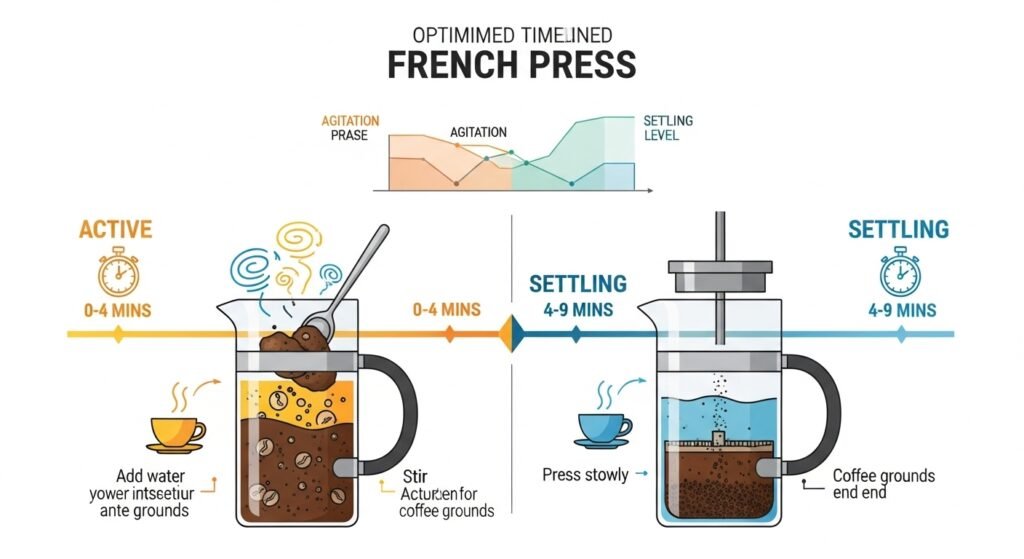
The Infusion (0:45 – 4:00): Pour the remaining water and place the lid on (without plunging) to trap the heat.
-
The “James Hoffmann” Technique (4:00 – 9:00): At the 4-minute mark, do not plunge. Instead, stir the crust so the grounds sink. Use two spoons to remove any floating foam or oils. Wait another 5 minutes. During this time, gravity does the work that the plunger usually does—settling the silt at the bottom.
The Impact of Filter Hygiene
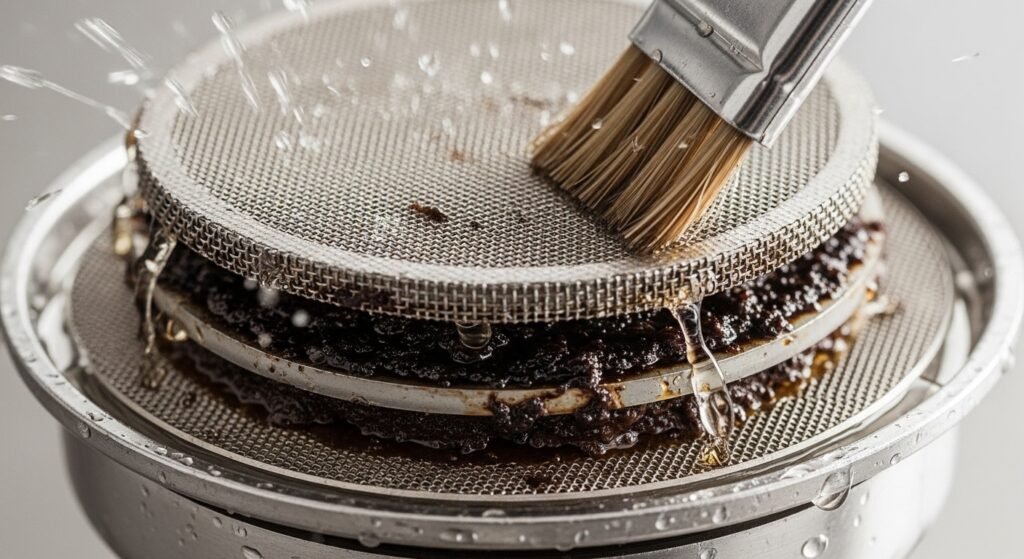
The French Press is a notorious hiding spot for rancid coffee oils. The metal mesh and the spiral spring assembly can trap old grounds that oxidize over time.
If you after every few uses, the in your fresh cup will be dominated by a stale, “fishy,” or metallic flavor. A professional-grade maintenance routine is non-negotiable for anyone brewing delicate .
Water Chemistry: The Silent Extraction Tool
Because the water sits with the coffee for nearly ten minutes, its chemical makeup is vital. If your water is , the extraction will be aggressive and “chalky.”
Ideally, use water with a moderate mineral content to emphasize the sweetness. When you , you will find that the French Press is the best method for identifying “savory” notes—like broth, tomato, or herbs—which are often lost in paper-filtered methods.
Selecting the Right Terroir for Immersion
Not all coffees are suited for the French Press.
-
The Winners: and earthy Indonesian coffees shine here. The immersion method amplifies their inherent chocolate, nut, and spice notes.
-
The Challenges: Very light-roasted, can sometimes taste “muddy” in a French Press. For these, a very clean, coarse grind and the 9-minute “no-plunge” method are required to maintain clarity.
The Final Pour: Decanting is Key
A common mistake is leaving the coffee in the French Press after plunging. This leads to “over-steeping,” as the grounds at the bottom continue to extract, making the last half of your cup unpleasantly bitter.
As soon as your brew is ready, decant the entire volume into a carafe or your mug. This “stops the clock” on the extraction and preserves the you worked so hard to achieve.
Conclusion: Engineering the Classic
The French Press is a tool of patience. It rewards those who understand that great extraction takes time and that is the foundation of all flavor. By and respecting the physics of immersion, you can produce a cup that is as sophisticated and clean as any modern dripper, but with a richness that only a press can provide.
Stop rushing the plunge. Respect the settling time, , and let the French Press show you the true depth of your favorite mountain-grown beans.

Brown Christopher is 47 years old and has been passionate about coffee since he was 15. For more than three decades, he has explored coffee culture, brewing methods, and the flavors behind every cup. Through this blog, he shares simple tips and knowledge to help beginners better understand and enjoy coffee in their daily lives. ☕