
One of the most profound revelations for a new specialty coffee drinker is the discovery that coffee can be naturally sweet. In the world of commodity coffee, sweetness is often something added via syrups or refined sugar to mask bitterness. However, in the realm of High-Altitude Specialty Beans from Regions like Ethiopia and Brazil , sweetness is an inherent chemical property. It is the result of a long, slow maturation process where the coffee cherry synthesizes complex carbohydrates into simple sugars.
To identify these sugars, one must move beyond the basic “sweet” label and begin to categorize the specific “sugar profiles” present in the cup. This requires an understanding of organic chemistry, the Technical Extraction of Solubles , and the biological mechanics of the human tongue. Mastering the identification of sweetness is the ultimate goal of Professional Coffee Cupping and Sensory Analysis .
The Origin of Sweetness: From Tree to Seed
Sweetness in coffee begins with photosynthesis. The coffee tree produces sucrose (table sugar) in its leaves and transports it to the developing fruit. The higher the altitude, the slower the fruit develops, allowing for a greater concentration of these precursors.
During the roasting process, these sugars undergo two critical chemical transformations:
-
The Maillard Reaction: A reaction between amino acids and reducing sugars that creates the complex “toasted” and “savory” flavors.
-
Caramelization: As the temperature rises, simple sugars break down into hundreds of new aromatic compounds, creating the deep, dark sweetness we associate with caramel, butterscotch, and molasses.
If your Brewing Equipment is Clogged with Rancid Oils , these delicate sugar profiles will be instantly obscured by a persistent, plastic-like bitterness. A clean machine is a prerequisite for a sweet cup.
Categorizing the Sugar Profiles
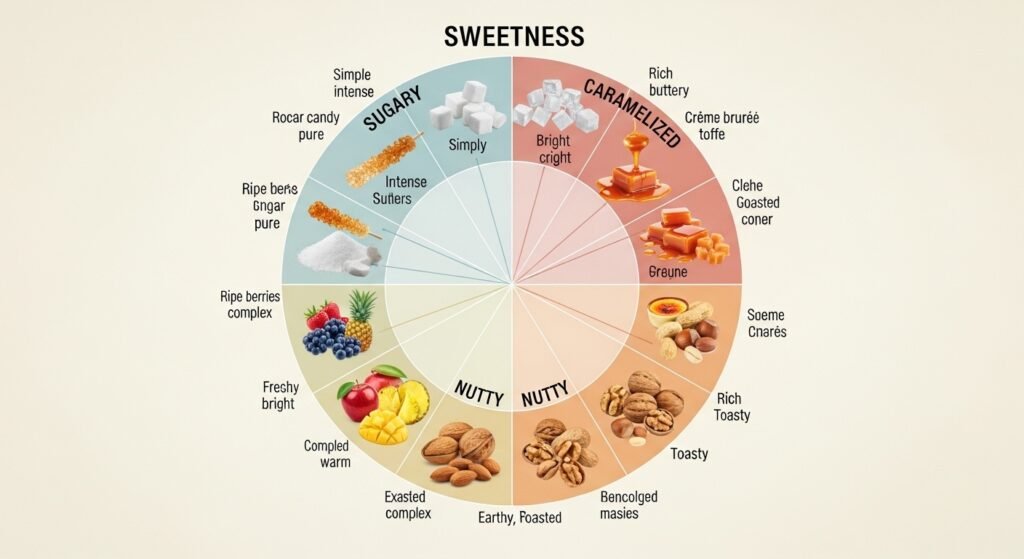
In specialty coffee, we rarely find “pure” sugar sweetness. Instead, we find “analogous” sweetness—flavors that remind our brains of other sweet foods.
1. Simple Sugars (White Sugar, Syrupy Sweetness)
This is the most basic form of sweetness, often found in washed coffees. It is “clean” and does not have much of an aftertaste. It acts as a foundation for other flavors.
2. Caramel and Toffee (The Cooked Sugars)
Common in medium-roasted Brazilian and Central American coffees. These sugars have a slightly “burnt” edge that provides depth and a “heavy” mouthfeel. This is often the result of perfect Espresso Calibration , where the high pressure emphasizes the creamy, caramelized lipids of the bean.
3. Fruity Sweetness (Fructose and Glucose)
Primarily found in Natural Processed African Coffees . This sweetness is intertwined with acidity, making it taste like ripe berries, stone fruits (peaches/apricots), or tropical fruits (mango/pineapple). Identifying this requires a high level of Sensory Perception and Palate Training .
The Physics of Perception: Why Temperature Matters
Our ability to perceive sweetness is highly dependent on the temperature of the liquid. The human tongue is most sensitive to sweet compounds when they are between $35^{\circ}C$ and $45^{\circ}C$—close to our body temperature.
When coffee is boiling hot, the heat receptors on the tongue send “pain” signals to the brain that can drown out subtle chemical signals. As the coffee cools, the Science of Aftertaste begins to reveal the true sugar profile. This is why professional cuppers wait for the coffee to reach a “warm-to-cool” state before making a final judgment. If a coffee maintains its sweetness even as it gets cold, it is a sign of exceptional agricultural quality and Perfect Water Chemistry .
The Interaction of Sweet and Sour
In the best coffees, sweetness and acidity are not separate; they are balanced. This is often called “Sweet Acidity.” Think of the difference between a lemon (pure acid) and a ripe orange (acid plus sugar).
If your water has Too Much Bicarbonate (High Alkalinity) , it will neutralize the acids, making the sweetness taste “flat” or “dull,” like a soda that has lost its carbonation. Conversely, if your water is too soft, the acids will be so sharp that they “mask” the sweetness entirely. Achieving the correct Mineral Balance is the only way to allow the natural sugars to shine.
How to Train Your “Sweetness Palate”
Identifying these profiles takes practice. You can perform a simple “Calibration Exercise” at home:
-
The Sugar Test: Dissolve different types of sugar (White, Demerara, Honey, Maple Syrup) in hot water and taste them blindly. Note how the “texture” of the sweetness changes.
-
The Comparative Cupping: Brew two different coffees—one Washed Ethiopian and one Natural Brazilian . Compare the “Type” of sweetness. Is one like a red fruit and the other like a roasted nut?
-
The Grind Adjustment: Take the same coffee and brew it at three different grind settings. Notice how the sweetness disappears into bitterness when the grind is too fine, or turns into a “vegetal” sourness when the grind is too coarse.

Sweetness and the “Finish”
The ultimate test of sweetness is the Aftertaste. When you swallow high-quality coffee, the back of your throat should feel “coated” in a sweet, clean film. This is the result of long-chain carbohydrates that are not immediately washed away by saliva.
If you experience a dry, “puckering” sensation (astringency), the sweetness has been compromised, likely by Poor Equipment Hygiene or over-extraction. A truly sweet coffee leaves you with a lingering “memory” of sugar that makes you crave the next sip. This is the hallmark of High-Altitude, Dense Beans that have been treated with technical respect.
Conclusion: The Reward of Precision
Seeking sweetness in coffee is a journey into the heart of the bean’s biology. It requires us to move past the “bitter” stereotype and embrace the complexity of a fruit that has been grown, roasted, and brewed with Scientific Rigor.

Brown Christopher is 47 years old and has been passionate about coffee since he was 15. For more than three decades, he has explored coffee culture, brewing methods, and the flavors behind every cup. Through this blog, he shares simple tips and knowledge to help beginners better understand and enjoy coffee in their daily lives. ☕