
Imagine spending fifty dollars on a rare, high-altitude Geisha lot from Ethiopia. You have the best burr grinder, a precision gooseneck kettle, and you’ve spent an hour dialing-in your espresso. Yet, when you take a sip, the coffee tastes flat, dull, and remarkably uninspiring. You check your technique, you check your roast date, but everything seems perfect. What went wrong?
The answer is likely flowing from your kitchen tap.
Water is the solvent that does the heavy lifting in every extraction. It is the vehicle that carries the flavors from the dry grounds to your palate. If the water is “empty,” it will over-extract and become aggressive. If the water is “full” of the wrong minerals, it will refuse to pick up the coffee’s delicate character. Understanding the chemistry of water is the final frontier for anyone looking to Develop a Professional Palate.
The Solvent Paradox: Why Pure Water is Bad
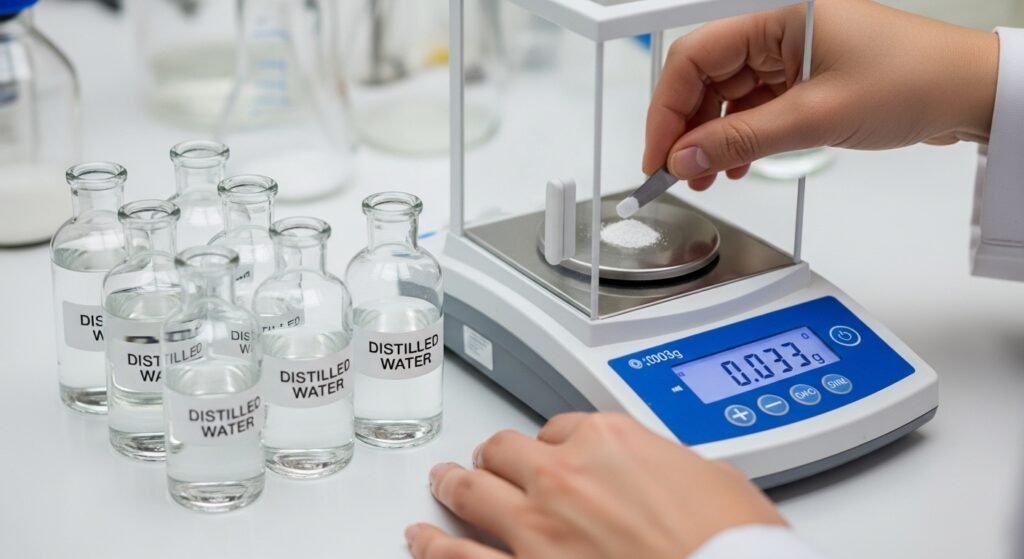
A common misconception among home brewers is that distilled or Reverse Osmosis (RO) water is the best choice because it is “pure.” In reality, pure $H_{2}O$ is a terrible medium for brewing coffee.
Extraction is a chemical exchange. For the water to “pull” the flavors out of the coffee cells, it needs help from specific minerals. Distilled water is chemically “hungry”; it is so empty that it attacks the coffee grounds indiscriminately, pulling out bitter tannins and woody cellulose along with the good oils. The result is a cup that tastes salty, thin, and strangely sour.
To achieve the Science of Aftertaste that defines specialty coffee, the water must contain a balanced “buffer” of minerals. These minerals act as hooks, grabbing onto specific flavor compounds and dragging them into the liquid.
The Key Players: Magnesium, Calcium, and Bicarbonate
In the context of brewing, three specific chemical components dictate the quality of your cup:
-
Magnesium ($Mg^{2+}$): This is the strongest “flavor extractor.” Magnesium ions are small and have a high charge density, making them excellent at pulling out sharp, fruity, and acidic notes. If you want to taste the citrus brightness of a Kenyan coffee, you need a healthy amount of magnesium in your water.
-
Calcium ($Ca^{2+}$): Calcium is more mellow. It tends to highlight the heavier, sweeter, and creamier notes like chocolate and caramel. However, too much calcium leads to “limescale” buildup, which we know can ruin expensive machines.
-
Bicarbonate (Alkalinity): This is the “buffer.” Bicarbonate’s job is to regulate the acidity. If your water has too much bicarbonate, it will neutralize the coffee’s natural acids, making a vibrant high-altitude bean taste chalky and dull. If it has too little, the coffee will taste sharp and vinegary.
Total Dissolved Solids (TDS): Finding the Goldilocks Zone
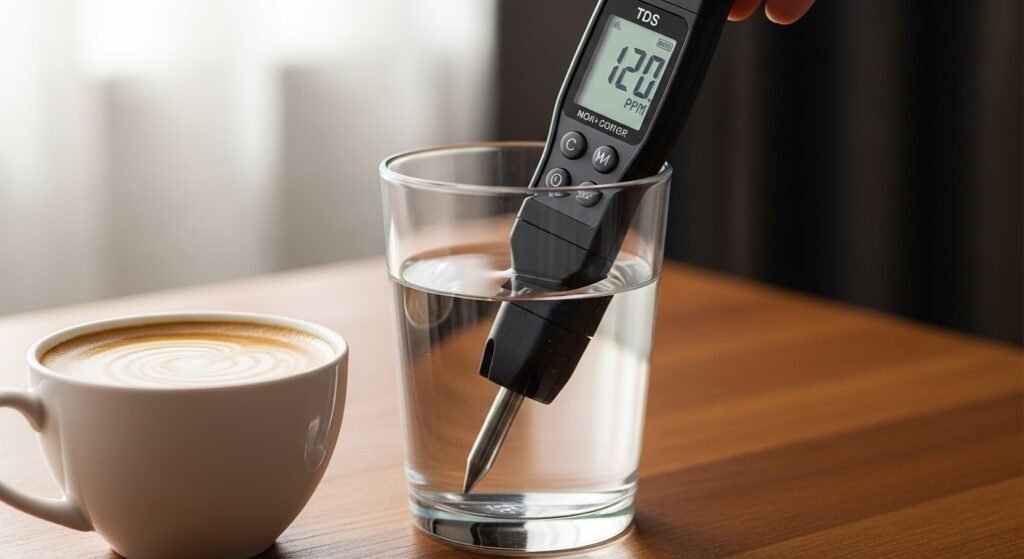
When professionals talk about water, they often refer to TDS—Total Dissolved Solids. This is a measurement of all the organic and inorganic substances dissolved in the water, expressed in parts per million (ppm).
-
Low TDS (< 50 ppm): The water is too soft. Extraction will be uneven and often overly acidic or “empty.”
-
High TDS (> 250 ppm): The water is too hard. The “solvent” is already full of minerals, leaving no room for the coffee flavor. This leads to a flat, muddy cup.
-
The Ideal Zone (75 ppm to 150 ppm): This is the Specialty Coffee Association (SCA) standard. In this range, there is enough mineral content to assist extraction but not enough to interfere with the flavor.
Chlorine and “Off” Flavors
Beyond the minerals, we have to consider contaminants. Most municipal tap water contains chlorine or chloramine to keep it safe for drinking. While great for health, chlorine is a disaster for coffee. Even in tiny amounts, it reacts with the phenols in coffee to create “chlorophenols,” which taste like medicinal plastic or Band-Aids.
This is why a basic charcoal filter is the bare minimum for any setup. Even if you don’t want to mess with mineral chemistry, removing the chlorine will instantly improve the Aftertaste of your brews. It is the simplest way to honor the modern carajillo or your morning pour-over.
Creating Your Own “Coffee Water”
If your tap water is unusable, you have three options to take control of your chemistry:
1. The Bottled Water Shortcut
Not all bottled water is created equal. Look for “Spring Water” rather than “Mineral Water.” Many professionals recommend brands like Volvic or Crystal Geyser (from specific sources) because their natural mineral balance happens to sit right in the SCA “Goldilocks Zone.” Avoid “Purified Water” unless you plan to add minerals back in.
2. Mineral Packets (Third Wave Water)
This has revolutionized the home brewing scene. You take a gallon of distilled water and add a pre-measured packet of minerals. This guarantees a perfect balance of magnesium, calcium, and bicarbonate every single time. It eliminates the water variable entirely, allowing you to focus on Calibrating Your Espresso.
3. The DIY Chemist Approach
For the truly obsessed, you can mix your own concentrates using Epsom salts ($MgSO_{4}$) and baking soda ($NaHCO_{3}$). By diluting these into distilled water, you can create custom “recipes” to highlight different aspects of the bean. Some recipes are designed for “Acidity” (high magnesium), while others are for “Body” (high calcium).
Water and the Lifecycle of Equipment
We cannot talk about water without mentioning Maintenance. Hard water doesn’t just mute the flavor; it physically destroys machines. Scale buildup inside an espresso boiler is the number one cause of professional repairs.
When calcium and bicarbonate meet heat, they form solid calcium carbonate. This “rock” coats the heating elements, leading to energy inefficiency and eventually total blockage. By using “optimized” water, you aren’t just making better coffee; you are extending the life of your equipment by years. It is the ultimate form of preventative care.
Conclusion: The Foundation of Every Cup
Coffee is a journey of discovery, and water is the map. After decades of Hosting Cuppings and exploring the Science of Cold Brew, I am convinced that water is the most underestimated tool in the barista’s kit.
You can have the most expensive beans and the most advanced machinery, but without the right chemistry in your kettle, the potential of the coffee will remain locked away inside the grounds. Water is the key.
Stop treating water as a secondary ingredient. Test your TDS, filter out the chlorine, and experiment with mineral balance. When you finally get the water right, it’s like seeing the world in high-definition for the first time. The flavors become vivid, the acidity becomes crystalline, and the sweetness lingers in a way you never thought possible.

Brown Christopher is 47 years old and has been passionate about coffee since he was 15. For more than three decades, he has explored coffee culture, brewing methods, and the flavors behind every cup. Through this blog, he shares simple tips and knowledge to help beginners better understand and enjoy coffee in their daily lives. ☕