
If coffee had a royal family, its ancestral home would be the rugged, high-altitude plateaus of East Africa. In my 30 years of traveling through the “Coffee Belt,” I have seen how the world’s palate has shifted. In the 1990s, the average consumer wanted something heavy, nutty, and chocolatey—the classic comfort of a Central American brew. But as The Third Wave Defined took hold, a new obsession emerged. Suddenly, we didn’t just want coffee that tasted like “coffee”; we wanted coffee that tasted like jasmine, bergamot, blueberries, and even sparkling wine.
We wanted Africa.
To Develop a Professional Palate, you must eventually come to terms with the two giants of the continent: Ethiopia and Kenya. While they are neighbors, their coffee profiles are as different as a delicate silk scarf and a vibrant, heavy tapestry. Understanding the nuance between these two origins is the final exam for any coffee enthusiast. One is a wild, genetic treasure chest, and the other is a triumph of rigorous agricultural engineering.

Ethiopia: The Wild Origin
Ethiopia is the only place on Earth where coffee grows wild. When we talk about “varieties” in Ethiopia, we often use the term Heirloom. Unlike the Volcanic Soils of Guatemala, where we can pinpoint the exact lineage of a Bourbon or Caturra tree, a single forest in Ethiopia might contain thousands of undocumented genetic variations.
This genetic diversity is why Ethiopian coffee is so hauntingly complex. Depending on the processing, you get two entirely different universes:
-
Washed (Wet-Processed) Ethiopia: These are the “ballerinas” of the coffee world. In regions like Yirgacheffe and Sidamo, the washing process highlights the floral notes. When you take a sip, you are hit with a bouquet of jasmine and lemon tea. It is light-bodied, elegant, and possesses a Clean Aftertaste that makes it perfect for a V60 or a Siphon.
-
Natural (Dry-Processed) Ethiopia: This is where the “blueberry bomb” comes from. By drying the coffee cherry with the fruit still attached to the bean, the sugars ferment slightly, infusing the seed with intense notes of dried strawberry, blueberry, and even chocolate. It is heavy, funky, and unforgettably sweet.
Kenya: The Precision Powerhouse
If Ethiopia is wild and poetic, Kenya is surgical and powerful. While I was visiting the Nyeri district in the early 2000s, I was struck by how different the farms looked compared to Ethiopia. Kenyan coffee is a product of intense research—specifically the SL28 and SL34 varieties developed by Scott Laboratories.
The Kenyan profile is defined by acidity. But not just any acidity; it is a Phosphoric Slingshot that creates a “zing” on the tongue.
-
The “Tomato” Note: Many top-tier Kenyans have a savory, sun-dried tomato or blackcurrant quality.
-
Mouthfeel: While Ethiopia is tea-like, Kenya is syrupy and wine-like. It has a structural “backbone” that demands your attention.
The secret to this clarity is the “Kenya Process”—a double-fermentation method that strips away every trace of impurity. This is why Kenyan coffee is so beloved by those who have Developed a Professional Palate. It is honest. It doesn’t hide behind roast notes; it screams of its terroir.
Terroir and Altitude: The African Edge
Both countries benefit from extreme altitudes, often exceeding 2,000 meters above sea level. In my 30 years of observation, I’ve seen that altitude acts as a “flavor concentrator.” At these heights, the oxygen is thin and the nights are cold. The coffee cherries grow painfully slow, which allows them to develop the complex organic acids that we perceive as fruitiness.
Furthermore, the Water Quality in these regions—particularly the high-mineral mountain streams—plays a role in the initial fermentation on the farms. When you brew these coffees at home, you must be careful. Because African beans are so dense, they require a slightly higher Brewing Temperature and a precise Grinder Setting to unlock those tucked-away sugars.
The Cultural Connection: More Than Just Beans
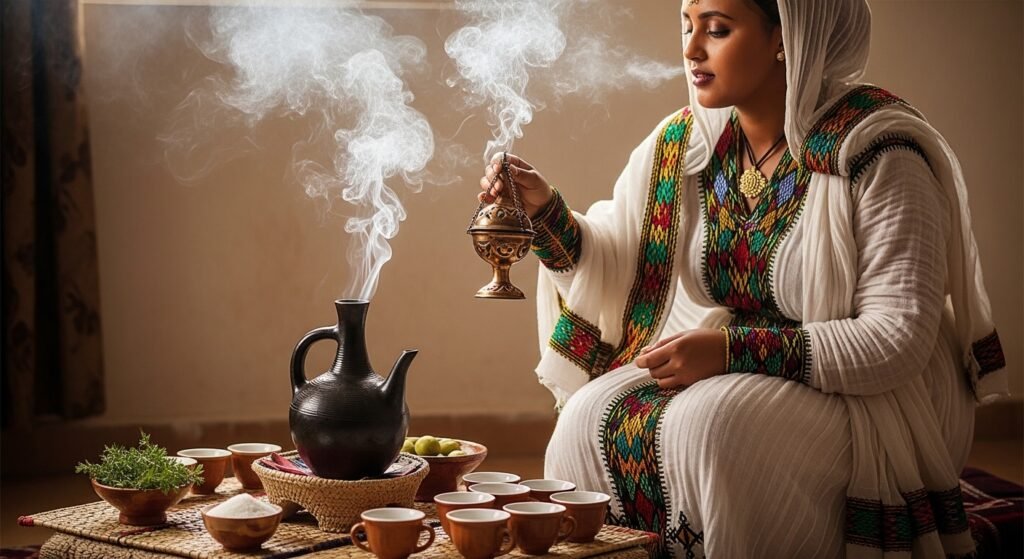
In Ethiopia, coffee is not just an export; it is a ceremony. The Buna Kala ceremony is a three-hour ritual of roasting, grinding, and brewing that emphasizes community. In Kenya, the coffee industry is built on the Auction System, a colonial legacy that has transitioned into a highly competitive platform for quality.
Understanding this history helps you appreciate why a bag of Ethiopian coffee might have a “wilder” taste than a Kenyan one. One is a gift from a forest; the other is a prize from a laboratory. Both are essential. As The Science of Cold Brew has shown us, these African beans are also the best candidates for slow-extraction methods, as their high sugar content prevents the brew from becoming dull or flat over time.
Brewing Recommendations for African Lots
Because these coffees are so delicate and complex, I have a few “rules of thumb” after three decades of trial and error:
-
Avoid Milk: Adding milk to a Yirgacheffe is like putting ketchup on a truffle. The fats in the milk will completely coat your palate and drown out the jasmine and bergamot. Drink these black.
-
Filter Paper is Your Friend: Use a V60 or Chemex. The paper filter traps the fines and allows the high-vibrancy acidity to shine through with crystal clarity.
-
Watch the Cool-Down: As I noted in Why Coffee Tastes Different When it Cools, African coffees often taste better at $50^{\circ}C$ than at $90^{\circ}C$. The “blueberry” or “grapefruit” notes often only emerge once the heat-haze has cleared.
Conclusion: The Horizon of Flavor
African coffee represents the horizon of what the species Coffea arabica can achieve. It challenges us to rethink what “coffee” is. It is the bridge between the agricultural world and the world of perfumery and fine wine.
Whether you prefer the floral elegance of a washed Sidamo or the aggressive, savory punch of a Nyeri SL28, you are participating in a tradition that spans centuries. These beans are the reason I am still in this industry after 30 years. Just when I think I’ve tasted everything, a new harvest from an Ethiopian hillside or a Kenyan cooperative arrives, and I am reminded that the journey of the palate never truly ends.


Brown Christopher is 47 years old and has been passionate about coffee since he was 15. For more than three decades, he has explored coffee culture, brewing methods, and the flavors behind every cup. Through this blog, he shares simple tips and knowledge to help beginners better understand and enjoy coffee in their daily lives. ☕